
Hermes Agent: The Rise of Local AI Automation and Why It Matters
.
Artificial intelligence is rapidly moving beyond simple chat interfaces and becoming a powerful operational layer for productivity, automation, and software development. While cloud-based AI services continue to dominate the mainstream conversation, a new generation of tools is emerging around local-first AI workflows — giving users more control, privacy, flexibility, and customization.
One of the most interesting examples in this growing ecosystem is Hermes Agent.
Hermes is not just another chatbot interface. It is designed as a fully operational AI agent environment that combines command-line productivity, automation pipelines, local model integration, dashboard management, gateway services, and developer-oriented workflows into a unified system. For developers, creators, power users, and AI enthusiasts, this represents a significant step toward truly personalized AI infrastructure.
Moving Beyond Traditional AI Interfaces
Most users are familiar with AI through browser-based chat applications. These interfaces are simple and accessible, but they often limit deeper workflow integration. Hermes approaches AI differently.
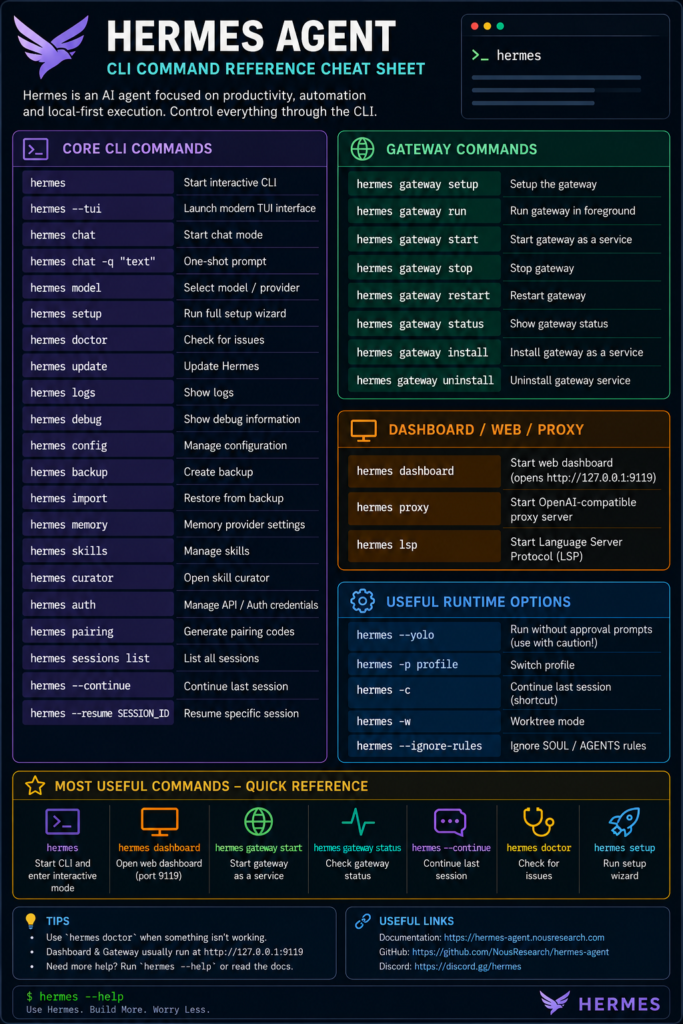
Instead of functioning only as a conversational assistant, Hermes acts more like an intelligent operational framework. Through its CLI (Command Line Interface), users can manage sessions, configure providers, launch dashboards, monitor gateways, automate repetitive tasks, and integrate AI directly into their local environments.
This shift is important.
As AI becomes increasingly integrated into daily work, users need systems that can function more like operating environments rather than isolated chat windows. Hermes embraces this concept by providing modular tools that can be adapted to different workflows and technical setups.
Local-First AI Is Becoming More Important
One of the strongest trends in AI development today is the move toward local execution. More users are exploring local language models, self-hosted dashboards, and private AI environments running directly on their own hardware.
There are several reasons behind this movement:
- Better privacy and data control
- Reduced dependence on cloud services
- Faster experimentation
- Lower long-term operational costs
- Greater customization
- Offline or hybrid workflows
Hermes fits naturally into this ecosystem. It supports local-first execution models while still remaining flexible enough to work with external providers and APIs when needed.
For advanced users running AI environments on powerful hardware — such as Apple Silicon systems, Linux workstations, or GPU servers — tools like Hermes can become the central orchestration layer for daily AI operations.
The Importance of Dashboards and Gateways
One particularly useful feature inside the Hermes ecosystem is its web dashboard and gateway system.
The dashboard provides a visual layer on top of the agent environment, making it easier to manage sessions, monitor activity, and interact with the system through a browser interface. This is especially valuable for users who prefer graphical interfaces instead of working exclusively inside terminal windows.
The gateway architecture is equally important because it allows Hermes to act as a bridge between various AI tools, APIs, providers, and local systems. This makes it possible to create more advanced automation scenarios and interconnected workflows.
As AI agents evolve, these gateway systems will likely become increasingly important. Future AI environments will not operate as isolated applications — they will function as interconnected ecosystems communicating across multiple services and platforms.
Why CLI-Based AI Tools Still Matter
At first glance, command-line tools may appear intimidating to non-technical users. However, many of the most powerful AI workflows still happen through terminal-based environments because they provide unmatched speed, automation capability, and flexibility.
Hermes demonstrates how CLI systems can evolve into modern AI operational platforms while still maintaining developer efficiency.
Commands like:
- hermes dashboard
- hermes gateway start
- hermes doctor
- hermes setup
allow users to quickly configure and control complex AI systems with minimal overhead.
What makes Hermes particularly interesting is that it attempts to bridge the gap between advanced developer workflows and accessible user interfaces through dashboards, runtime options, and modular architecture.
The Future of AI Agents
We are entering a phase where AI agents are becoming more autonomous, context-aware, and operationally capable. Instead of simply answering prompts, future AI systems will increasingly manage tasks, coordinate workflows, maintain memory, interact with tools, and operate continuously in the background.
Hermes represents part of this broader transition.
Its architecture reflects a growing understanding that AI is no longer just about model intelligence — it is also about infrastructure, orchestration, usability, and workflow integration.
As the ecosystem matures, we will likely see more hybrid environments combining:
- Local AI models
- Cloud inference
- Automation frameworks
- Persistent memory systems
- Dashboards
- API gateways
- Multi-agent collaboration
For creators, developers, digital agencies, and productivity-focused users, understanding these systems early could become a significant advantage.
Final Thoughts
Hermes Agent is a strong example of how AI tooling is evolving beyond basic chat interfaces toward complete operational environments. Its combination of local-first architecture, CLI productivity, gateway services, and dashboard management makes it an intriguing platform for anyone interested in the future of AI automation.
While the ecosystem is still evolving, one thing is already clear: the next generation of AI tools will not simply answer questions — they will help orchestrate entire workflows.
And systems like Hermes are showing what that future may look like.

 Dralart studios
 Dralart studios
 dralart studios
 Dralart studios
Leave a Reply
Want to join the discussion?Feel free to contribute!