Artificial intelligence is rapidly moving beyond simple chat interfaces and becoming a powerful operational layer for productivity, automation, and software development. While cloud-based AI services continue to dominate the mainstream conversation, a new generation of tools is emerging around local-first AI workflows — giving users more control, privacy, flexibility, and customization.
One of the most interesting examples in this growing ecosystem is Hermes Agent.
Hermes is not just another chatbot interface. It is designed as a fully operational AI agent environment that combines command-line productivity, automation pipelines, local model integration, dashboard management, gateway services, and developer-oriented workflows into a unified system. For developers, creators, power users, and AI enthusiasts, this represents a significant step toward truly personalized AI infrastructure.
Moving Beyond Traditional AI Interfaces
Most users are familiar with AI through browser-based chat applications. These interfaces are simple and accessible, but they often limit deeper workflow integration. Hermes approaches AI differently.
Instead of functioning only as a conversational assistant, Hermes acts more like an intelligent operational framework. Through its CLI (Command Line Interface), users can manage sessions, configure providers, launch dashboards, monitor gateways, automate repetitive tasks, and integrate AI directly into their local environments.
This shift is important.
As AI becomes increasingly integrated into daily work, users need systems that can function more like operating environments rather than isolated chat windows. Hermes embraces this concept by providing modular tools that can be adapted to different workflows and technical setups.
Local-First AI Is Becoming More Important
One of the strongest trends in AI development today is the move toward local execution. More users are exploring local language models, self-hosted dashboards, and private AI environments running directly on their own hardware.
There are several reasons behind this movement:
Better privacy and data control
Reduced dependence on cloud services
Faster experimentation
Lower long-term operational costs
Greater customization
Offline or hybrid workflows
Hermes fits naturally into this ecosystem. It supports local-first execution models while still remaining flexible enough to work with external providers and APIs when needed.
For advanced users running AI environments on powerful hardware — such as Apple Silicon systems, Linux workstations, or GPU servers — tools like Hermes can become the central orchestration layer for daily AI operations.
The Importance of Dashboards and Gateways
One particularly useful feature inside the Hermes ecosystem is its web dashboard and gateway system.
The dashboard provides a visual layer on top of the agent environment, making it easier to manage sessions, monitor activity, and interact with the system through a browser interface. This is especially valuable for users who prefer graphical interfaces instead of working exclusively inside terminal windows.
The gateway architecture is equally important because it allows Hermes to act as a bridge between various AI tools, APIs, providers, and local systems. This makes it possible to create more advanced automation scenarios and interconnected workflows.
As AI agents evolve, these gateway systems will likely become increasingly important. Future AI environments will not operate as isolated applications — they will function as interconnected ecosystems communicating across multiple services and platforms.
Why CLI-Based AI Tools Still Matter
At first glance, command-line tools may appear intimidating to non-technical users. However, many of the most powerful AI workflows still happen through terminal-based environments because they provide unmatched speed, automation capability, and flexibility.
Hermes demonstrates how CLI systems can evolve into modern AI operational platforms while still maintaining developer efficiency.
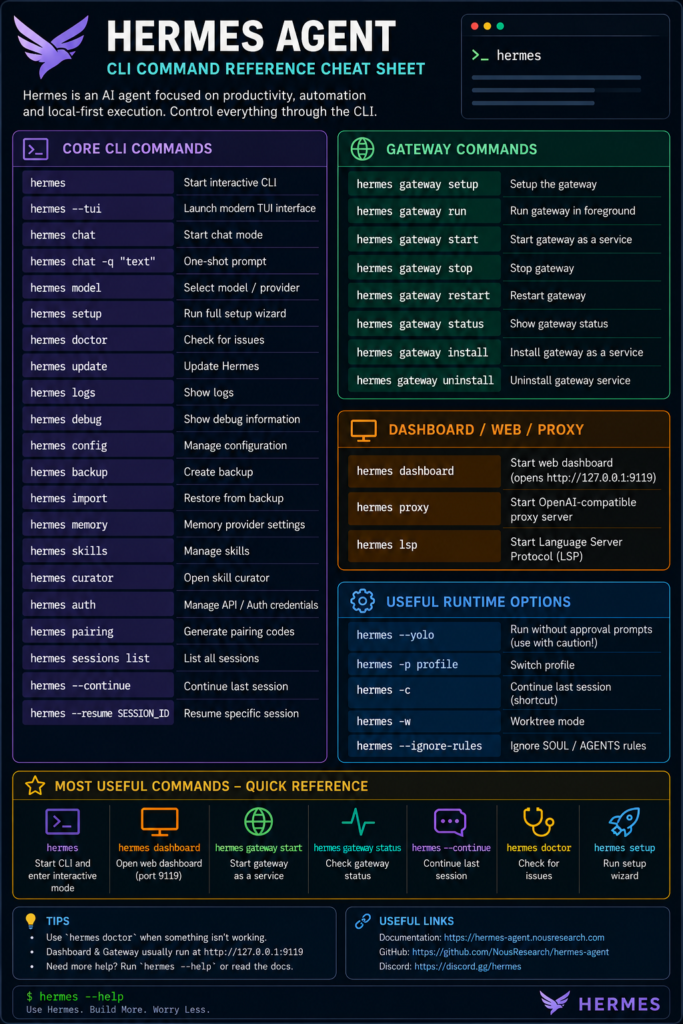
Commands like:
hermes dashboard
hermes gateway start
hermes doctor
hermes setup
allow users to quickly configure and control complex AI systems with minimal overhead.
What makes Hermes particularly interesting is that it attempts to bridge the gap between advanced developer workflows and accessible user interfaces through dashboards, runtime options, and modular architecture.
We are entering a phase where AI agents are becoming more autonomous, context-aware, and operationally capable. Instead of simply answering prompts, future AI systems will increasingly manage tasks, coordinate workflows, maintain memory, interact with tools, and operate continuously in the background.
Hermes represents part of this broader transition.
Its architecture reflects a growing understanding that AI is no longer just about model intelligence — it is also about infrastructure, orchestration, usability, and workflow integration.
As the ecosystem matures, we will likely see more hybrid environments combining:
Local AI models
Cloud inference
Automation frameworks
Persistent memory systems
Dashboards
API gateways
Multi-agent collaboration
For creators, developers, digital agencies, and productivity-focused users, understanding these systems early could become a significant advantage.
Final Thoughts
Hermes Agent is a strong example of how AI tooling is evolving beyond basic chat interfaces toward complete operational environments. Its combination of local-first architecture, CLI productivity, gateway services, and dashboard management makes it an intriguing platform for anyone interested in the future of AI automation.
While the ecosystem is still evolving, one thing is already clear: the next generation of AI tools will not simply answer questions — they will help orchestrate entire workflows.
And systems like Hermes are showing what that future may look like.
1. Introduction: Why M1 Max is Ideal for Local Models
Apple Silicon computers, specifically the M1 Max with 64GB RAM, offer a unique advantage for running Large Language Models (LLMs) due to their Unified Memory architecture.
Unlike traditional PCs with discrete graphics cards, the M1 Max CPU and GPU read directly from the same memory pool, eliminating data copy latency. Furthermore, the M1 Max boasts a massive memory bandwidth of 400 GB/s, making it exceptionally fast at token generation. This allows software developers to use AI assistants with 100% data privacy, as confidential code never leaves the machine.
The Unified Memory Reservoir Defeats the PCIe BottleneckThe Local AI Execution Stack
2. Essential Software for Deployment
To run models locally, you need software that acts as a server:
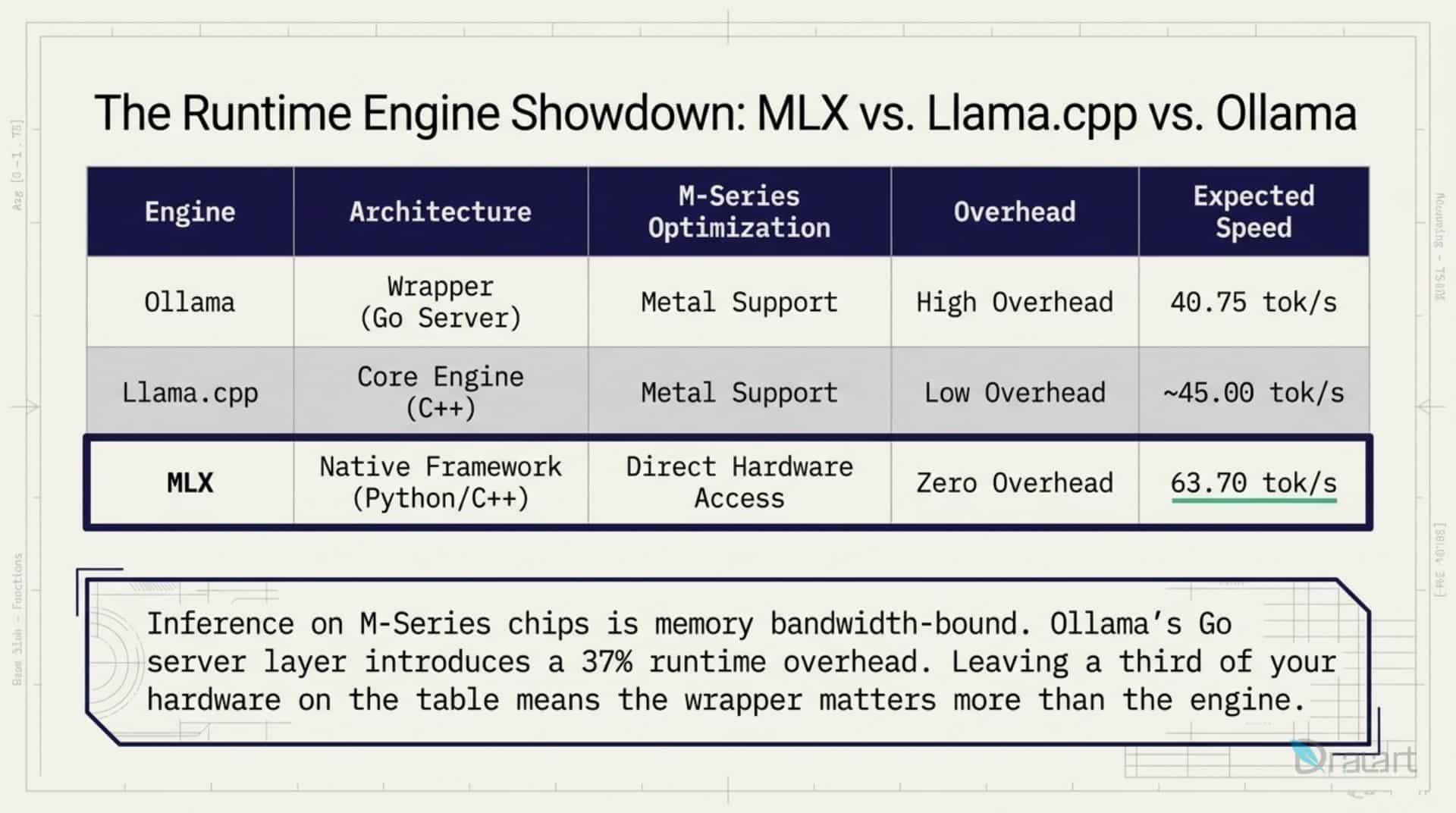
LM Studio: A highly recommended GUI tool that functions as a local server and utilizes the MLX backend, specifically designed for Apple chips.
Ollama: A popular tool that has also transitioned to the MLX framework. This update allows models to load directly into the GPU and can double the text generation speed (decode speed) on Mac computers.
The Runtime Engine Showdown: MLX vs. Llama.cpp vs. OllamaBypassing the macOS 75% VRAM Constraint
3. Recommended Models for M1 Max (64GB RAM)
With 64GB of RAM, you can run powerful, coding-focused models:
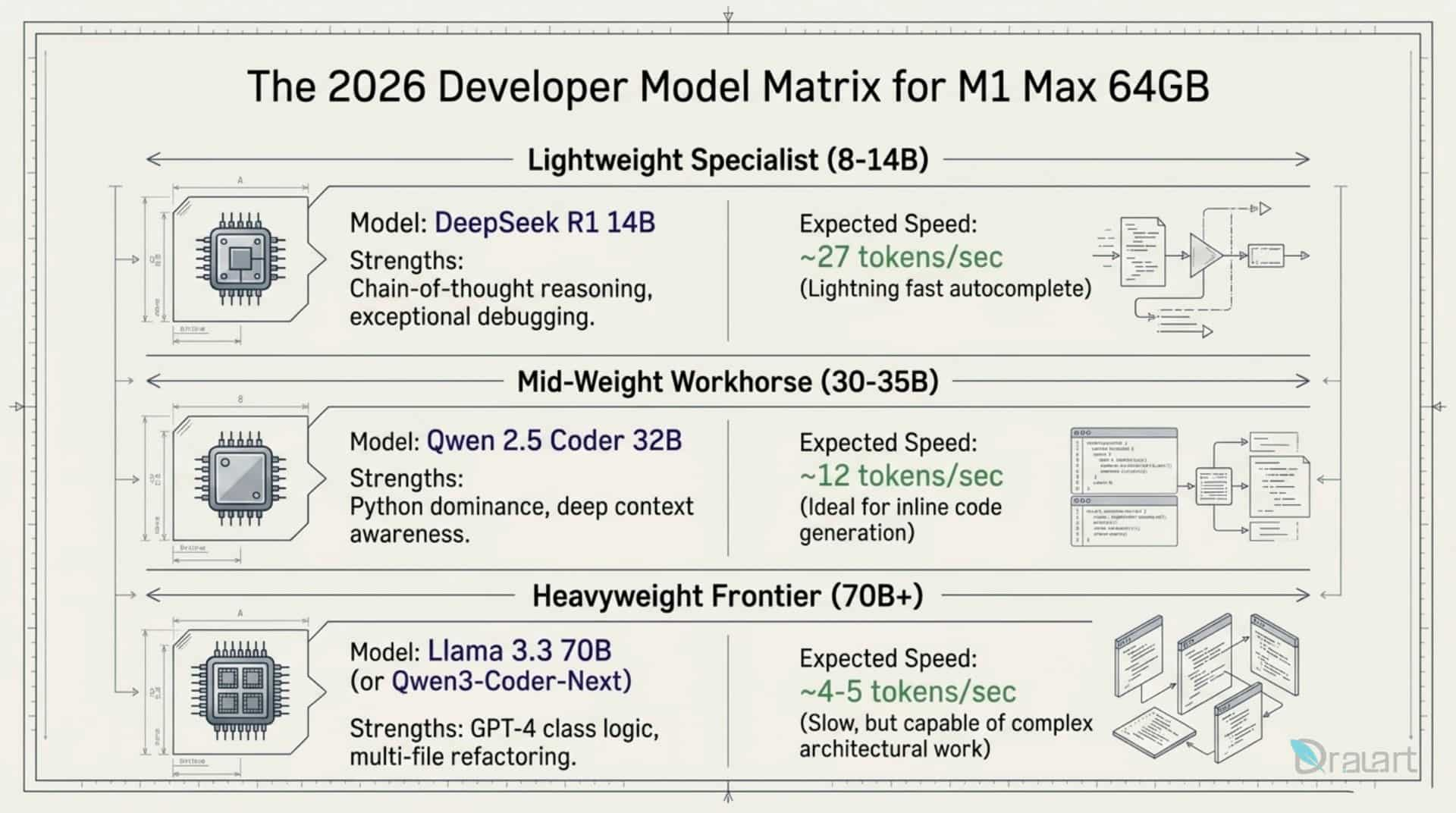
Gemma 4 31B MLX: The flagship model for this configuration, optimized specifically for Apple hardware. It supports massive context windows (128K to 256K tokens) and runs at 23-28 tokens per second on M1 Max.
Qwen 3.6 27B / Qwen 2.5 Coder: These are considered among the best local models for coding, fitting perfectly within 64GB RAM and achieving results competitive with much larger models.
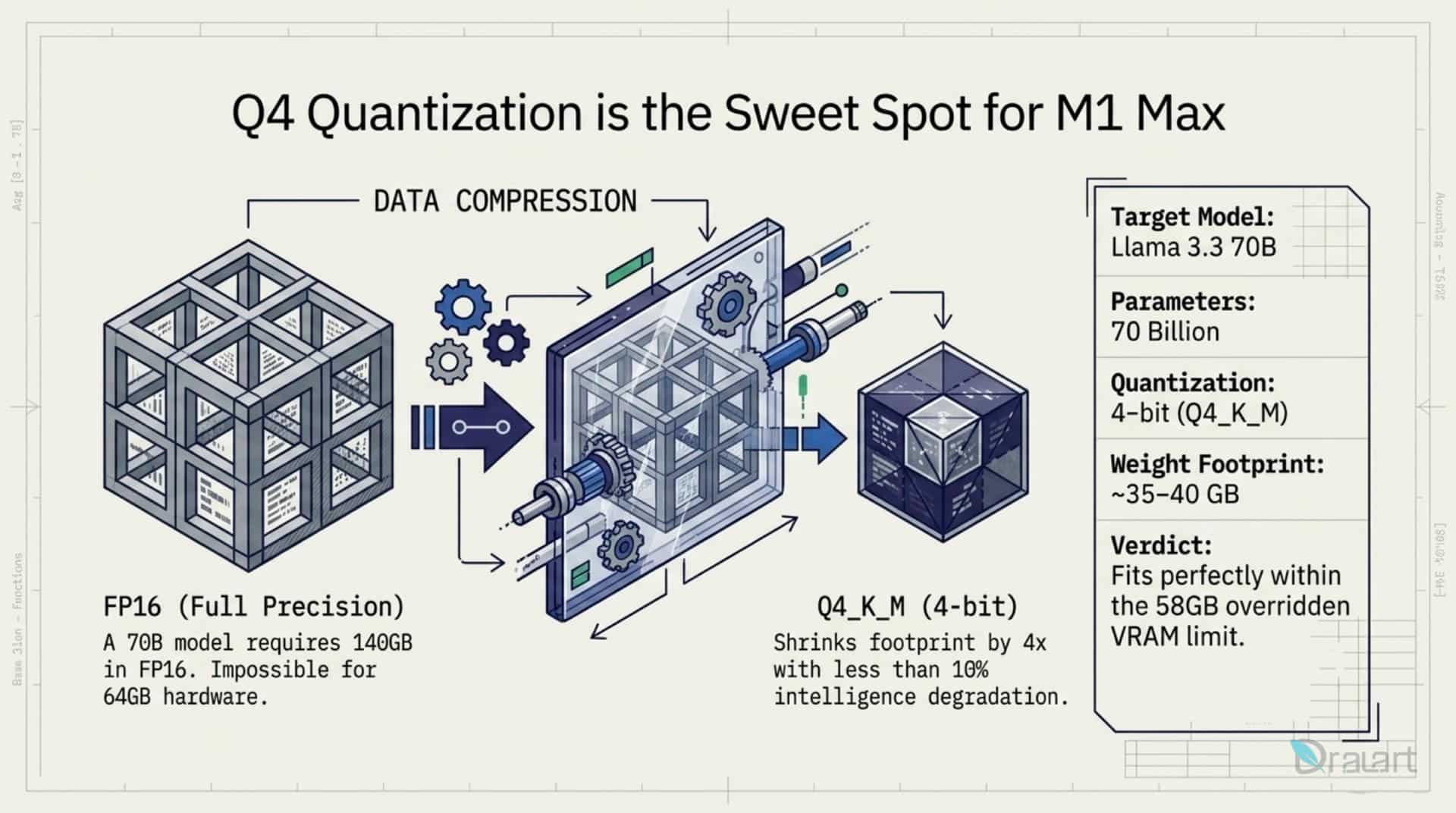
Llama 3.1 70B: An extremely powerful model for complex architecture and logic, occupying approximately 40GB of memory in compressed form.
Q4 Quantization is the Sweet Spot for M1 MaxThe KV Cache Memory Monster
4. Usage Guidelines: Hardware Specifics and Optimization
Quantization
Always download quantized models. Never attempt to load a model in its full resolution (16-bit). Look for 4-bit quantization formats (such as Q4_K_M). Quantization compresses the model 4x, keeping quality almost intact while drastically accelerating performance and saving memory.
Overcoming the 75% VRAM Limit
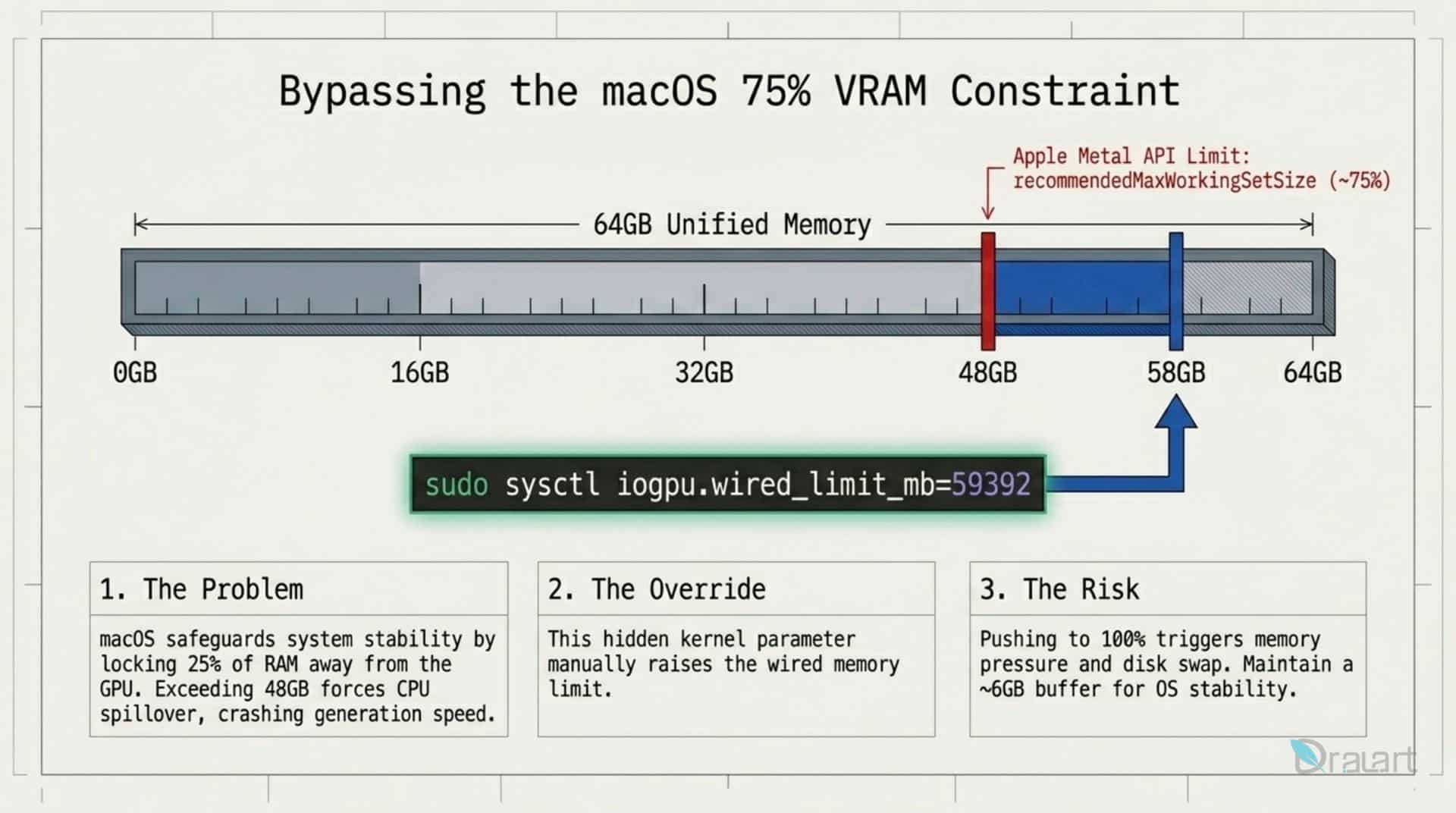
By default, macOS limits the GPU to using only about 75% of the total RAM. For a 64GB machine, this means a limit of approximately 48GB for AI models. You can unlock more memory via the Terminal:
sudo sysctl iogpu.wired_limit_mb=57344
This command allows the GPU to use 56GB of memory. Always leave at least 8GB free for macOS; otherwise, the system may overload and lead to a hard lockup.
Context Management (KV Cache)
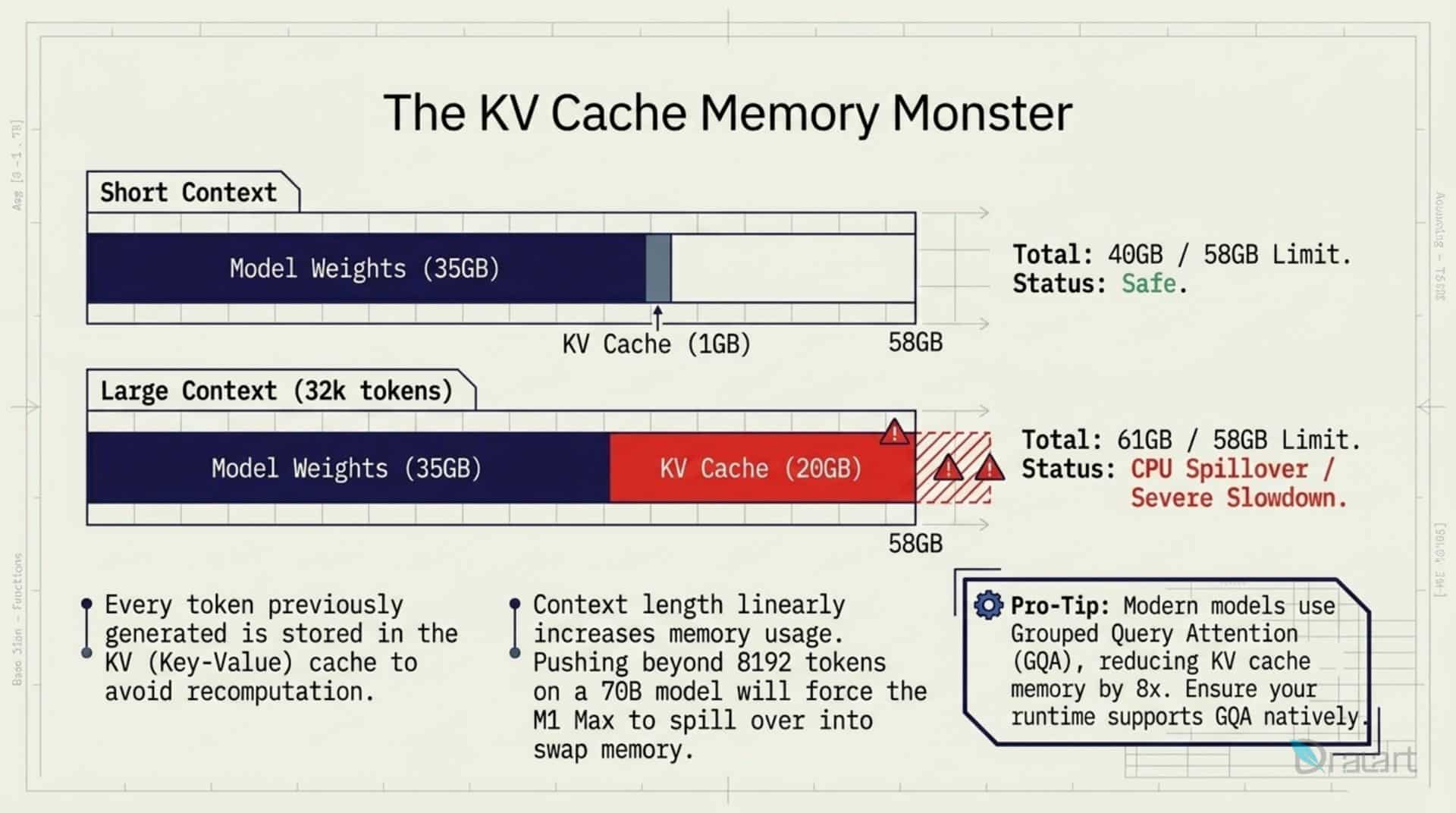
The more code files you provide (longer context), the more memory is consumed linearly for the KV Cache. With 64GB RAM, you can allocate up to 40GB specifically for context. If you exceed the system memory limit, the computer will switch to the slow CPU, severely degrading performance.
Thermal Control
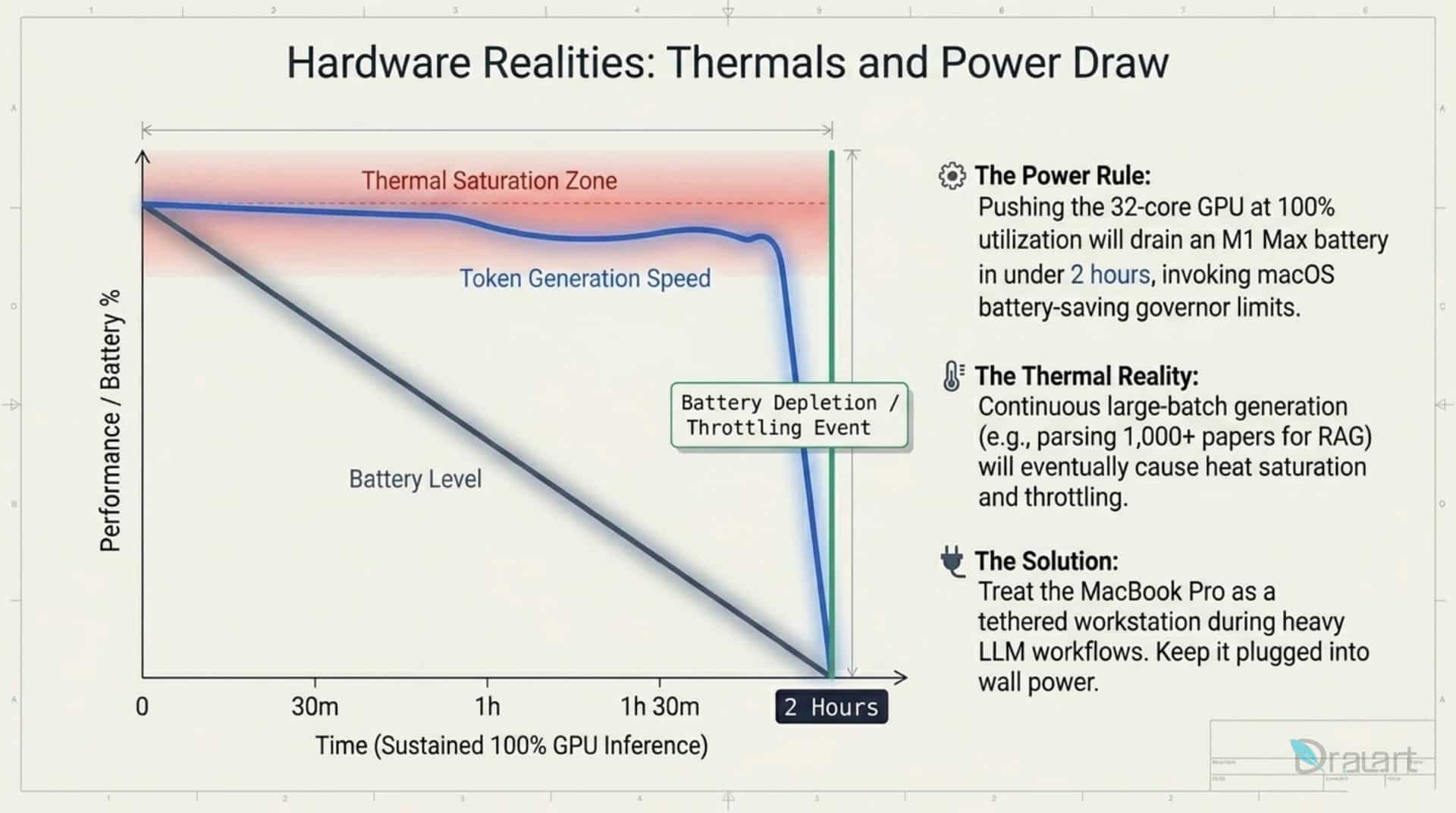
LLMs put a heavy load on the system. Monitor temperatures during long programming sessions to avoid thermal throttling (performance slowdown due to overheating).
The 2026 Developer Model Matrix for M1 Max 64GBIntegrating the Local Model with the IDE
5. IDE Integration (Cursor and Antigravity)
To apply local models in daily development, they can be integrated directly into code editors:
Local Server: Start a server in LM Studio using the MLX backend for maximum speed.
Connection: In the AI assistant settings of Cursor or Antigravity, change the configuration to send requests to your local server address (e.g., http://localhost:1234) instead of cloud services.
MCP (Model Context Protocol): Use the Superpower tool. It acts as a bridge, allowing the model via the MCP protocol to access local project files. This helps the AI assistant “understand” the entire project architecture.
Reasoning Mode: For complex software tasks, use system instructions to force the model into “Reasoning Mode” (thinking step-by-step).
Integrating the Local Model with the IDEHardware Realities: Thermals and Power Draw
6. Conclusion
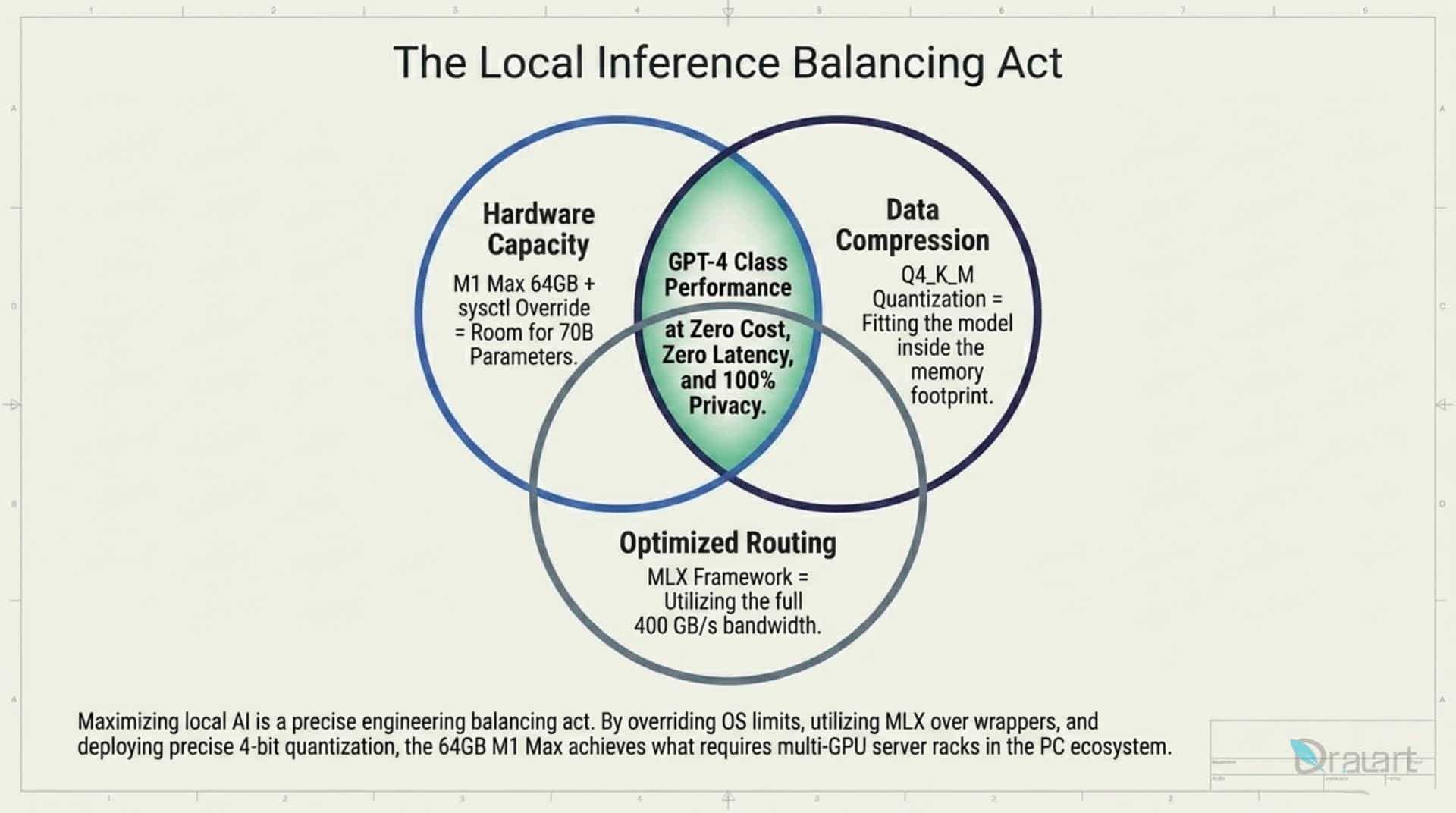
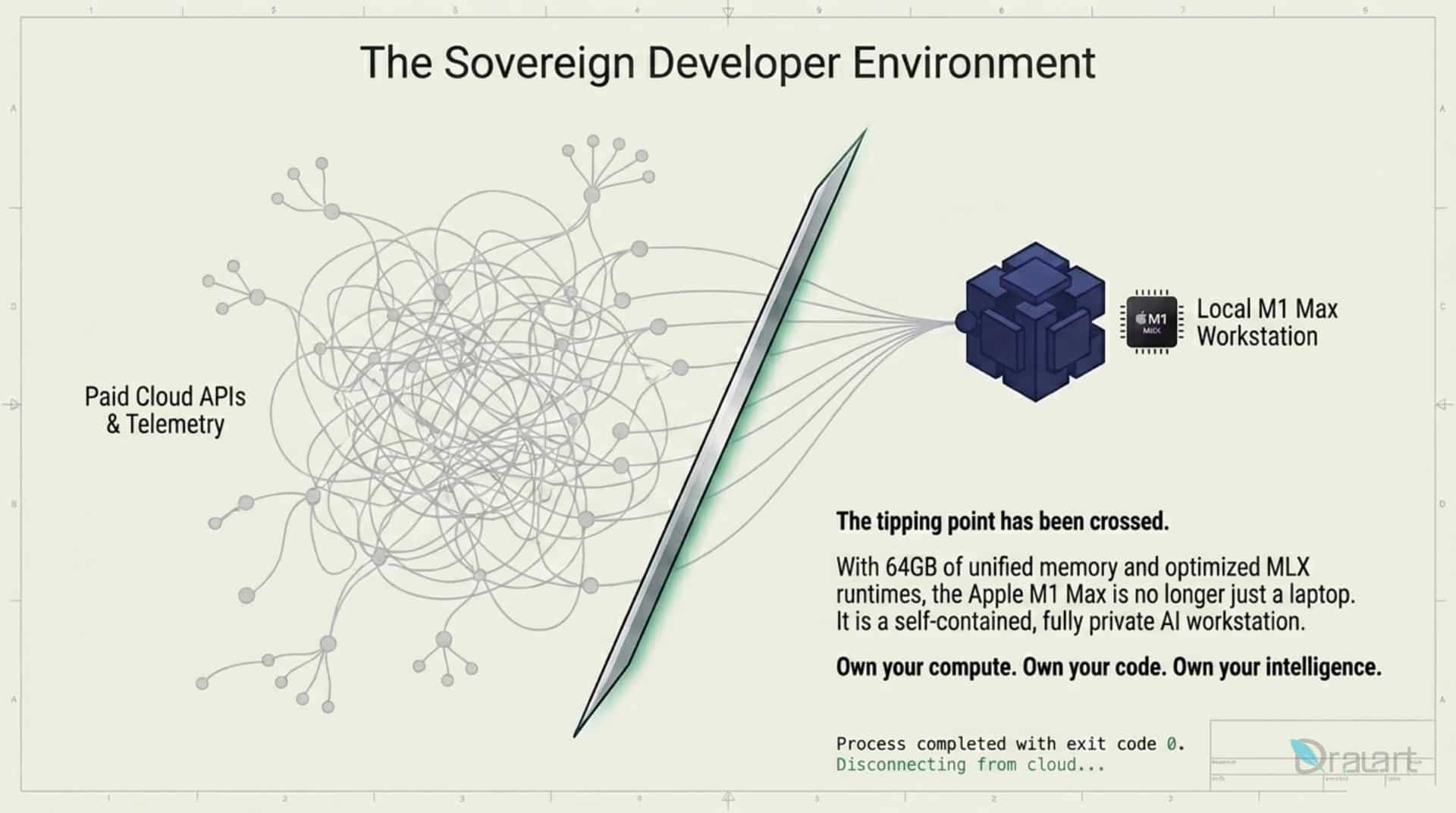
With the right setup on a 64GB M1 Max—utilizing 4-bit quantization, unlocking additional VRAM via sysctl, and running models through the MLX infrastructure—you create an incredibly fast and independent work environment. Integrating these local models with Cursor and Antigravity, supported by MCP and Superpower, ensures that writing and refactoring complex code remains local, private, and free of subscription fees.
The Local Inference Balancing ActThe Sovereign Developer Environment
FAQ section
The M1 Max offers a unified memory architecture with 400 GB/s bandwidth. With 64GB of RAM, developers can load large models like Gemma 4 (31B) or Qwen 3.6 (27B) with high precision while leaving enough room for a massive KV Cache, enabling the processing of entire code repositories locally.
By default, macOS restricts the GPU to using roughly 75% of the total system RAM. By using the command sudo sysctl iogpu.wired_limit_mb=57344, you manually override this limit, allowing the GPU to access up to 56GB of the 64GB available. This is crucial for running 70B parameter models or maintaining long context windows.
MLX is a library specifically designed by Apple’s AI research team for Apple Silicon. Unlike GGUF, which is a more general format, MLX utilizes Metal Performance Shaders more efficiently, often resulting in a 30-50% increase in token generation speed and significantly faster context processing.
Yes, but you will need higher quantization levels (e.g., 3-bit or 4-bit) and smaller context windows. For professional development where you need to feed multiple files into the AI, 64GB is the recommended baseline to avoid “memory swapping,” which drastically slows down the system.
Absolutely. This is the primary advantage of local LLMs. When using LM Studio or Ollama as a local server, 100% of the data processing happens on your machine. No data is sent to the cloud, making it the most secure way to use AI assistants for confidential software development.
You can use LM Studio to host a local Inference Server (typically at http://localhost:1234). Then, using tools like Antigravity or Superpower (via MCP), you point your IDE’s AI settings to your local endpoint. This allows the local model to act as the primary brain for your coding environment.
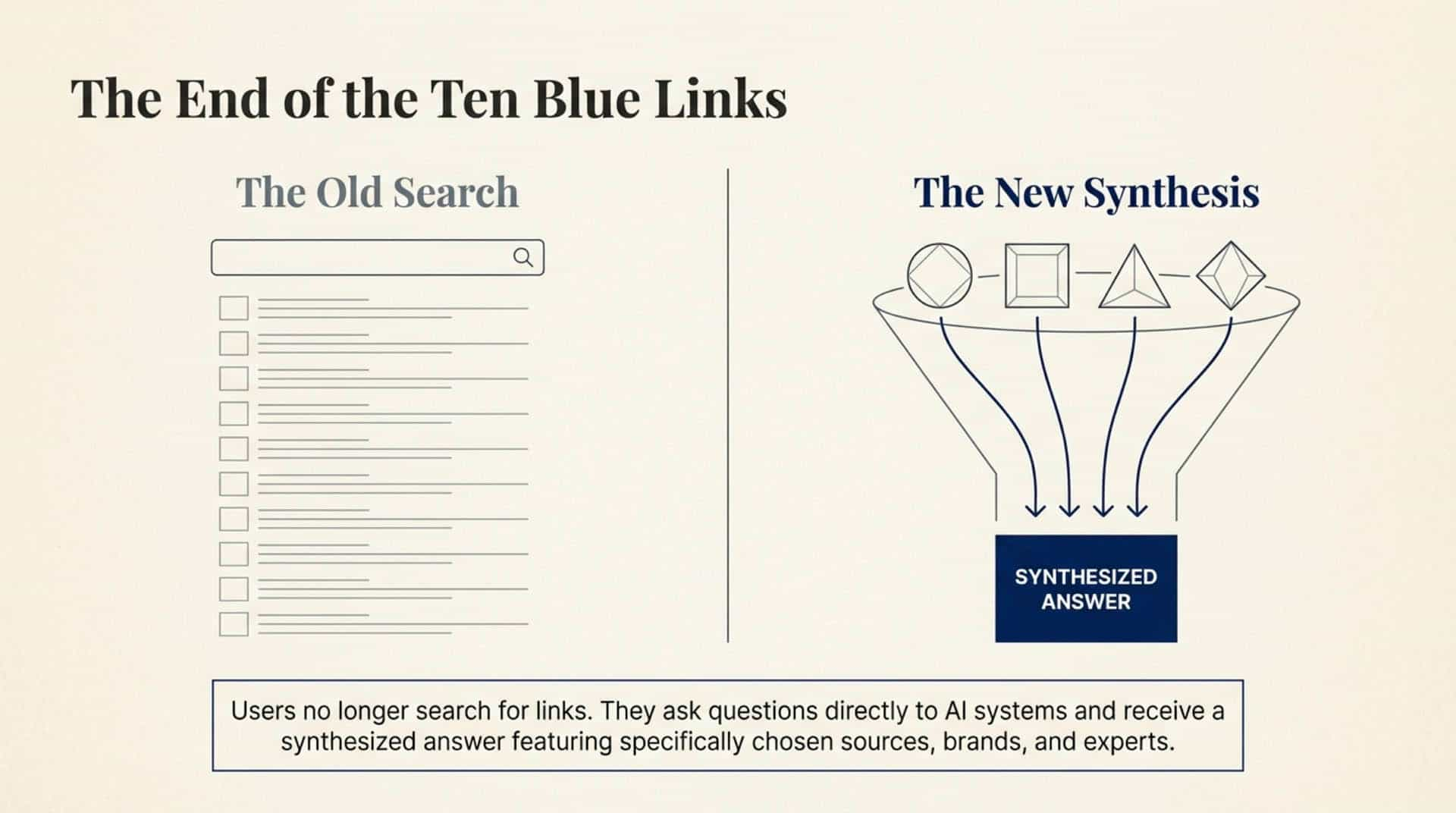
For a long time, digital visibility was measured mainly through rankings in Google. If a page ranked well, it had a strong chance of attracting traffic, trust, and business results. Today, however, user behavior is changing. More and more often, people are not simply searching for links — they are asking questions directly to AI systems such as ChatGPT, Gemini, Claude, and Perplexity. Instead of a list of results, they receive a synthesized answer in which specific sources, brands, publications, and experts are often included.
This changes the strategic question for businesses, PR teams, and marketers. It is no longer enough to simply be present online. It is becoming increasingly important to understand why AI systems choose some sources and ignore others.
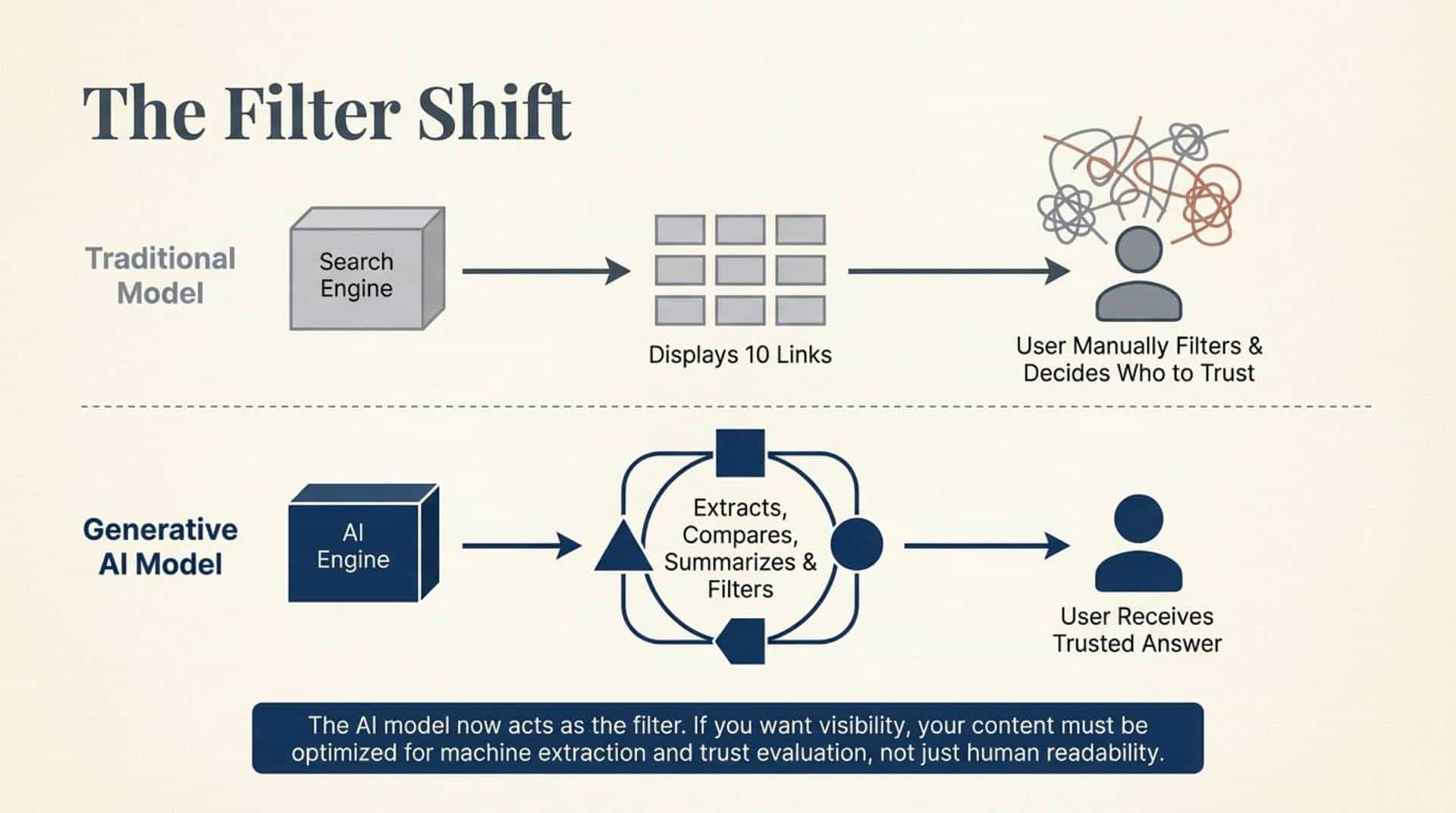
In the traditional search model, the search engine displayed a list of links and the user decided which source to trust. In generative systems, that filter shifts. The AI model extracts, compares, summarizes, and organizes information instead of the user doing it manually. This means that if you want your brand, publication, or expert opinion to be visible in this new environment, you need to think not only about SEO, but also about whether your content appears reliable, clear, and easy to cite.
The End of the Ten Blue LinksThe Filter Shift
From Links to Trusted Answers
Traditional search engines work by indexing, ranking, and displaying results. Generative AI systems have a different task. Their goal is not simply to show ten links, but to compose a useful and meaningful answer. To do that, they must determine which sources seem the most reliable, the clearest, and the most relevant to the question being asked.
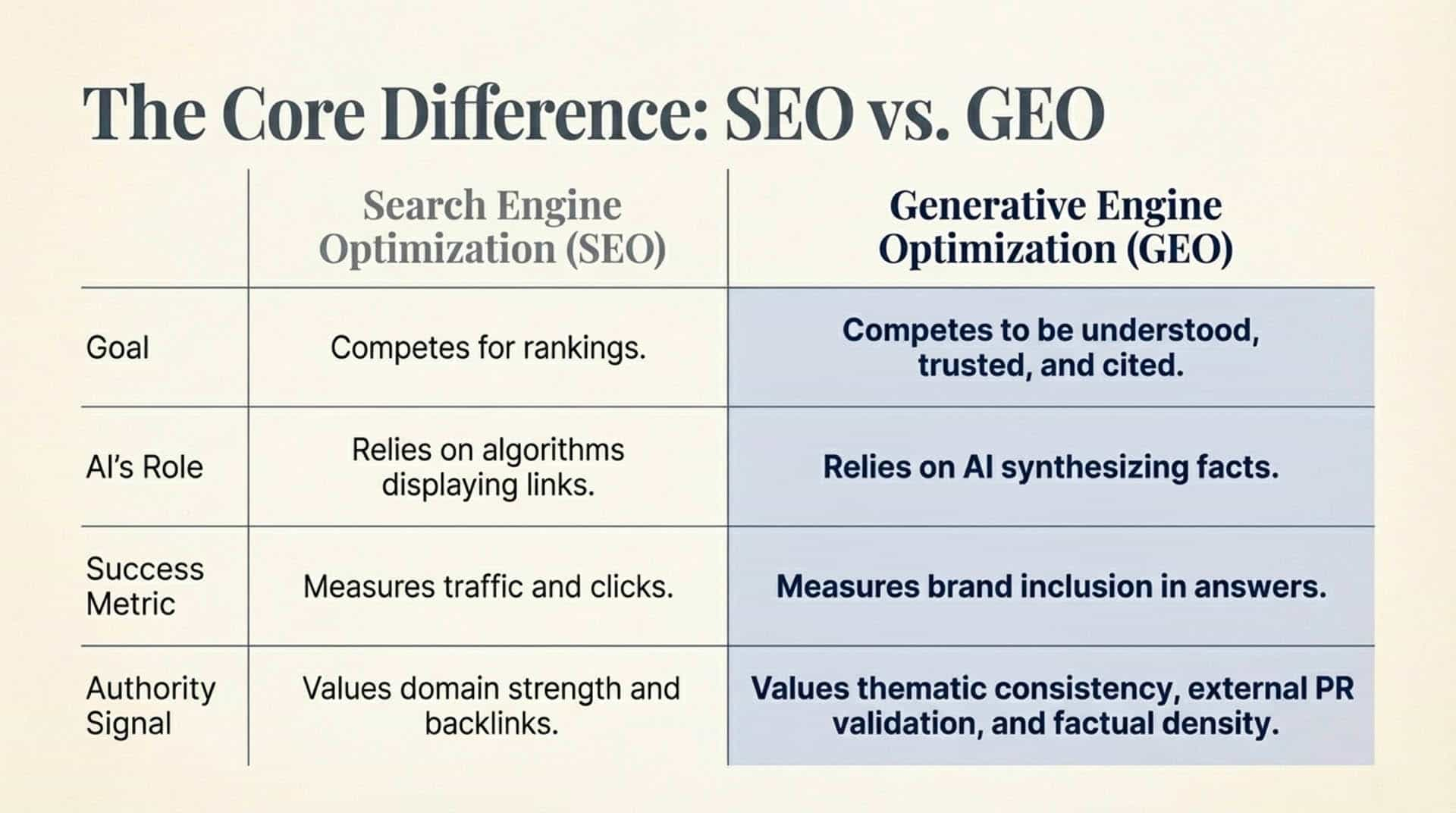
This is where the major difference between traditional SEO and GEO becomes visible. With SEO, you compete for better rankings. With GEO, you compete to have your content understood, trusted, and used directly in the answer itself.
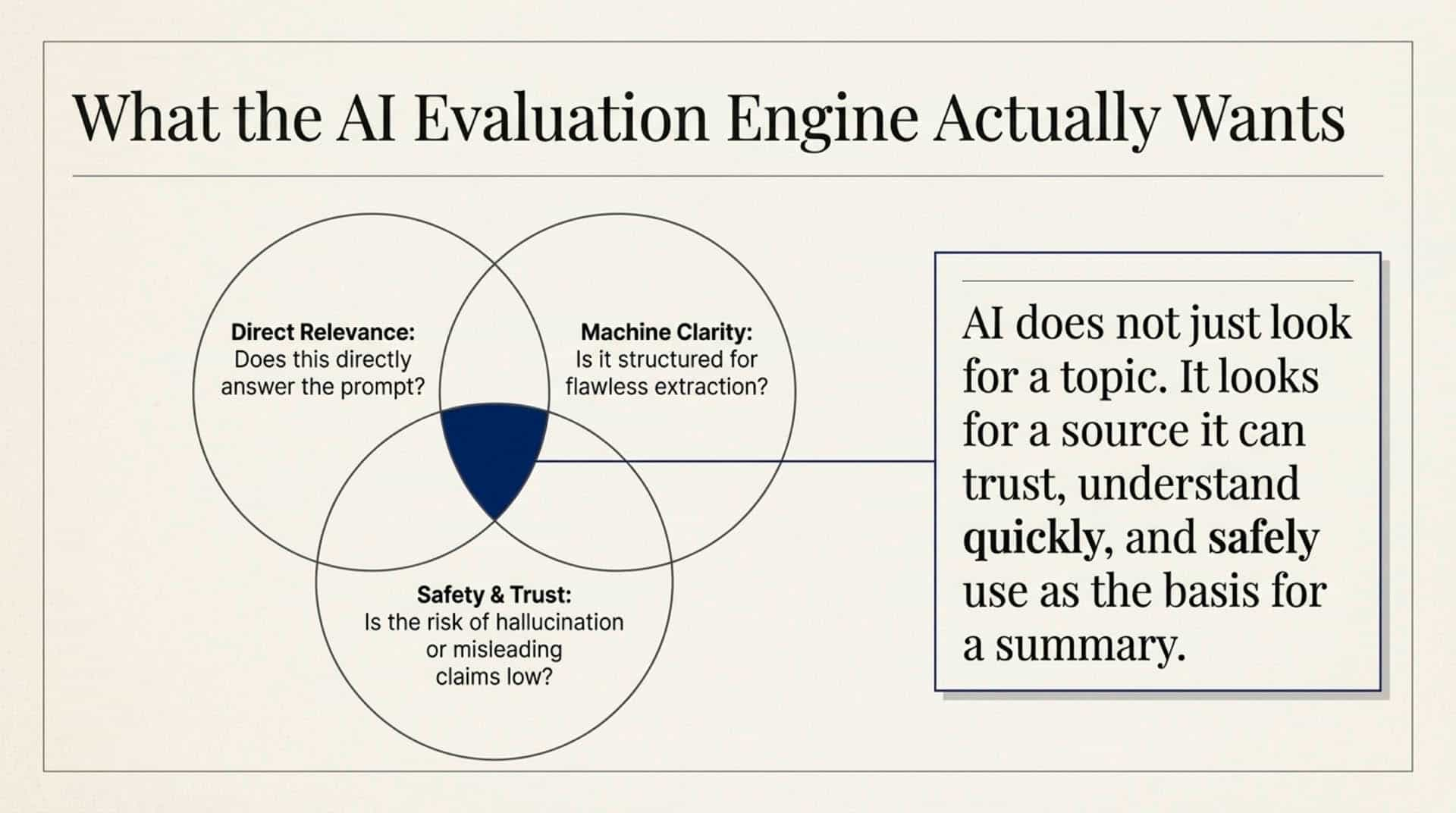
In other words, AI does not simply look for a page about a topic. It looks for a source it can trust, understand quickly, and safely use as the basis for a summary.
The Core Difference: SEO vs. GEOWhat the Al Evaluation Engine Actually Wants
What AI Actually Looks for When “Choosing” a Source
When an AI system formulates an answer, it is effectively trying to evaluate several things at once. First, whether a piece of content directly answers the question. Second, whether it is clear and well-structured enough to be extracted and summarized. Third, whether it appears trustworthy and consistent with other signals. And fourth, whether the risk of being misleading is low.
That is why, in an AI environment, it is not enough to simply have a page on the topic. What wins is content that is the easiest for machines to understand and the safest to cite.
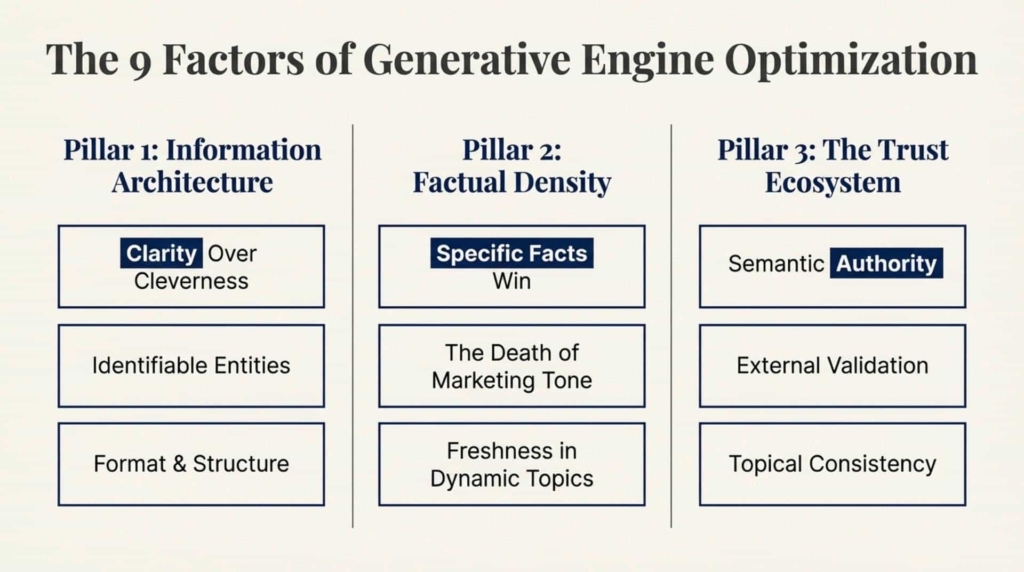
The 9 Factors of Generative Engine Optimization
1. Clarity Matters More Than Many Brands Realize
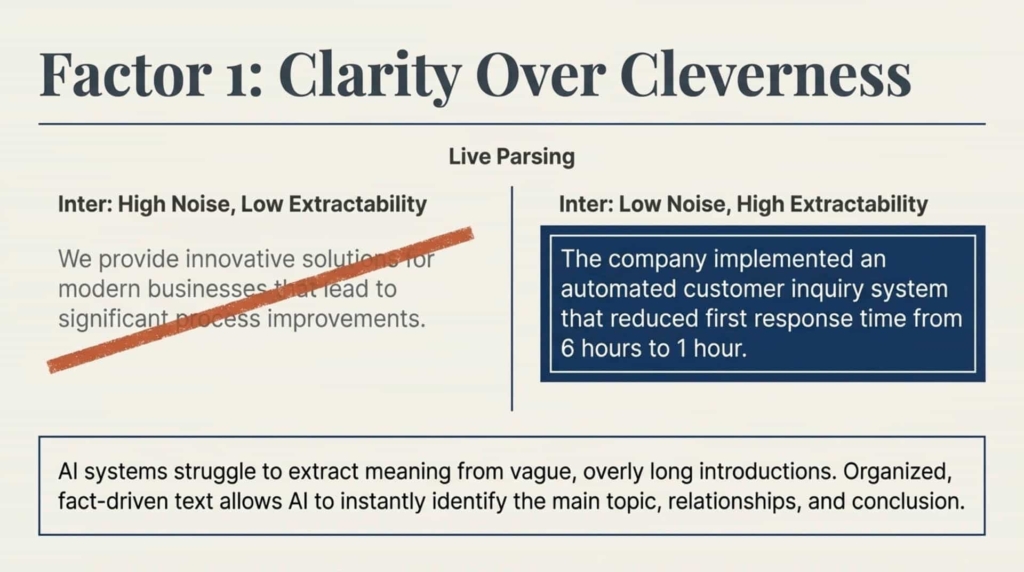
AI systems prefer content that is organized, clear, and free of unnecessary noise. Vague texts, overly long introductions, generic statements, and chaotic structure make understanding more difficult. And when AI cannot quickly determine what matters most, the chance of that source being used drops.
When a text is well organized, AI can more easily identify the main topic, the key claims, the facts, the relationships between them, and the conclusion.
Example:
Weak version: “We provide innovative solutions for modern businesses that lead to significant process improvements.”
Stronger version: “The company implemented an automated customer inquiry system that reduced first response time from 6 hours to 1 hour.”
The second version is clearer, more specific, and much easier to extract and cite.
This is one of the reasons many corporate websites may look good to a human reader but still function as relatively weak sources for AI. They often sound polished, yet fail to explain clearly what actually happened, who was involved, when it happened, and what the outcome was.
Factor 1: Clarity Over Cleverness
2. Specific Facts Win Over General Claims
AI systems prefer information that can be repeated with minimal risk. That is why specificity is so valuable. Numbers, dates, names, percentages, results, and timelines provide solid anchors that machines can more easily use.
Example:
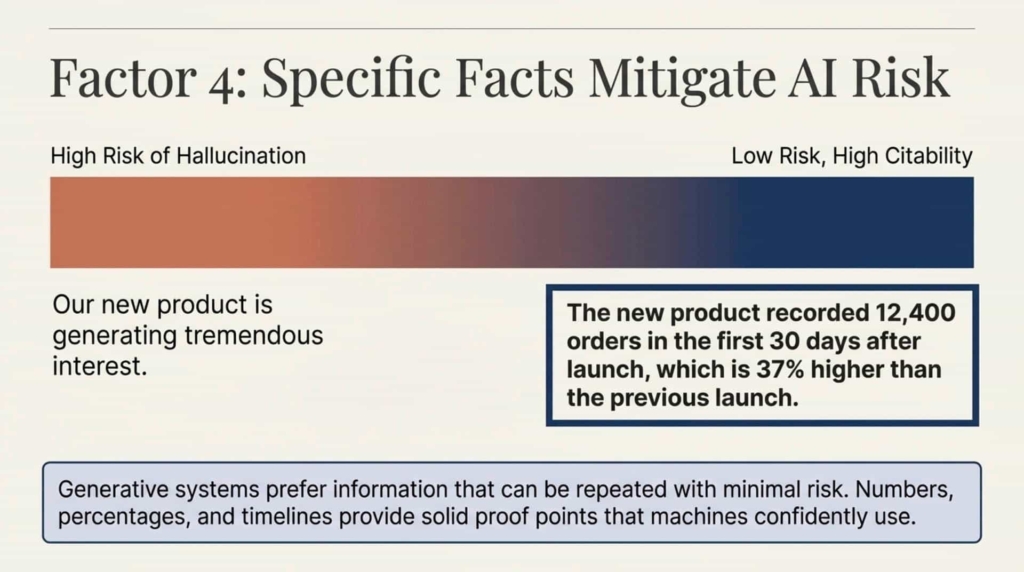
Marketing statement: “Our new product is generating tremendous interest.”
Factual statement: “The new product recorded 12,400 orders in the first 30 days after launch, which is 37% higher than the company’s previous product launch.”
In the second example, there is a concrete result, a time frame, and a comparison. That makes the text far stronger as a source.
The same applies to press releases, corporate news, interviews, and analytical articles. Phrases such as “strong interest,” “successful initiative,” “strong presence,” or “leading solution” may sound confident, but they do not provide enough value to AI systems unless they are supported by measurable information.
Factor 2: The Anatomy of a Citable Format
3. Authority Is No Longer Just an SEO Metric — It Is a Trust Signal
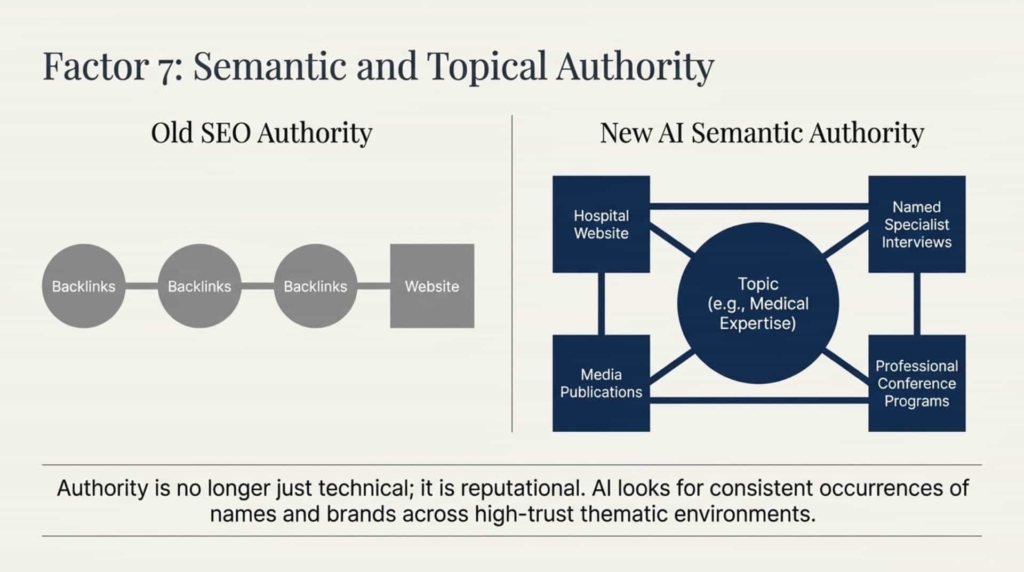
In traditional SEO, authority was often discussed in terms of domain strength, backlinks, and rankings. In AI environments, authority is interpreted more broadly. It is not only technical, but also reputational, topical, and semantic.
AI systems pay attention to whether a given brand, organization, or expert appears consistently within a topic. If multiple reliable sources point to the same names, institutions, or publications on a particular issue, the chance of those entities being used in an answer increases.
This means authority is built not only through onsite SEO, but also through:
expert publications;
media mentions;
interviews;
presence in topical environments;
clear authorship;
consistency around a subject.
Example:
If a medical topic is covered:
on a hospital website;
in an interview with a named specialist;
in a media publication;
in the program of a professional conference;
then AI is more likely to interpret that information as trustworthy.
The same topic, published only as an anonymous article in a corporate blog without an author, date, or external confirmation, sends a much weaker signal.
Factor 3: Identifiable Entities Act as Anchors
4. External Validation Is Critical
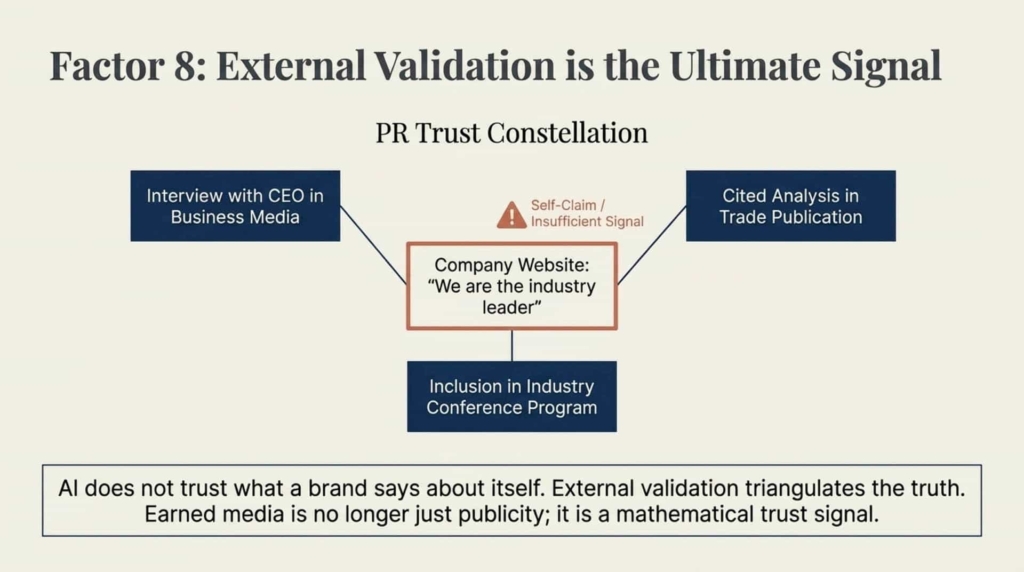
One of the most important ideas in GEO is that AI systems do not fully trust what a brand says about itself. If a company describes itself as a leader, innovator, or key market player, that alone is not enough. A much stronger signal appears when that role is confirmed externally.
AI prefers information that is consistent across multiple sources. This can include a media article, an interview, a professional analysis, conference participation, expert commentary, or another independent context.
Example:
Weak scenario: A company publishes on its own website: “We are the leader in industrial investment in the region.”
Stronger scenario: The company:
publishes its own analysis;
has an interview with its CEO in a business publication;
appears in a conference program;
is cited in a local or specialized media outlet.
In that case, AI does not see only self-promotion. It sees a thematic footprint and external validation. That makes the brand more credible as a source.
This is where PR becomes especially important. Earned media, expert participation, and visibility beyond your own website are no longer just a matter of publicity. They become trust signals that help AI recognize your brand more reliably.
Factor 4: Specific Facts Mitigate AI Risk
5. Clearly Identifiable Entities Have an Advantage
AI works with entities and the relationships between them: companies, individuals, institutions, products, events, dates, and locations. The more clearly and consistently these elements are named, the easier it is for the system to understand the content.
That is why strong sources almost always use precise names, specific roles, and clear context.
Example:
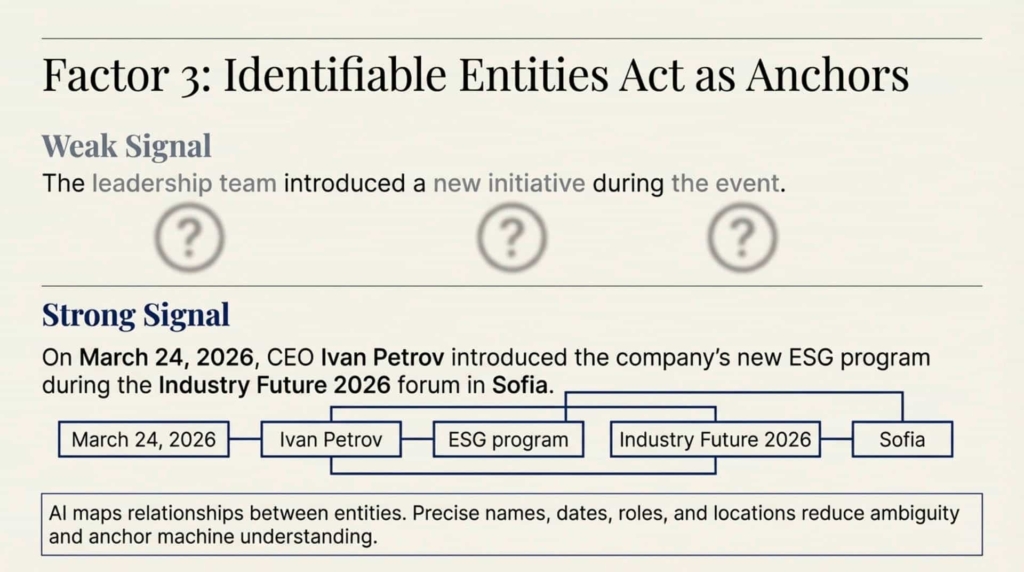
Unclear: “The leadership team introduced a new initiative during the event.”
Clear: “On March 24, 2026, CEO Ivan Petrov introduced the company’s new ESG program during the Industry Future 2026 forum in Sofia.”
The second version includes a name, role, date, topic, and location. That is far more valuable to AI systems because it helps them connect the right entities and reduce ambiguity.
The same applies to press releases. Terms such as “the company,” “the team,” “the event,” or “the new solution” are acceptable only if it is already absolutely clear who or what they refer to. Otherwise, they make machine understanding more difficult.
Factor 5: The Death of Marketing Tone
6. Freshness Matters, Especially in Dynamic Topics
In areas such as technology, healthcare, regulation, markets, products, appointments, and events, freshness is often critical. AI systems are especially cautious when there is a risk that information may be outdated.
That is why sources that are current, updated, and timely often have an advantage over older, neglected pages.
Example:
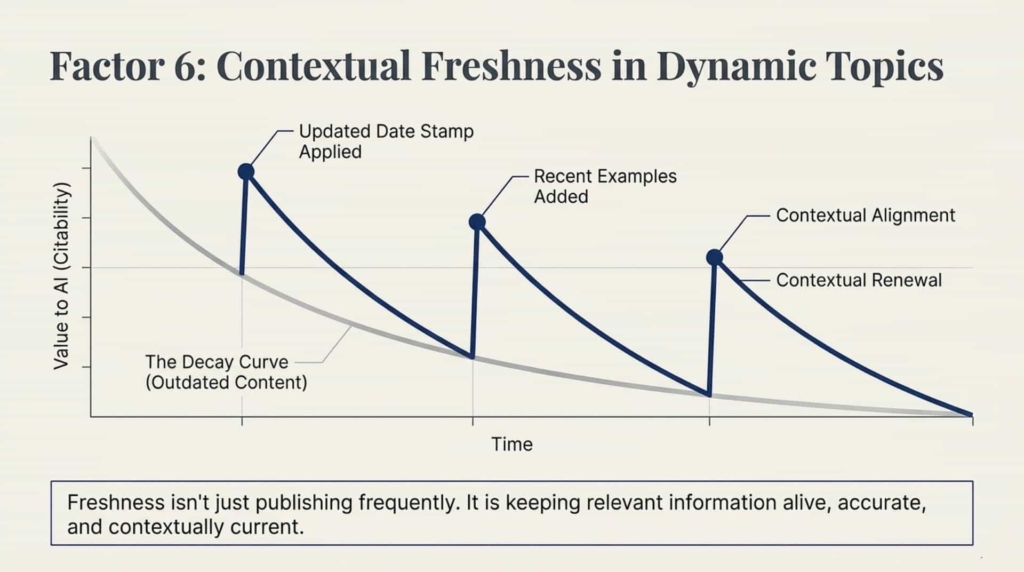
If you have an article on “AI regulation in the EU” that was published once a year ago and never updated, its value will gradually decline.
But if that same page:
includes a clear updated date;
reflects the latest developments;
adds new examples;
clarifies the context;
then the chance of it being used in an AI response is significantly higher.
Freshness does not simply mean publishing often. It also means keeping relevant information alive, accurate, and contextually current.
Factor 6: Contextual Freshness in Dynamic Topics
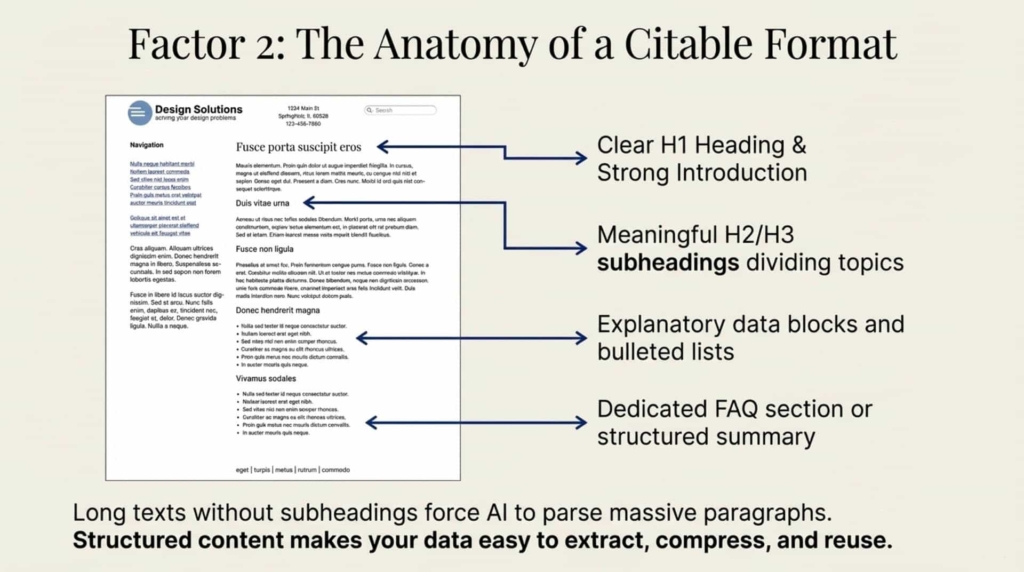
7. Format and Structure Often Determine Whether a Text Is “Citable”
Some texts are rich in information but difficult to extract from. Others are shorter, but structured in a way that allows AI to quickly understand what matters most. Very often, this makes the second type more powerful.
Citable content usually includes:
a clear H1 heading;
a strong introduction;
meaningful H2 and H3 subheadings;
logical topic separation;
short explanatory blocks;
lists where useful;
examples;
a FAQ section or summary.
Example:
An article structured like this:
What GEO is
How AI chooses sources
What the main trust signals are
Examples of good and bad practices
FAQ
is far more suitable for AI than a long text without subheadings, where all ideas are merged into a few massive paragraphs.
This is not just an editorial preference. It is a way to make your content easier for machines to extract, compress, and reuse in an answer.
Factor 7: Semantic and Topical Authority
8. Excessive Marketing Tone Reduces Trust
Many corporate texts lose value for AI because they sound more like advertising than information. Generative systems are not simply looking for “impressive” content. They are looking for content that appears reliable enough to be used with minimal risk.
When a text is filled with phrases such as “leading,” “revolutionary,” “unmatched,” “without competition,” or “best-in-class,” without supporting evidence, it often becomes a weaker source.
Example:
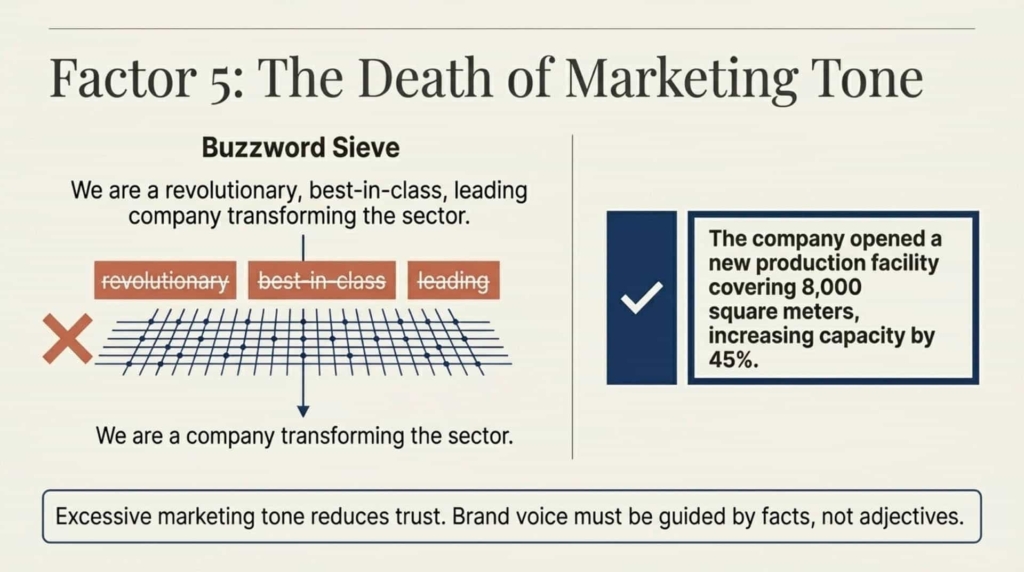
Weak version: “We are a leading, innovative, and revolutionary company transforming the future of the sector.”
Stronger version: “The company opened a new production facility covering 8,000 square meters, where 120 people will work and which will increase capacity by 45%.”
The second sentence may sound less “promotional,” but it is much stronger because it provides real value and carries less ambiguity.
This does not mean brand voice should disappear. It means it should be guided by facts instead of replacing them.
Factor 8: External Validation is the Ultimate Signal
9. Topical Consistency Is Stronger Than a Single “Hit”
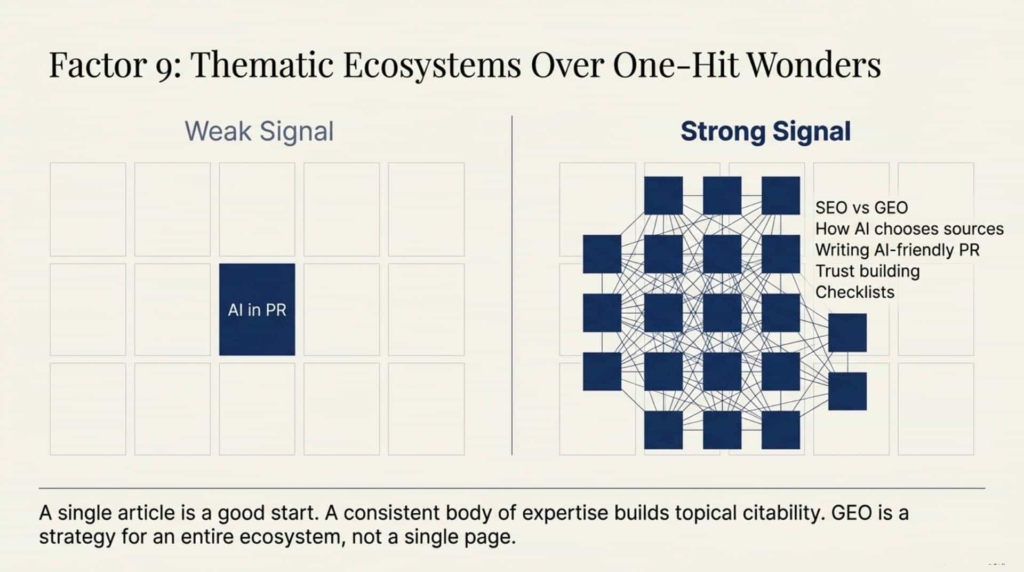
One strong article can be useful. But for AI systems, a stronger signal appears when a brand publishes consistently on a topic. That shows the topic is not being addressed randomly, but is part of a real thematic presence.
If a website regularly publishes analyses, commentary, FAQs, guides, press releases, and expert viewpoints along the same line, it gradually builds topical authority. That increases the chance that AI will treat it as a reliable source.
Example:
If a company has only one article about “AI in PR,” that is a good start.
But if it has an entire series such as:
SEO vs GEO;
how AI systems choose sources;
how to write AI-friendly press releases;
how trust is built through PR;
a GEO checklist for content teams;
then AI sees not a single isolated article, but a consistent body of expertise.
This is exactly why GEO is not a tactic for one page. It is a strategy for building a thematic ecosystem.
Factor 9: Thematic Ecosystems Over One-Hit Wonders
A Quick Example from Practice
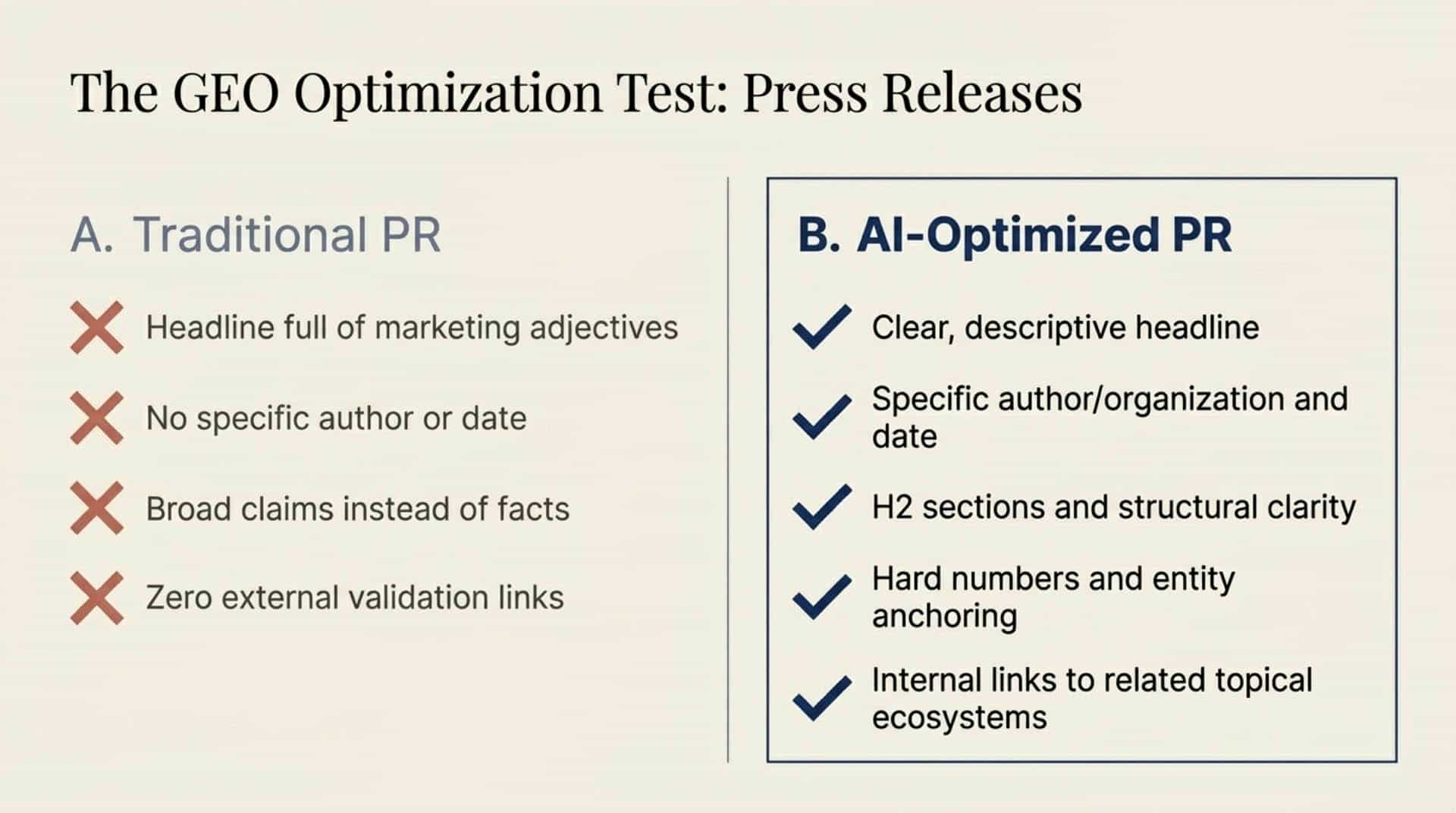
Let us take the topic “How to optimize a press release for AI systems.”
Version A: weak signal
headline full of marketing language;
no author;
no date;
no examples;
no numbers;
no external validation;
broad claims instead of facts.
Version B: strong signal
clear and descriptive headline;
specific author or organization;
publication date;
clear H2 sections;
“weak vs strong” examples;
practical guidance;
internal links to related topics;
logical connection between PR, trust, and GEO.
AI is far more likely to use the second version because it is better structured, clearer, and safer as a source for an answer.
The GEO Optimization Test: Press ReleasesThe 5 Pillars of AI Trust
What This Means for PR Teams and Brands
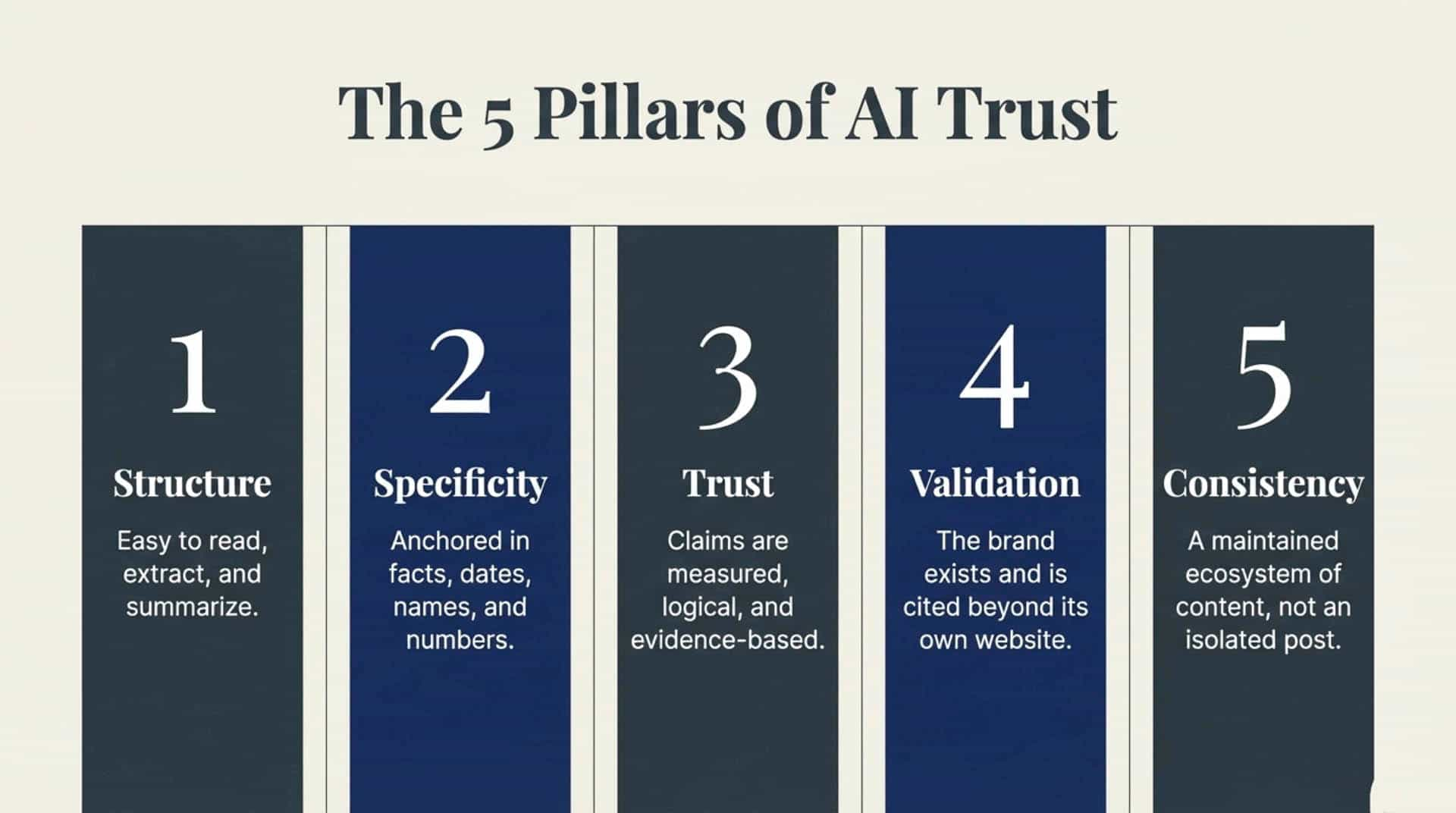
If we reduce all of this to a practical conclusion, AI systems most often choose sources that combine five key qualities.
First, clear structure. The text should be easy to read, understand, and summarize.
Second, specificity. Facts, dates, names, numbers, and real parameters are essential.
Third, trust. Claims should be measured, logical, and supported.
Fourth, external validation. The brand should exist beyond its own website.
Fifth, topical consistency. Not one isolated publication, but a whole ecosystem of content builds citability.
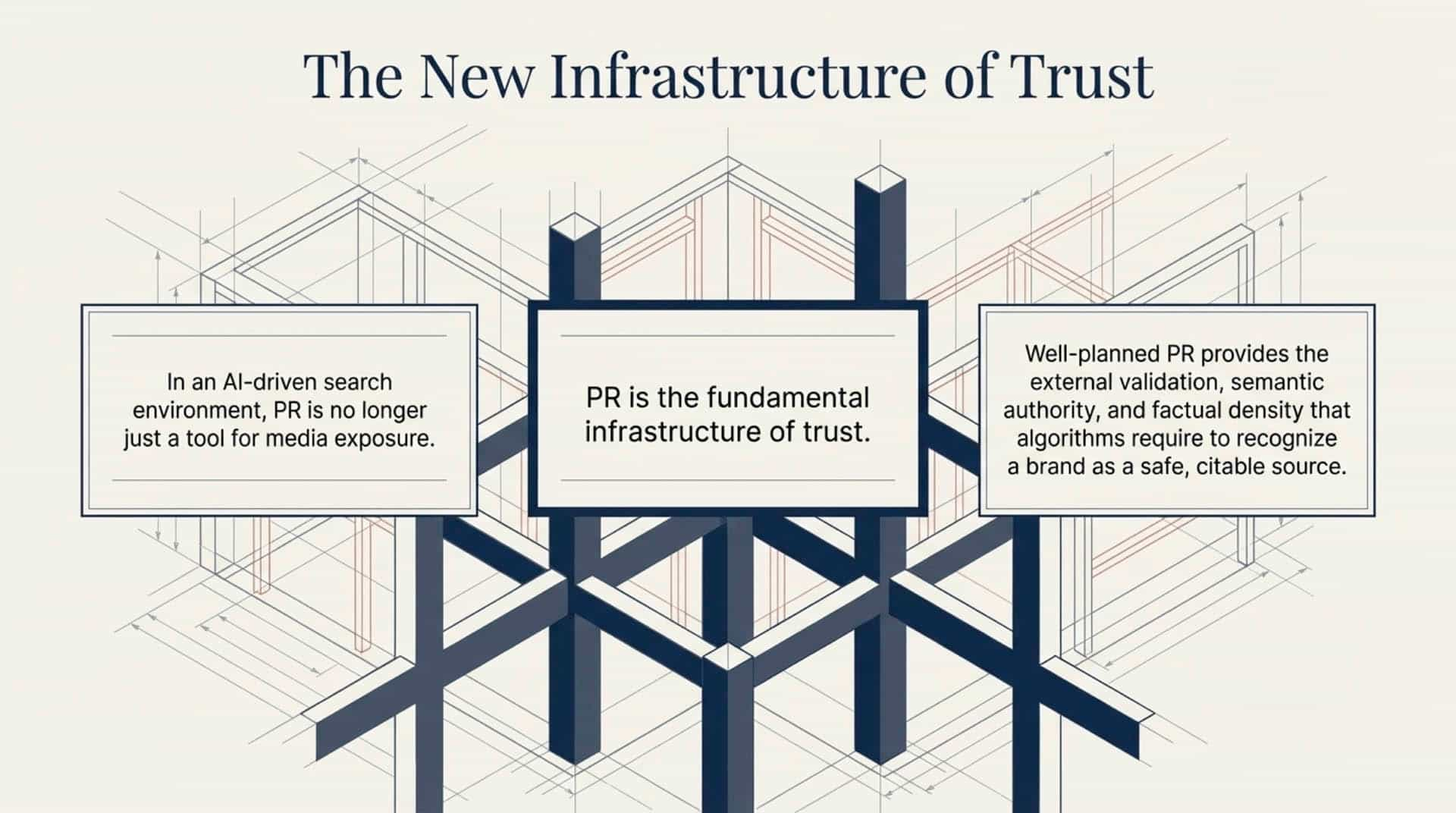
This also changes the role of PR. In AI environments, PR is no longer only a tool for media exposure. It becomes part of the infrastructure of trust. Well-planned PR helps not only people see the brand, but also helps AI systems recognize it as a more reliable source.
The New Infrastructure of TrustAre you building links, or are you building trust?
Conclusion
AI systems do not choose sources at random. They are not impressed by the loudest content, but by the most useful, the clearest, and the best-supported information. In an environment where machines increasingly summarize information instead of users reviewing dozens of links, trust, structure, and factual density become decisive.
For brands, this means something very important: visibility in AI answers is not earned through SEO alone, but through a combination of strong content, GEO thinking, expertise, PR, and external validation.
That is why the real question is no longer simply, “Do we rank well?” but: Do we look like a source AI would choose to cite?
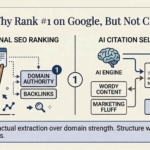
AI systems don’t choose sources based solely on traditional domain authority or backlink counts. Their goal is to find the most direct, extractable answer. If your content is too wordy, filled with “marketing fluff,” or lacks a clear structure, an AI might prefer a lower-ranking site that provides specific data, figures, and concise definitions.
Consistency across multiple channels. AI builds trust in a brand or expert when it sees the same information confirmed by independent sources—media publications, social signals, professional profiles, and official documents. The more uniform and clear your identity is across the web, the easier it is for AI to identify you as a reliable source.
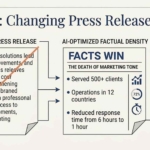
Yes. You are no longer writing just for journalists, but also for data extraction algorithms. Focus on “factual density”—instead of saying “we are industry leaders,” state “we serve 500+ clients across 12 countries.” Using bullet points, clear headings, and direct answers to the 5 Ws (Who, What, Where, When, Why) drastically increases your chances of being cited.
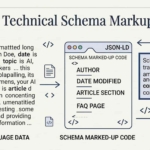
It is critical. Structured data (JSON-LD) acts as the “translator” between your human language and the machine’s language. Through Schema, you explicitly tell the AI who the author is, when the content was last updated, and what the core topic is. This removes ambiguity and boosts the AI’s “confidence score” in your content.
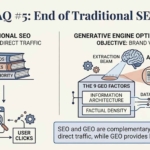
No, but it signals its evolution. Traditional SEO remains important for driving direct traffic, but GEO is now essential for brand reputation and visibility. It’s no longer enough to just be “in the search results”; the goal is to be part of the synthesized answer that the user consumes first.
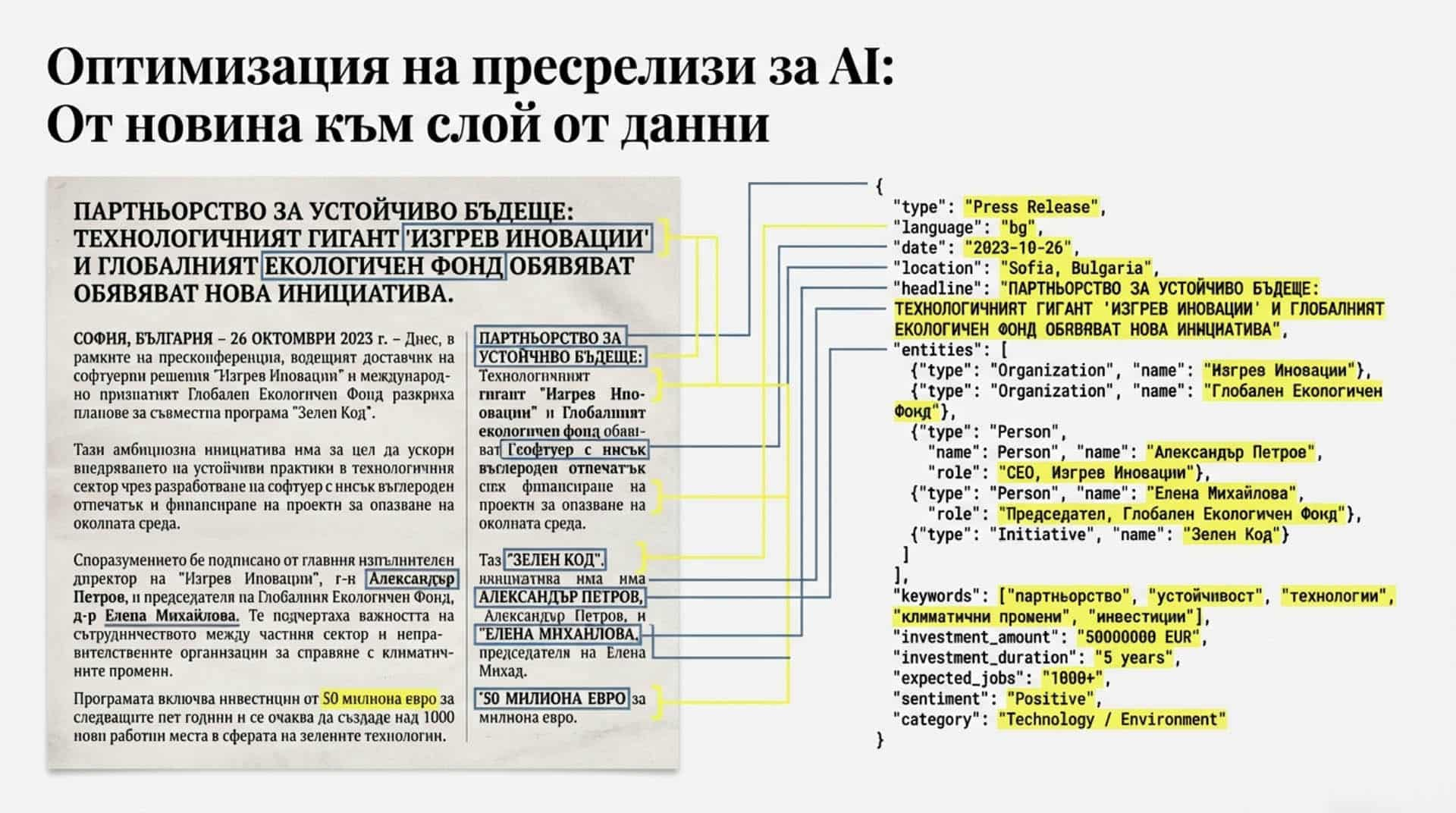
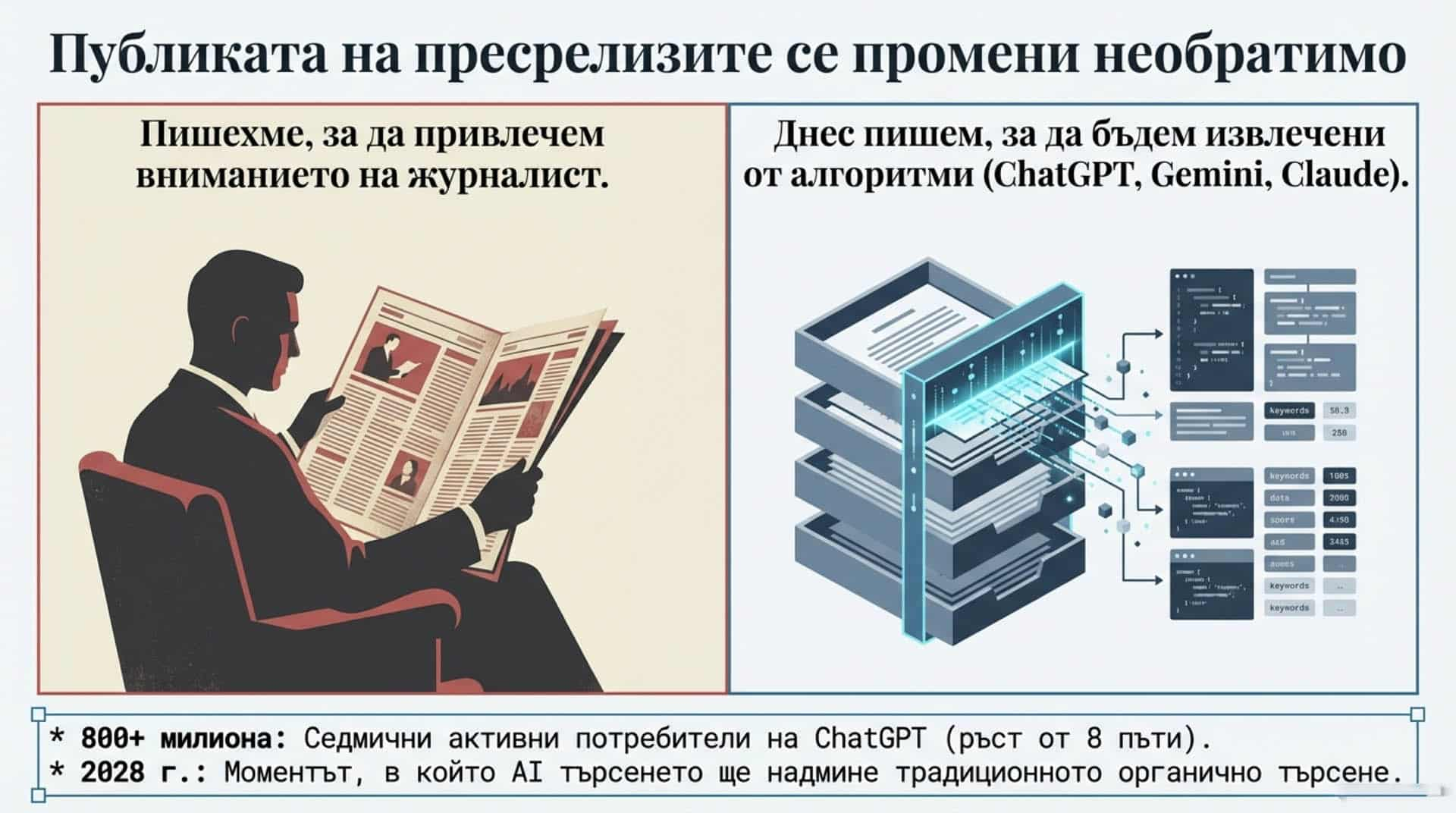
Дълго време пресрелийзът беше създаван основно с една цел – да привлече вниманието на журналисти, редактори и медии. Днес обаче информационната среда се променя. Наред с традиционните медии, все по-важна роля играят и системите с изкуствен интелект, които откриват, анализират, обобщават и цитират съдържание при генериране на отговори. Именно тук идва нуждата от нов подход – пресрелизите вече не трябва да се разглеждат само като PR текстове, а и като структуриран информационен ресурс, лесен за машинно четене и интерпретация.
Тази промяна стои в основата на GEO и AEO подходите – Generative Engine Optimization и Answer Engine Optimization. Ако традиционното SEO оптимизира съдържание за търсачки, то GEO оптимизира съдържание за AI системи като ChatGPT, Gemini, Claude, Perplexity и други подобни платформи. Това означава, че успешният пресрелийз днес трябва да съчетава два ключови елемента: журналистическа достоверност и техническа яснота.
Пресрелийзът като data layer, а не само като новина
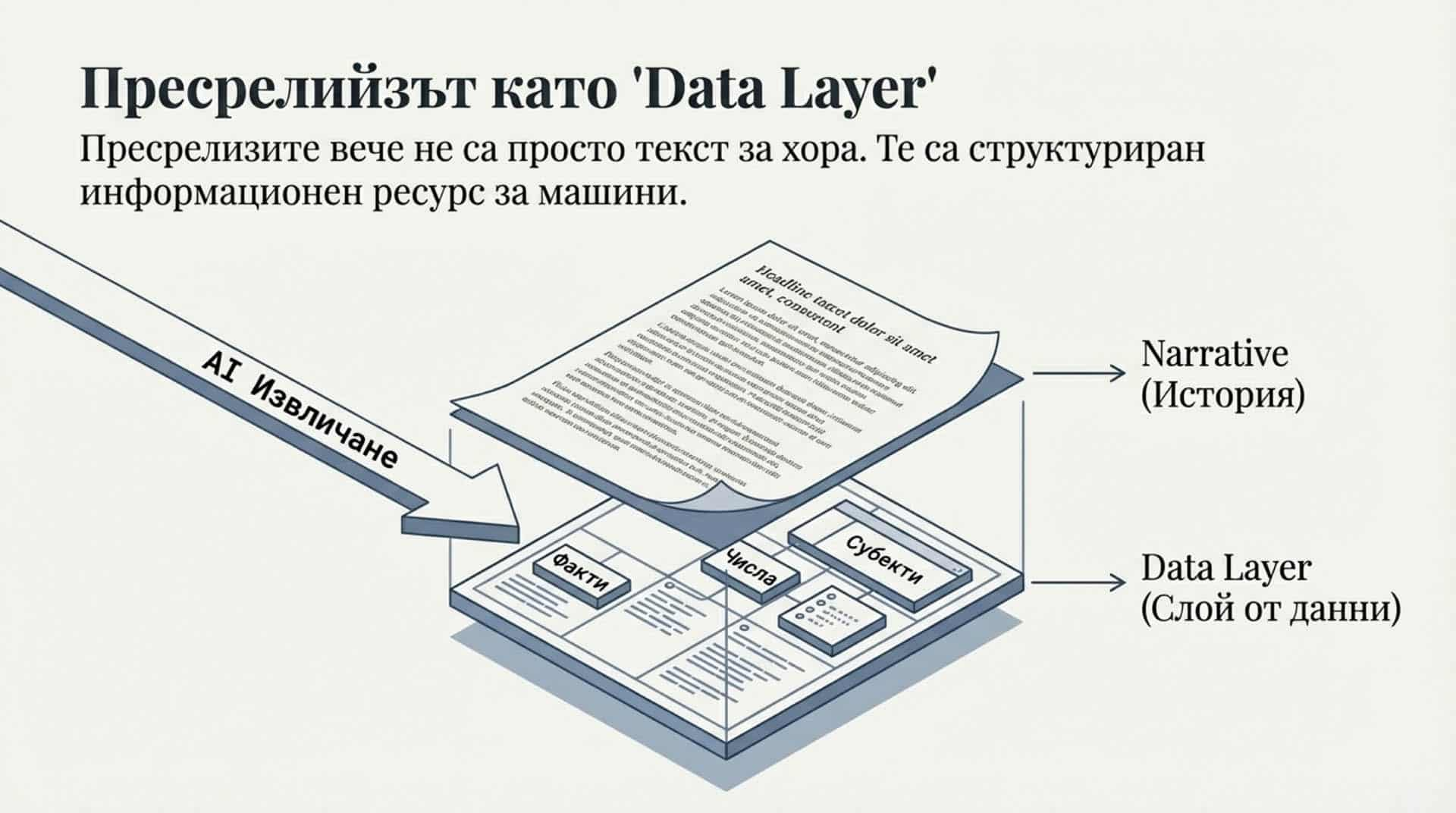
Една от най-важните промени в мисленето е да спрете да възприемате пресрелийза единствено като текст за четене от човек. За AI системите той е слой от данни – набор от факти, имена, числа, събития и взаимовръзки, които трябва да бъдат извлечени, разбрани и използвани в отговор. Колкото по-ясно и логично е структурирана тази информация, толкова по-голям е шансът тя да бъде разпозната като надежден източник.
С други думи, добрият пресрелийз за AI не е просто “красиво написан”. Той е добре организиран, фактологичен, контекстуален и достатъчно ясен, за да може машината да го цитира без колебание.
Защо Al тьрсенето променя правилата на комуникацията АI не ‘чете’ вашия пресрелийз. Той извлича факти, за да формулира отговори.Еволюцията на дигиталния PR
1. Увеличете статистическата плътност
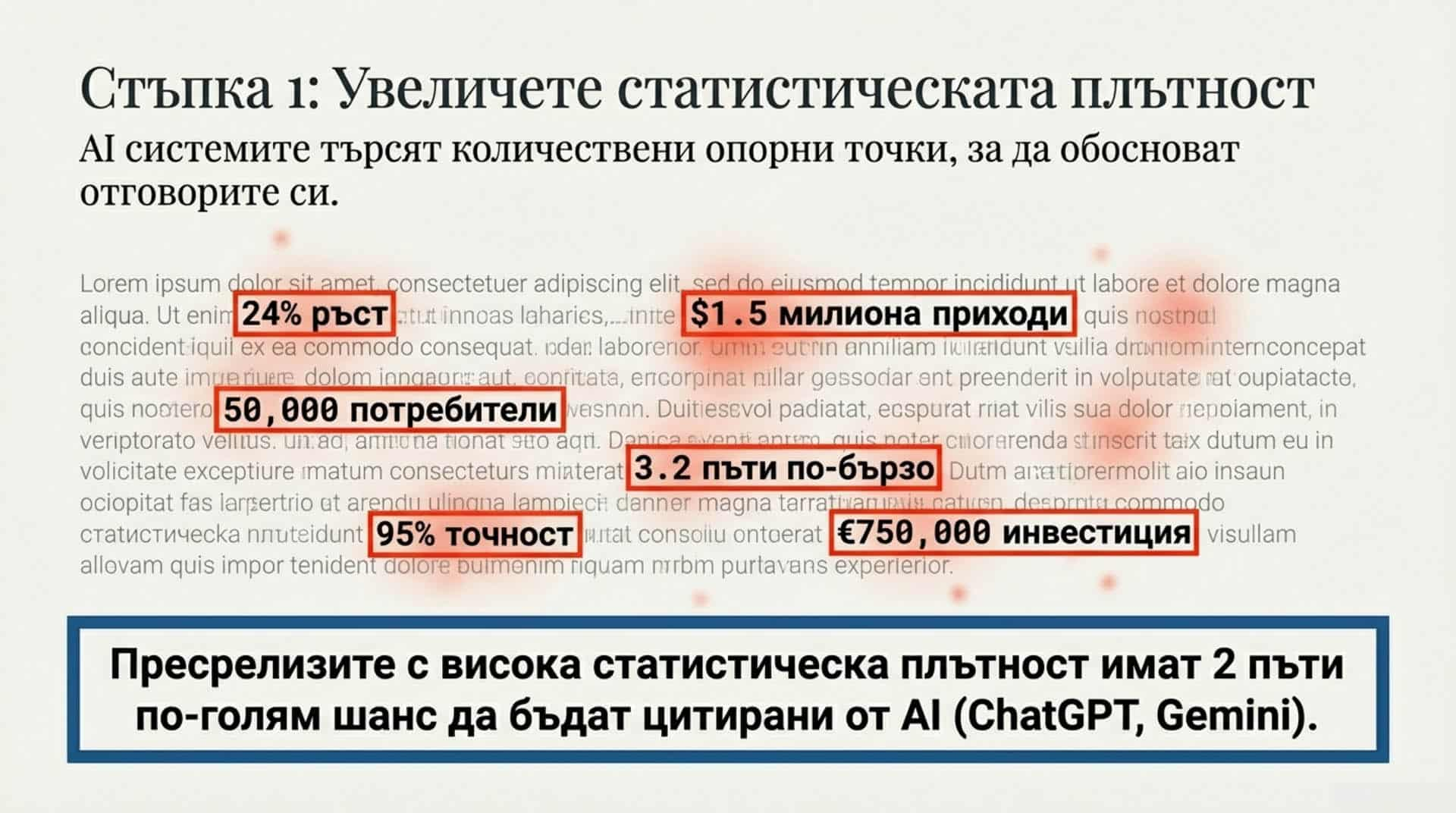
AI системите предпочитат съдържание, което съдържа конкретни данни. Причината е проста: числата, процентите и измеримите резултати правят информацията по-лесна за обосноваване и цитиране. Когато една AI система формулира отговор, тя търси опорни точки. Статистиката е една от най-силните такива.
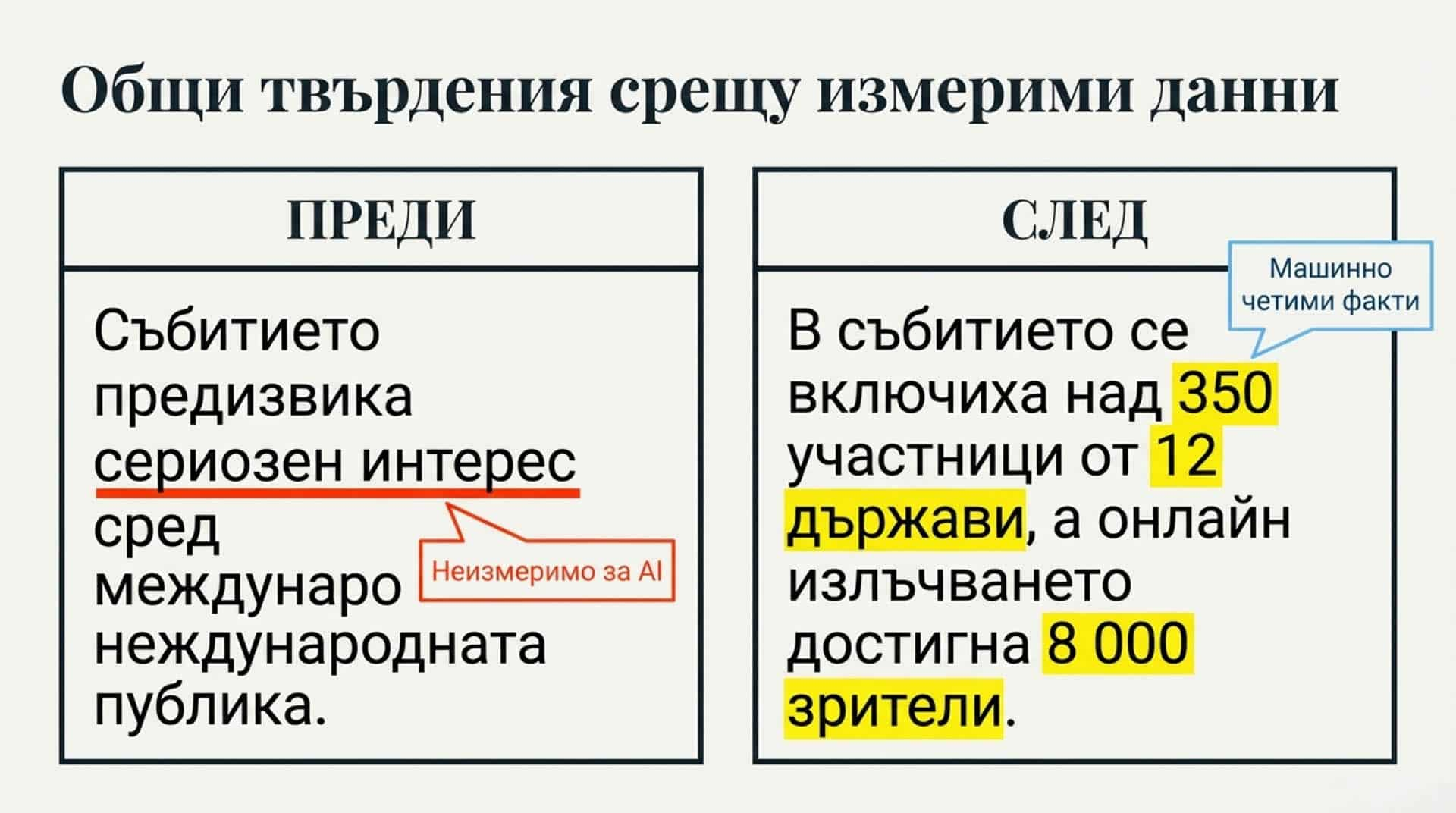
Затова, когато подготвяте пресрелийз, не се ограничавайте до общи твърдения като „проектът беше успешен“ или „интересът беше голям“. Заменете ги с измерими показатели: колко участници е имало, с какъв процент е нараснала активността, колко пациенти са обхванати, какъв е размерът на инвестицията, колко време е отнела реализацията, какъв ефект е отчетен.
Вместо:
„Събитието предизвика сериозен интерес.“
По-добре:
„В събитието се включиха над 350 участници от 12 държави, а онлайн излъчването достигна до повече от 8 000 зрители в първите 48 часа.“
Количествените данни превръщат текста в по-силен източник както за журналисти, така и за AI системи.
Пресрелийзьт като ‘Data Layer’ пресрелизите вече не са просто текст за хора. Те са структуриран информационен ресурс за машини.Увеличете статистическата пльтност – AI системите търсят количествени опорни точки, за да обосноват отговорите си.
2. Използвайте максимална структурна яснота
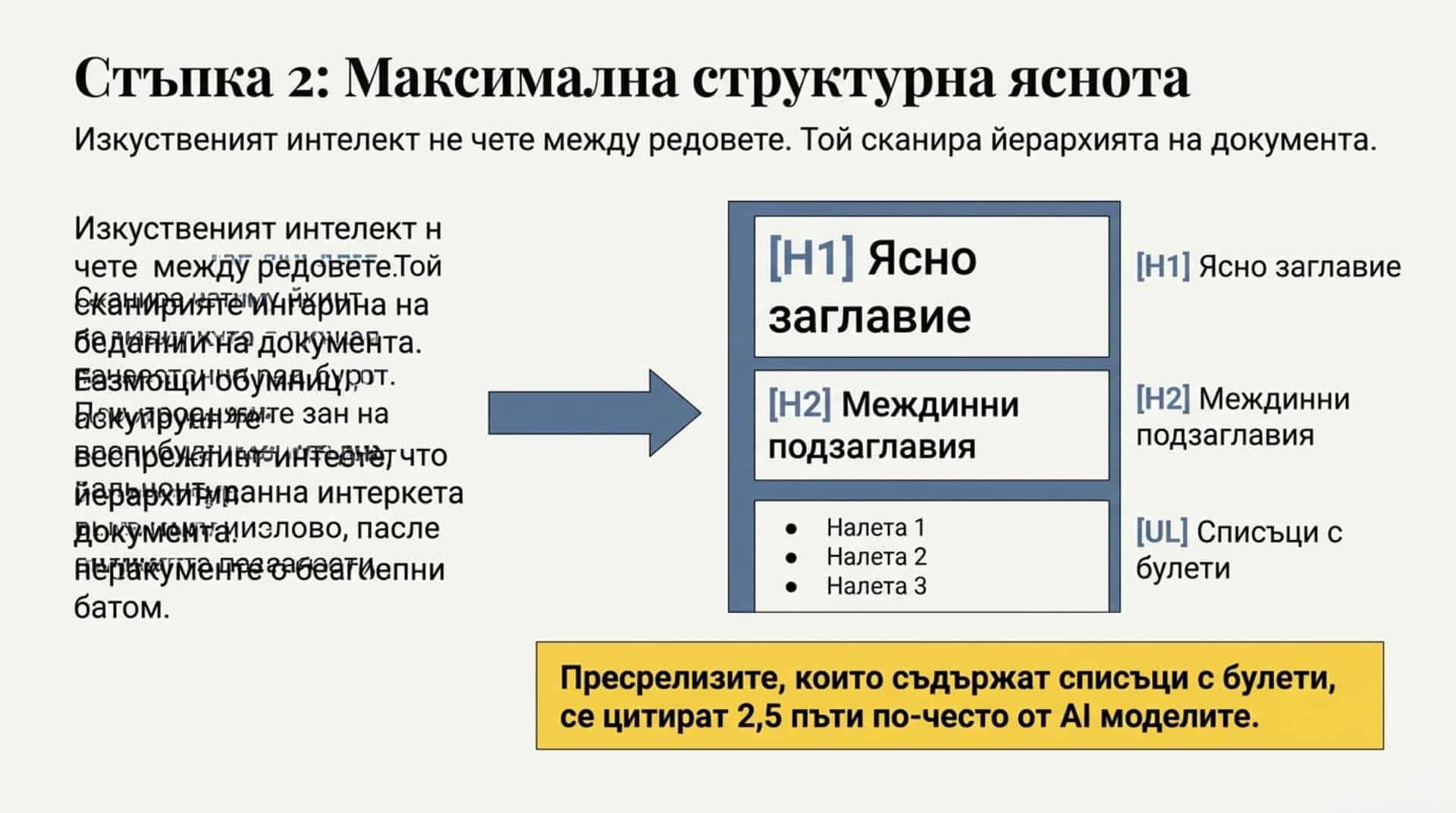
Изкуственият интелект работи по-добре със съдържание, което е ясно организирано. Това означава добре подредени заглавия, логически обособени абзаци, кратки изречения и ясно разграничени секции. Когато текстът е структуриран, машината по-лесно разпознава основната тема, поддържащите аргументи и най-важните факти.
Практически това означава:
ясно заглавие с основната тема;
силен първи абзац, който отговаря на въпросите кой, какво, къде, кога и защо;
междинни подзаглавия;
кратки абзаци;
списъци, когато представяте ключови акценти, резултати или предимства.
Този тип организация не само подобрява четимостта за хората, но и улеснява автоматичното резюмиране и извличането на факти от AI системите.
Общи твърдения срещу измерими данниСтъпка 2: Максимална структурна яснота
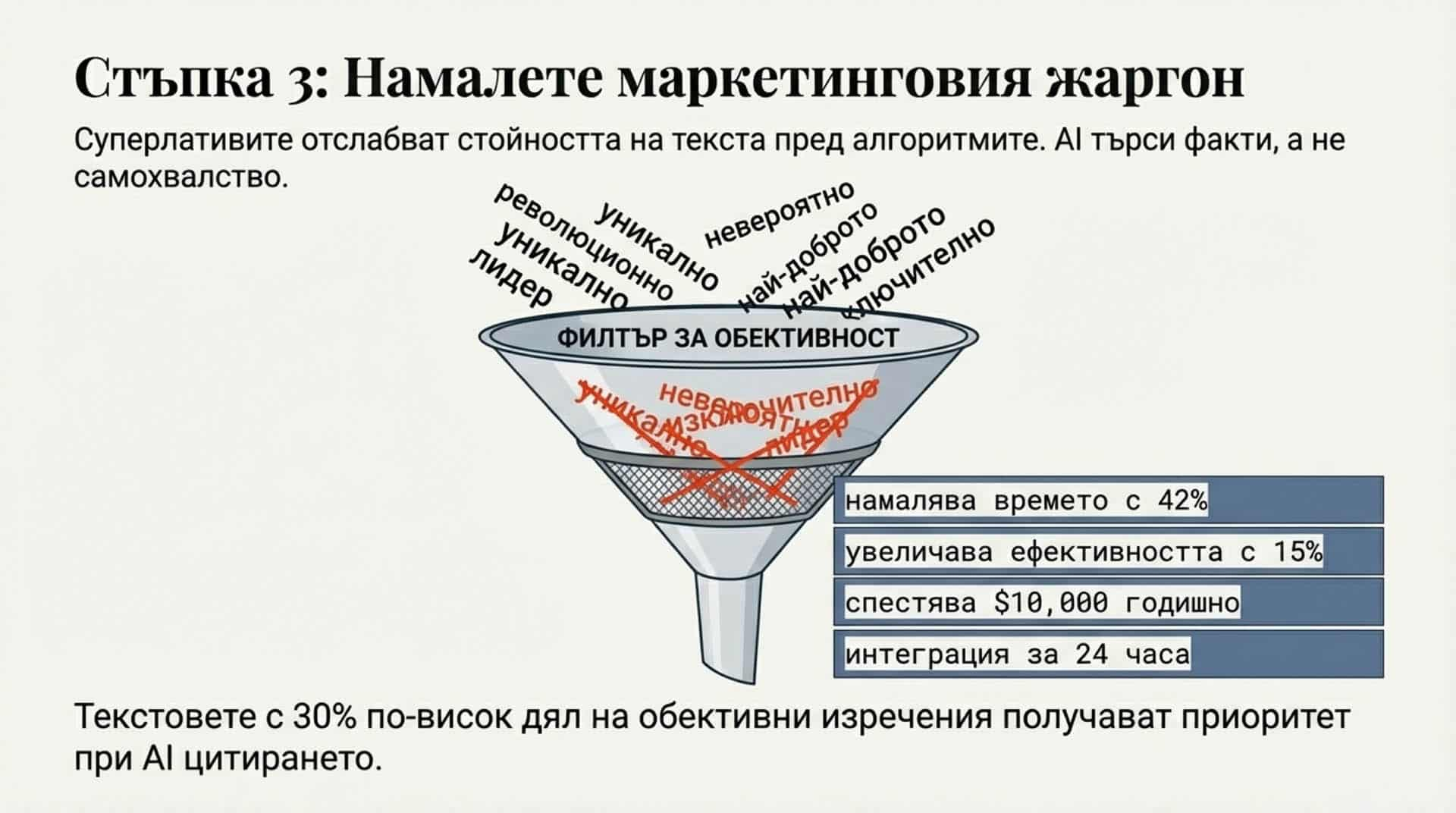
3. Намалете маркетинговия жаргон и засилете обективността
Една от най-честите грешки в корпоративните пресрелизи е прекомерната употреба на рекламни суперлативи. Изрази като „иновативен лидер“, „революционно решение“, „без аналог на пазара“ или „уникален продукт“ могат да звучат добре в рекламно послание, но често отслабват стойността на текста пред AI системите. Те търсят факти, а не самохвалство.
Това не означава, че текстът трябва да е сух. Означава, че всяко твърдение трябва да бъде подкрепено с доказуемо съдържание. Ако твърдите, че дадена технология е иновативна, посочете с какво точно. Ако казвате, че проектът е значим, обяснете неговия мащаб, резултати или обществена стойност.
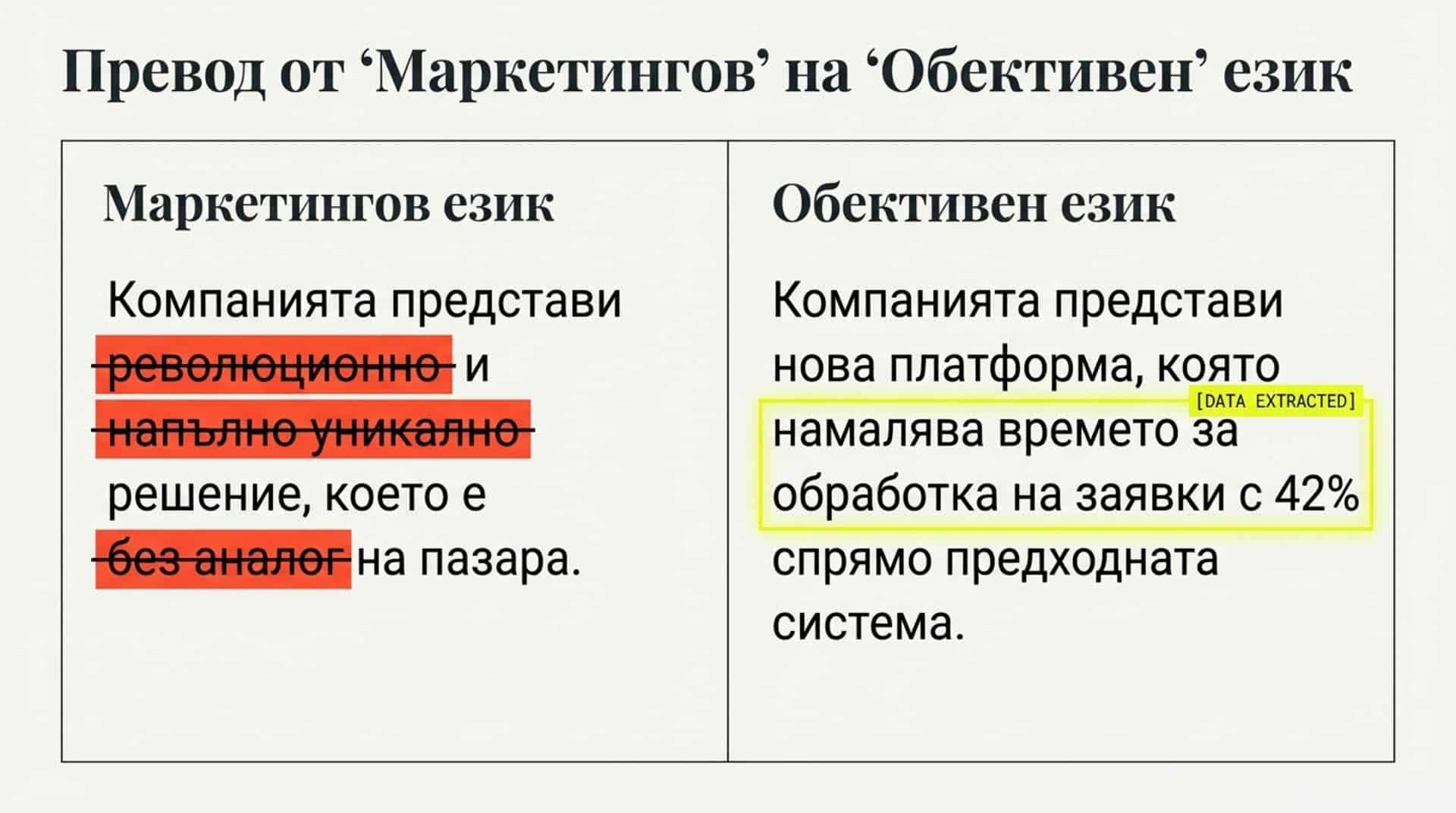
Вместо:
„Компанията представи революционно решение.“
По-добре:
„Компанията представи нова платформа, която намалява времето за обработка на заявки с 42% спрямо предходната система.“
Обективният стил увеличава доверието. А доверието е решаващо, когато алгоритмите избират какво да използват като източник.
Стъпка 3: Намалете маркетинговия жаргонПревод от ‘Маркетингов’ на ‘Обективен” език
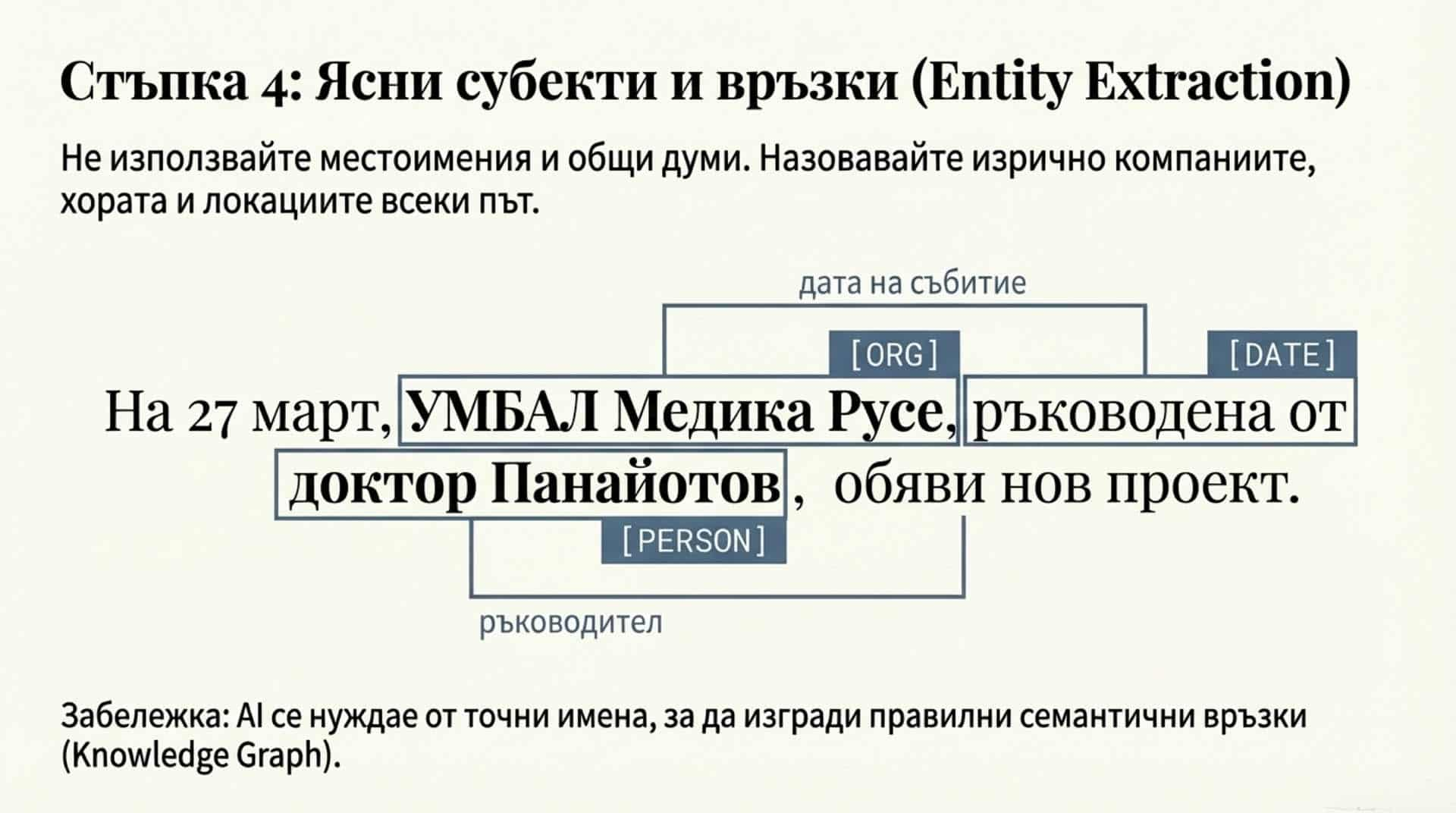
4. Назовавайте ясно ключовите субекти и връзките между тях
AI системите работят чрез разпознаване на обекти и връзки – компании, продукти, личности, институции, локации, дати и събития. Затова в един пресрелийз трябва да назовавате ясно и последователно основните участници в историята.
Посочвайте пълните имена на организации, точните наименования на продукти и инициативи, имената и длъжностите на говорители, както и конкретните места и дати. Избягвайте неясни формулировки като „компанията“, „екипът“, „проектът“, ако преди това не сте дефинирали ясно за кого или за какво става дума.
Например:
„МЕДИКА“, „УМБАЛ Медика Русе“, „ д-р Пaнайотов“, „Русе“, „27 март 2026 г.“ са далеч по-силни опорни елементи от общи заместващи думи.
Това помага на AI моделите да правят правилни семантични връзки и увеличава вероятността съдържанието ви да бъде използвано коректно в генерирани отговори.
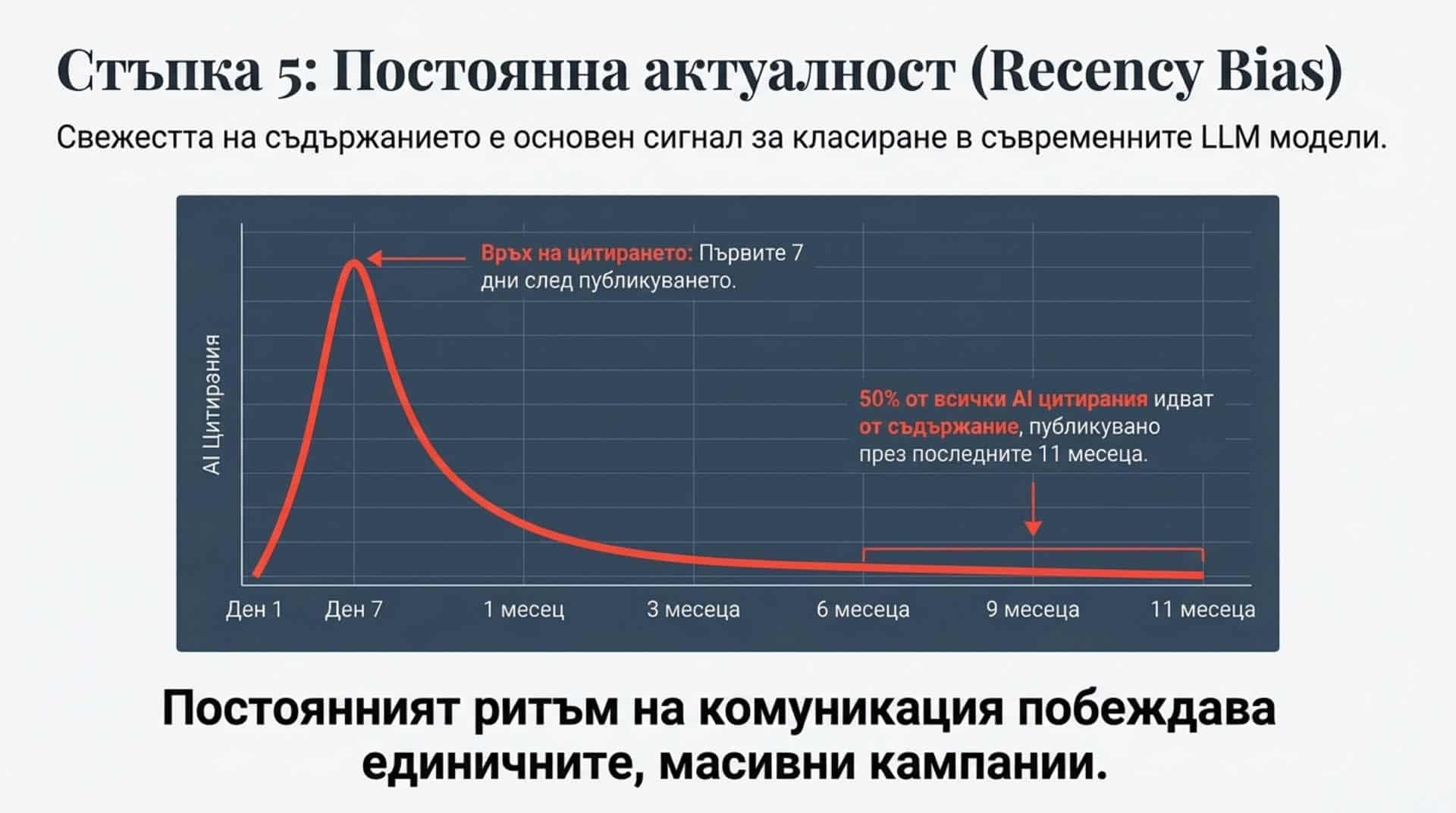
Свежестта на съдържанието е особено важна за AI системите. Новата информация има по-висока стойност, когато става дума за новини, събития, статистики, назначения, партньорства, инвестиции, продукти и публични изяви. С други думи, шансът да бъдете цитирани е най-висок в първите дни след публикуването.
Това означава, че не бива да разчитате само на единични, редки публикации. По-добрата стратегия е постоянен ритъм на комуникация. По-честите, но добре подготвени пресрелизи подават редовен сигнал към алгоритмите, че сайтът или организацията ви са активен и актуален източник.
Актуалността не означава просто честота. Означава и навременно публикуване, обновяване на фактите, допълване на контекст и последователност в комуникацията.
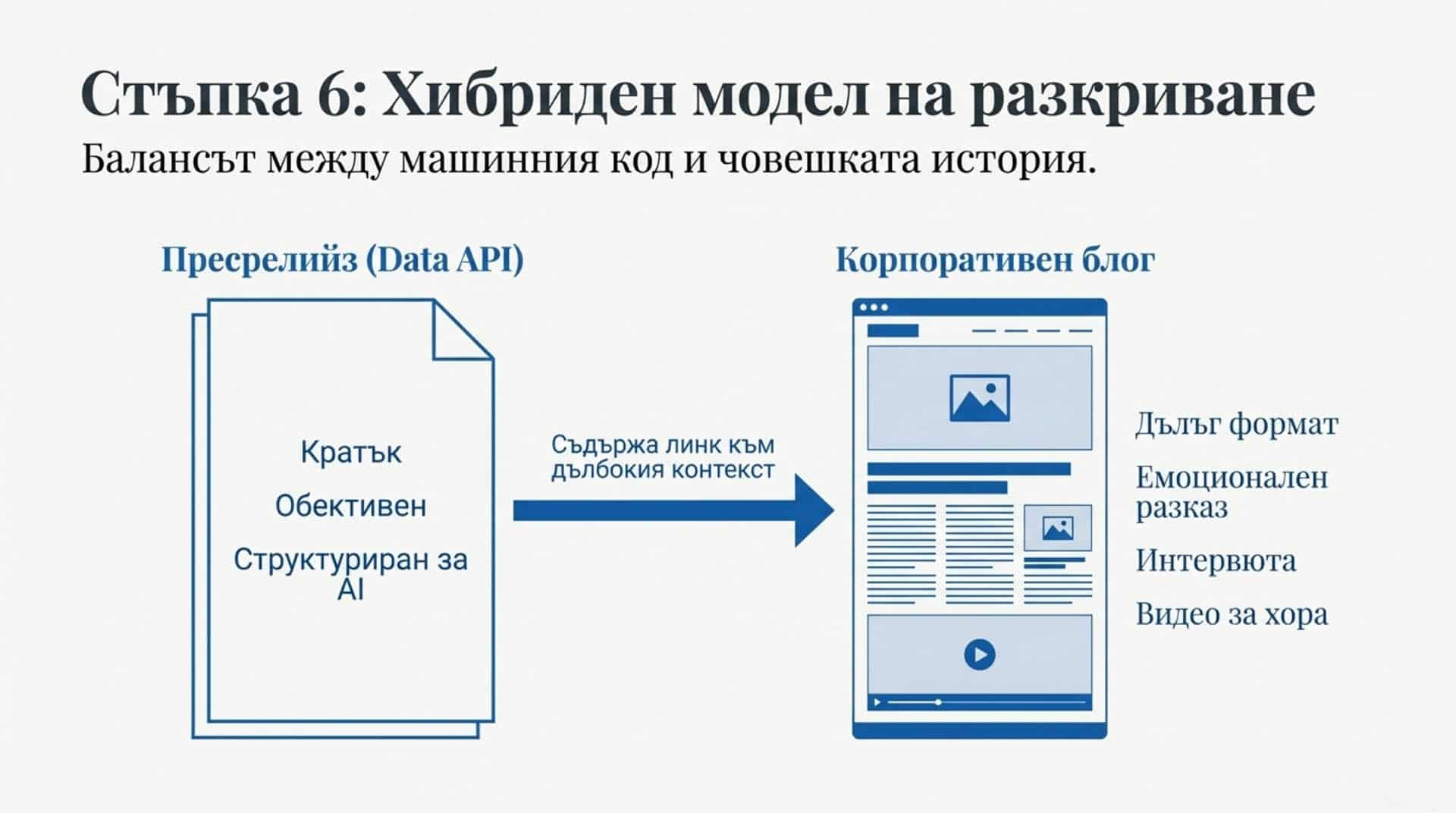
Стъпка 6: Хибриден модел на разкриванеСинтез: Анатомия на AI-оптимизирания пресрелийз
Един от най-работещите подходи е така нареченият хибриден модел на разкриване. При него класическият пресрелийз служи като кратка, обективна и добре структурирана фактологична база, а към него се добавя линк към по-подробна публикация в корпоративен блог, новинарска секция или специализирана страница.
Този модел има двойно предимство. От една страна, AI системите получават чист и ясен фактологичен текст, който могат лесно да анализират и цитират. От друга, човешките читатели получават по-богат разказ, допълнителен контекст, примери, интервюта, визуални материали и аргументи.
Така:
машините получават структура и факти;
хората получават история и дълбочина;
вашият домейн получава по-качествен трафик и по-голям авторитет.
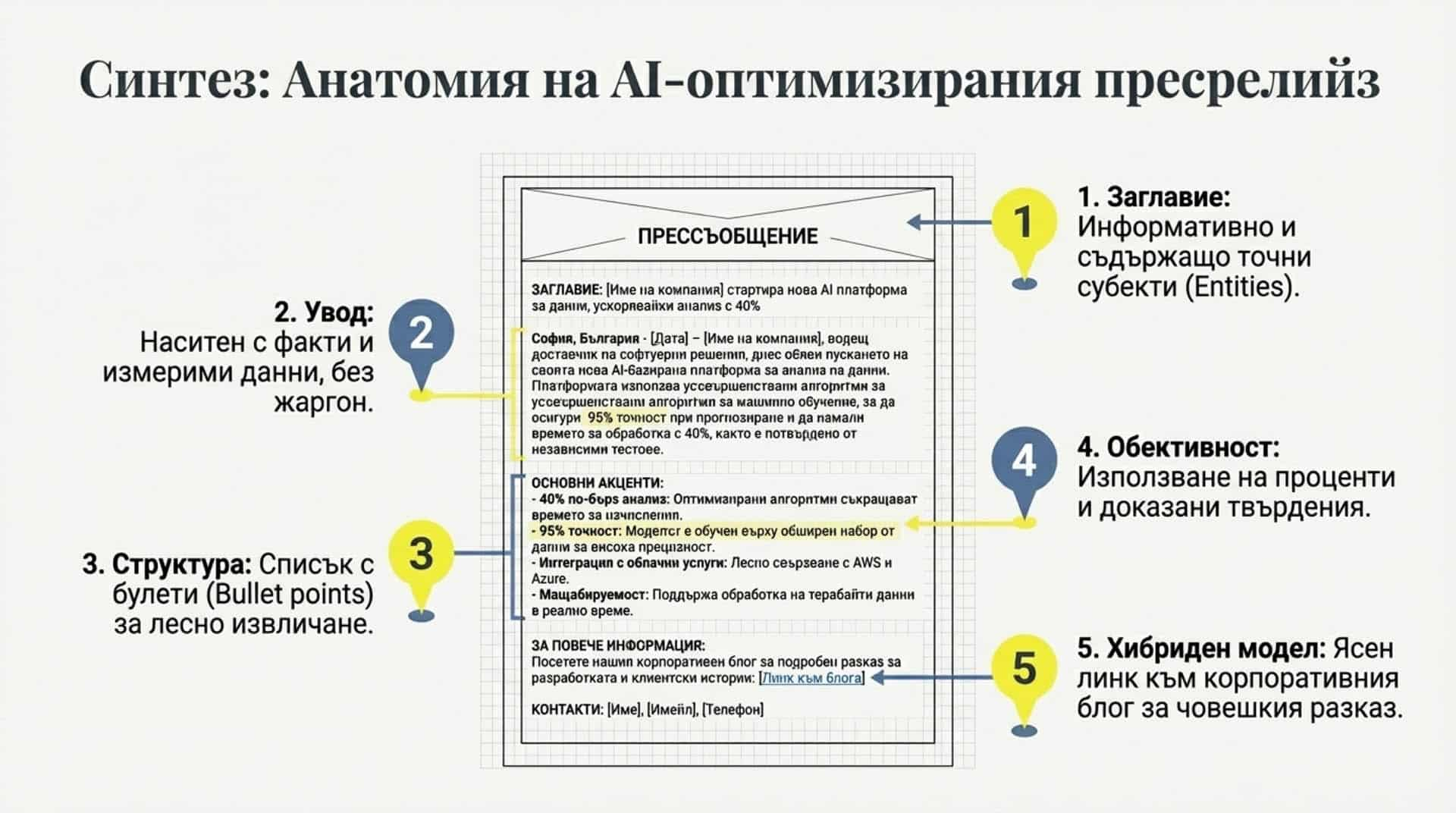
Синтез: Анатомия на AI-оптимизирания пресрелийз
Как изглежда добрият AI-оптимизиран пресрелийз
Един добре подготвен пресрелийз за AI среда трябва да:
започва с ясен, информативен заглавен ред;
съдържа силен увод с най-важните факти;
включва числа, дати, резултати и конкретни показатели;
използва разбираеми подзаглавия;
избягва претрупан рекламен език;
назовава точно всички ключови субекти;
съдържа линкове към допълнителен контекст на собствения ви сайт;
бъде публикуван навреме и в последователна комуникационна рамка.
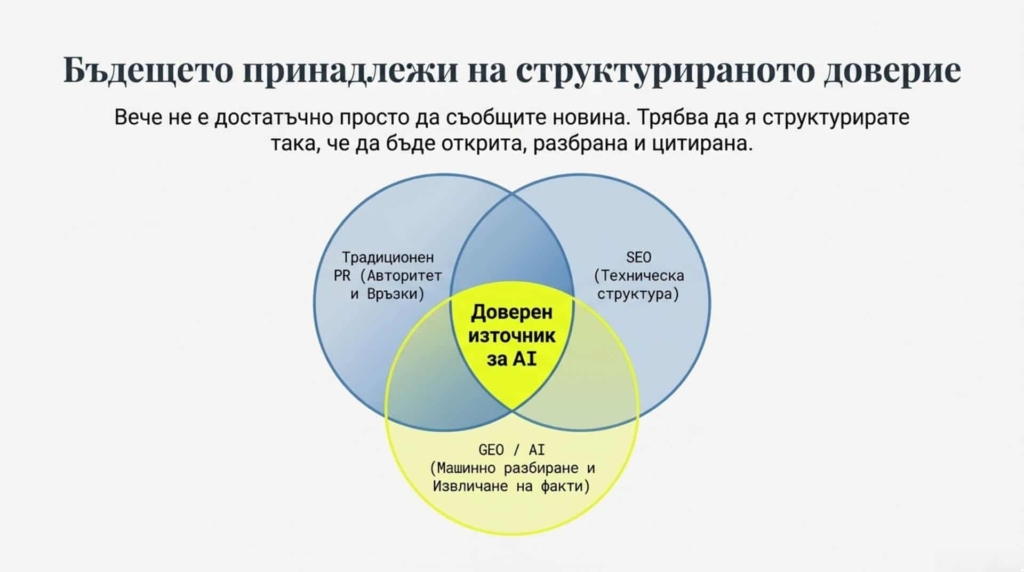
Бъдещето принадлежи на структурираното доверие
Заключение
Оптимизацията на пресрелизите за AI системи не е временна мода, а логична еволюция на дигиталната комуникация. В свят, в който отговорите все по-често се генерират, а не просто се намират, печелят онези организации, които умеят да подават информацията си така, че да бъде едновременно авторитетна, структурирана и машинно разбираема.
С други думи, бъдещето на добрия пресрелийз е в баланса между PR, SEO и GEO. Не е достатъчно просто да съобщите новина. Нужно е да я оформите така, че да може да бъде открита, разбрана, цитирана и използвана като доверен източник в новата AI екосистема.
SEO срещу GEO: каква е разликата и защо AI променя правилата на дигиталната видимост
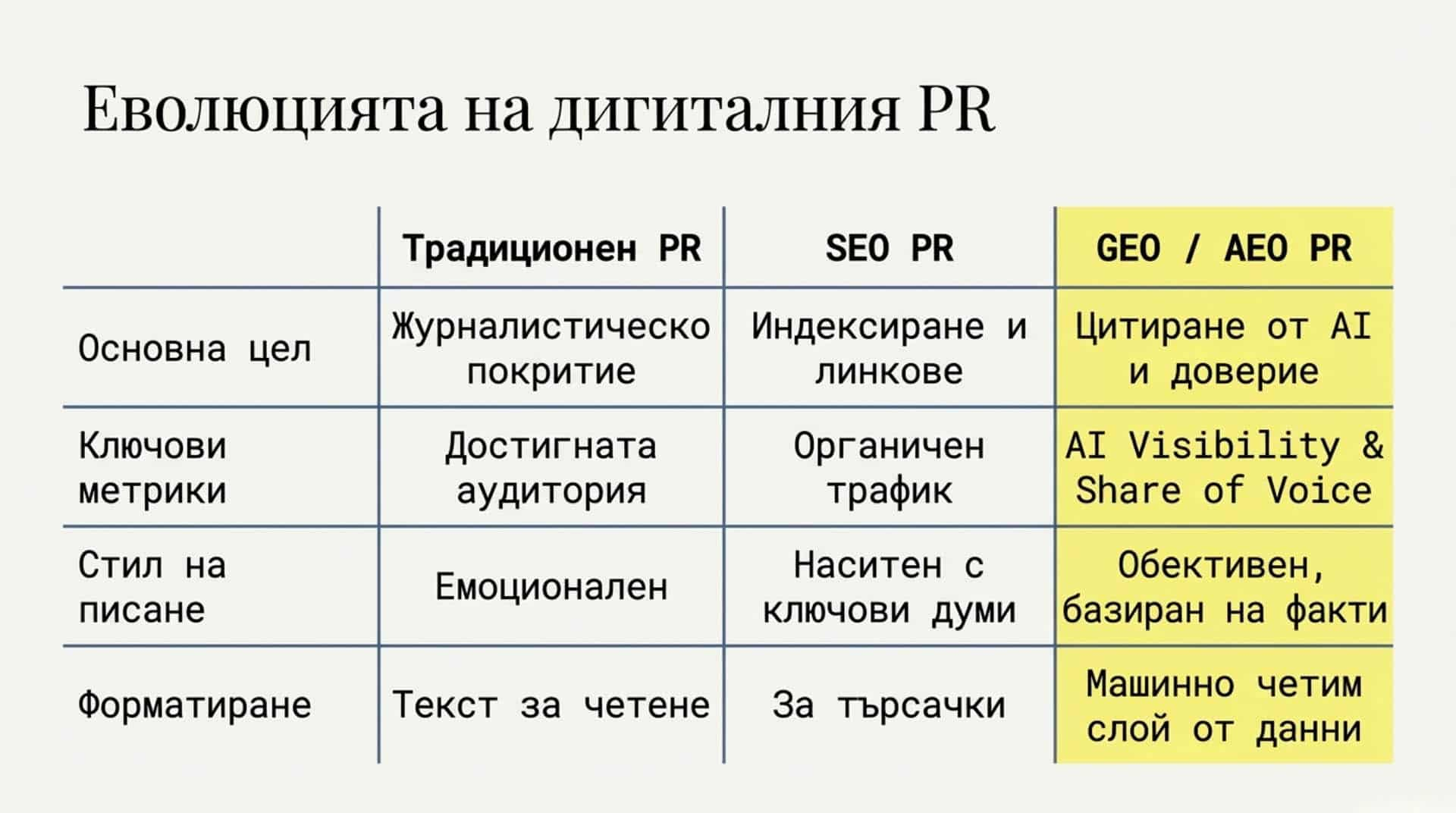
Основната разлика между SEO (Search Engine Optimization) и GEO (Generative Engine Optimization), известно още като AEO (Answer Engine Optimization), е в това какво точно се оптимизира и как дигиталните системи оценяват стойността на съдържанието.
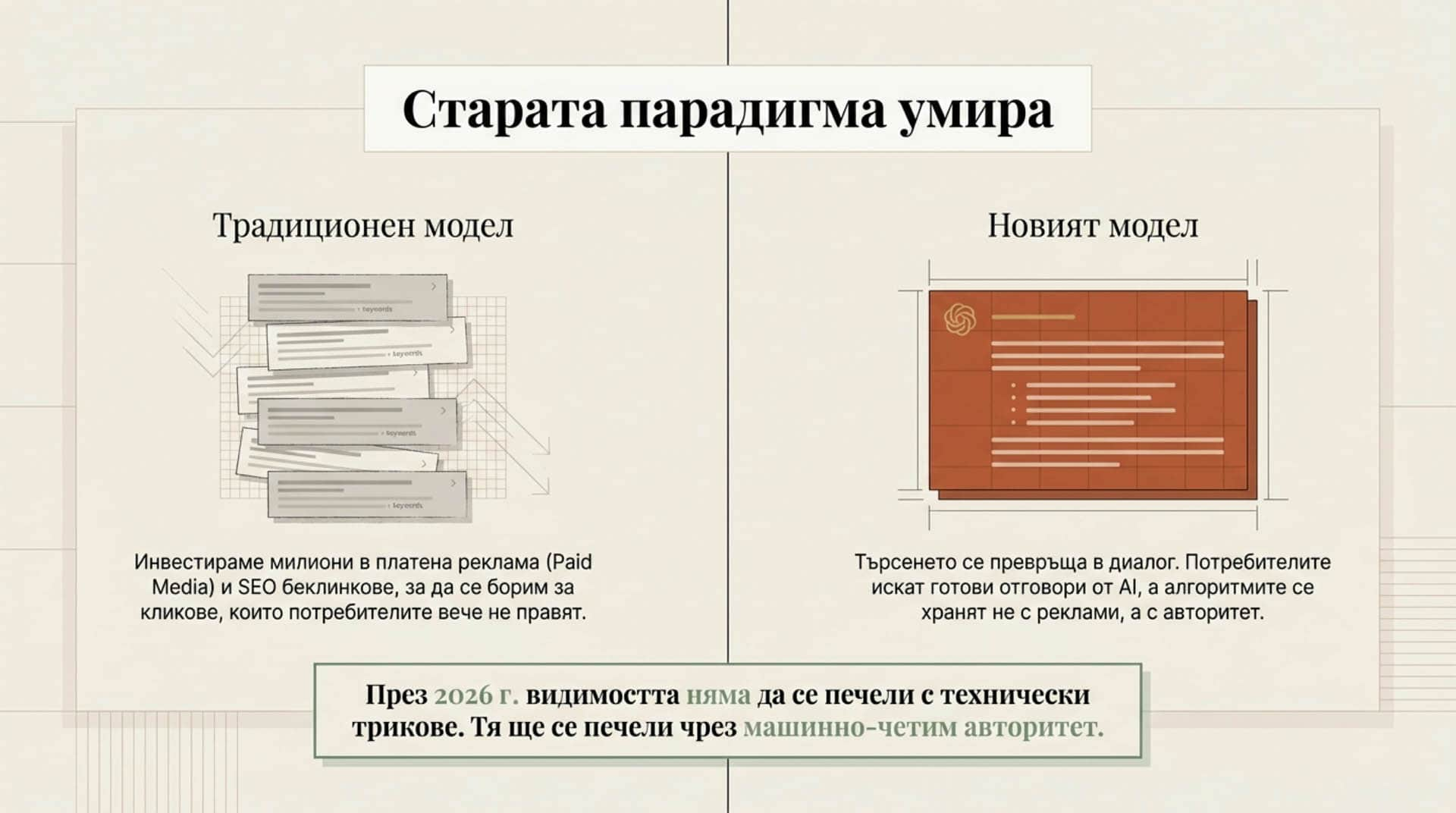
SEO е създадено за класическите търсачки и неговата цел е да помогне на дадена страница да се класира по-високо в резултатите от търсене. GEO е логичната следваща стъпка в среда, в която системи като ChatGPT, Claude, Gemini, Perplexity и AI Overviews не просто показват линкове, а генерират готови отговори и цитират източници.
С други думи, при SEO въпросът е: „На коя позиция сме?“
При GEO въпросът е: „Ще бъдем ли избрани като надежден източник в AI отговор?“
SEO срещу GEO: каква е разликата и защо AI променя дигиталната видимост Старата парадигма умира – SEO срещу GEO: каква е разликата и защо AI променя дигиталната видимост
1. SEO оптимизира за класиране, GEO оптимизира за цитиране
Традиционното SEO работи основно за по-добри позиции в Google и другите търсачки. То се стреми да доведе повече органичен трафик чрез ключови думи, техническа оптимизация, вътрешна структура и линк профил.
GEO има различна крайна цел. Вместо да се фокусира единствено върху позицията в SERP, то цели съдържанието да бъде разпознато, разбрано и цитирано в AI отговор. Това означава, че сайтът вече не се състезава само за клик, а и за място вътре в самия отговор, който потребителят получава.
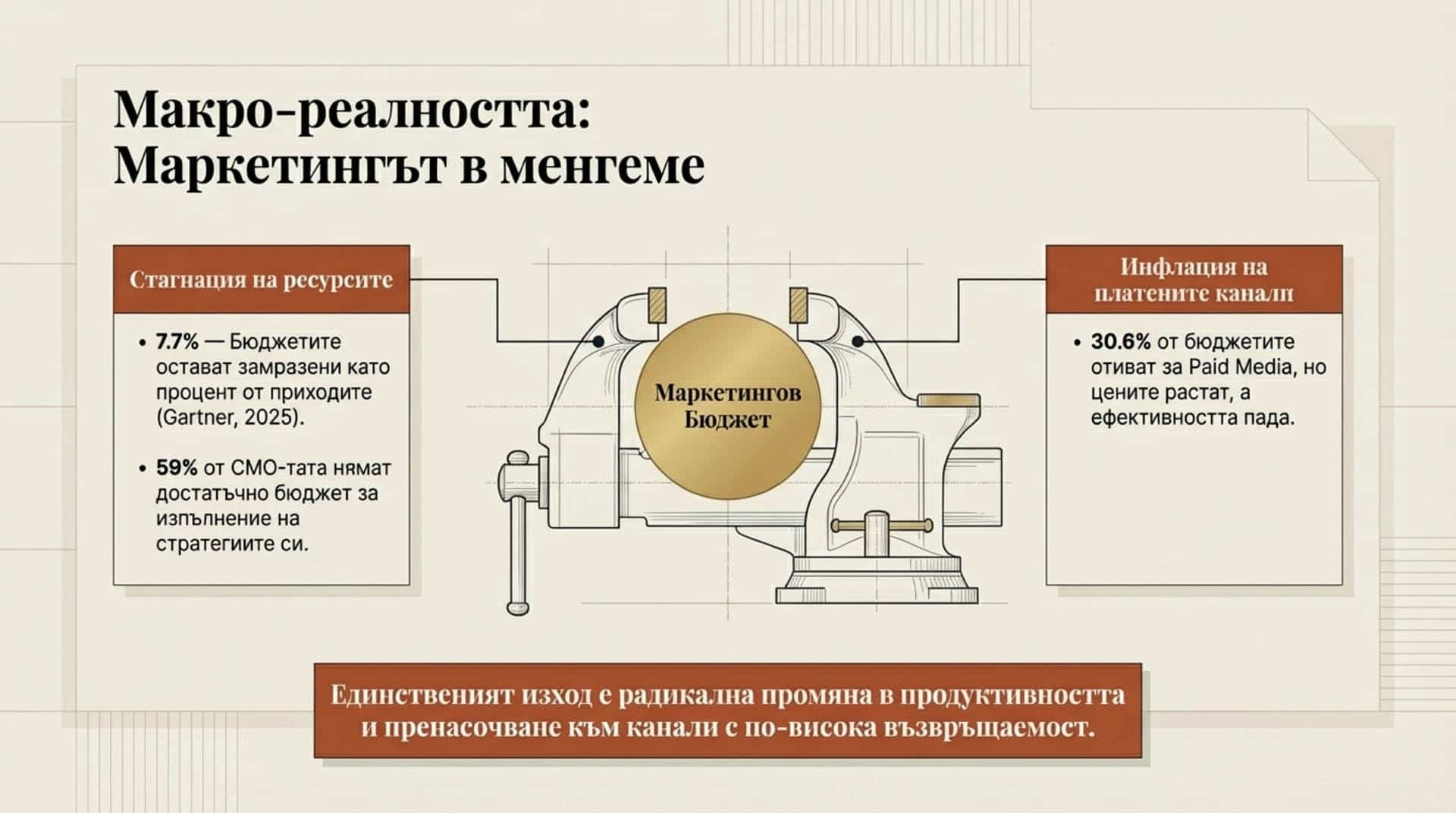
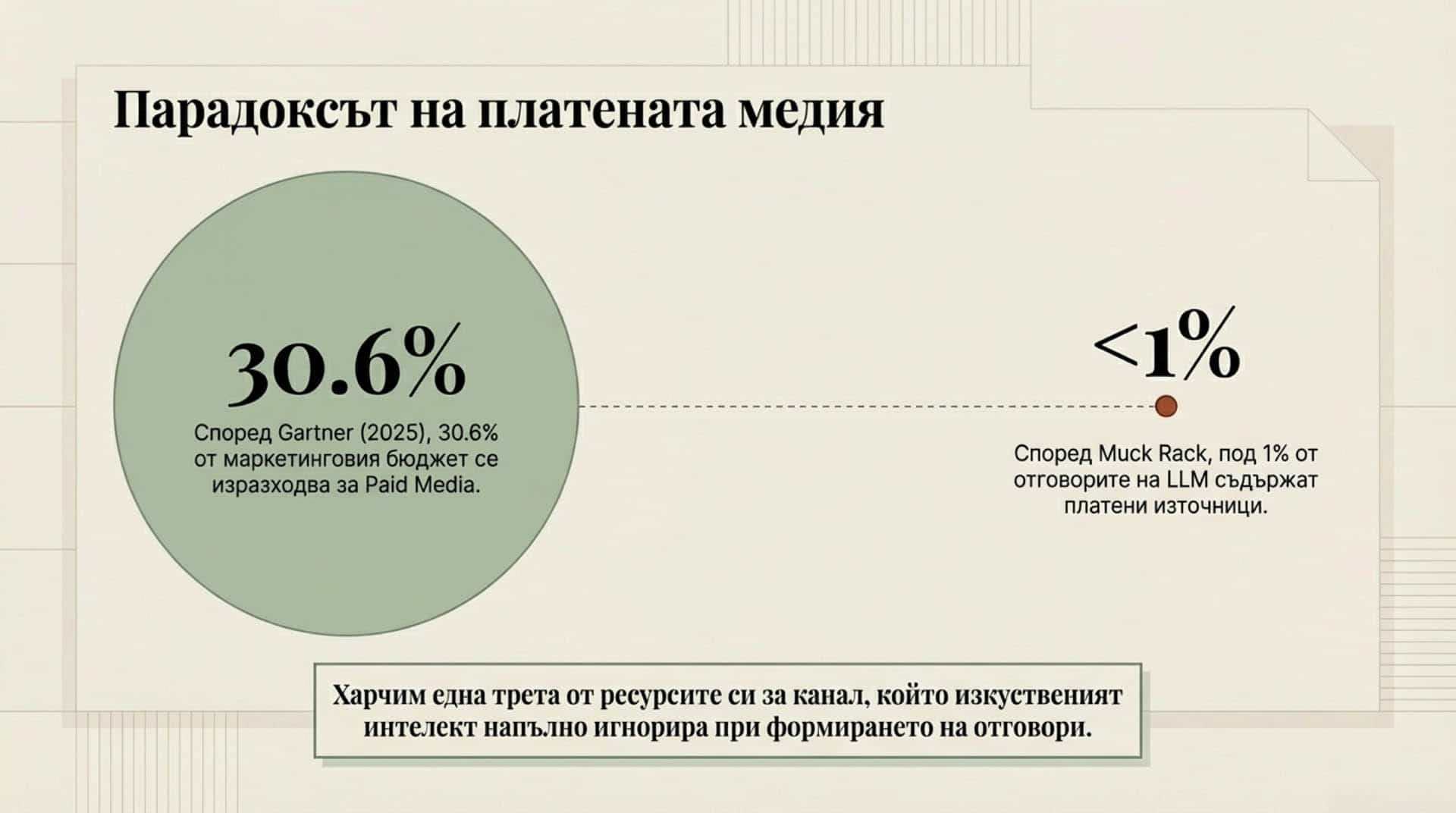
Макро-реалността: Маркетингьт в менгеме – SEO срещу GEO: каква е разликата и защо AI променя дигиталната видимост Парадокст на платената медия
2. GEO изисква повече доверие, не само добра техническа оптимизация
През последните две десетилетия SEO се развиваше основно около технически показатели като скорост на зареждане, crawlability, структура на страниците и backlinks. Тези фактори продължават да са важни, но при GEO вече не са достатъчни сами по себе си.
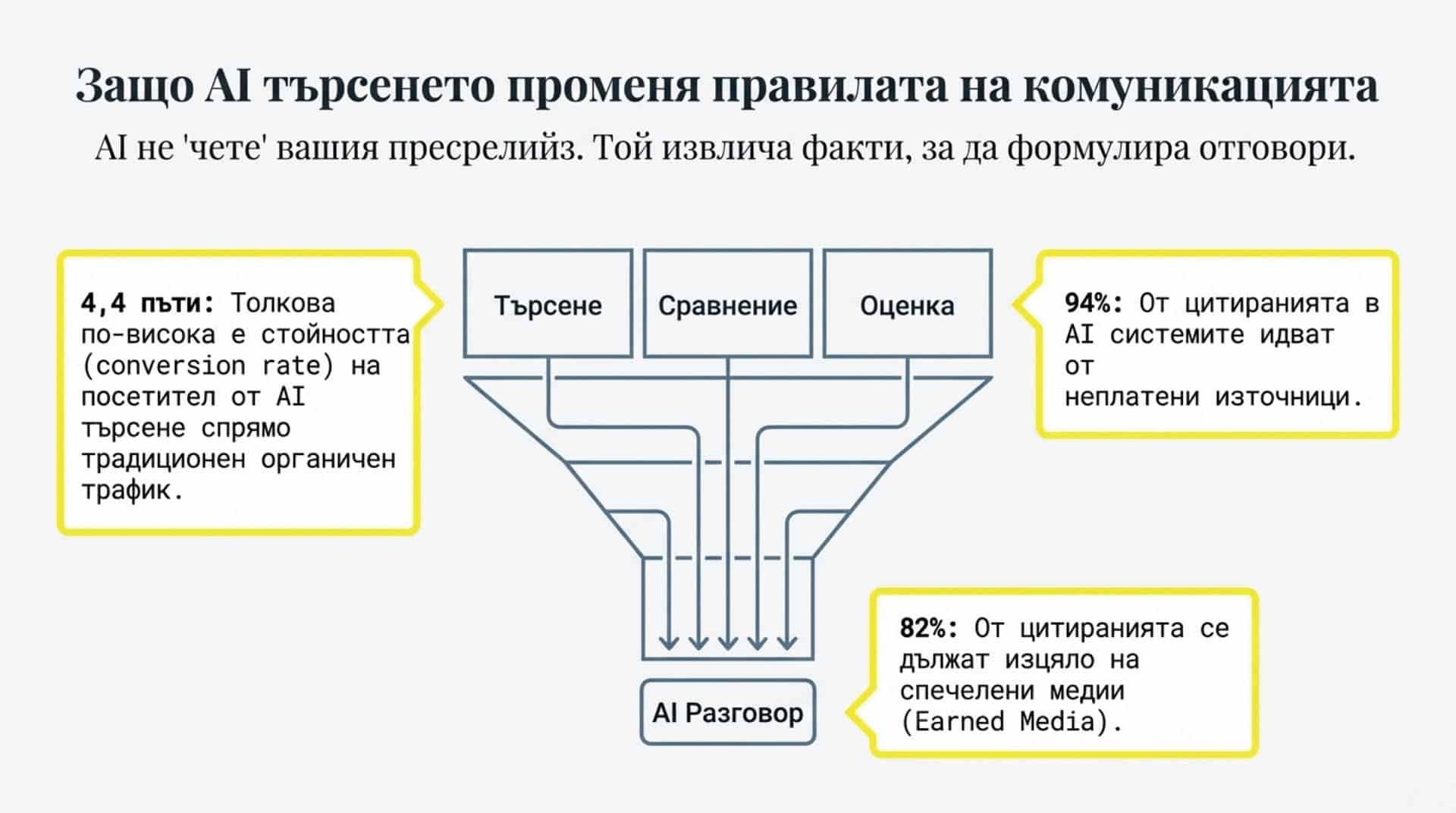
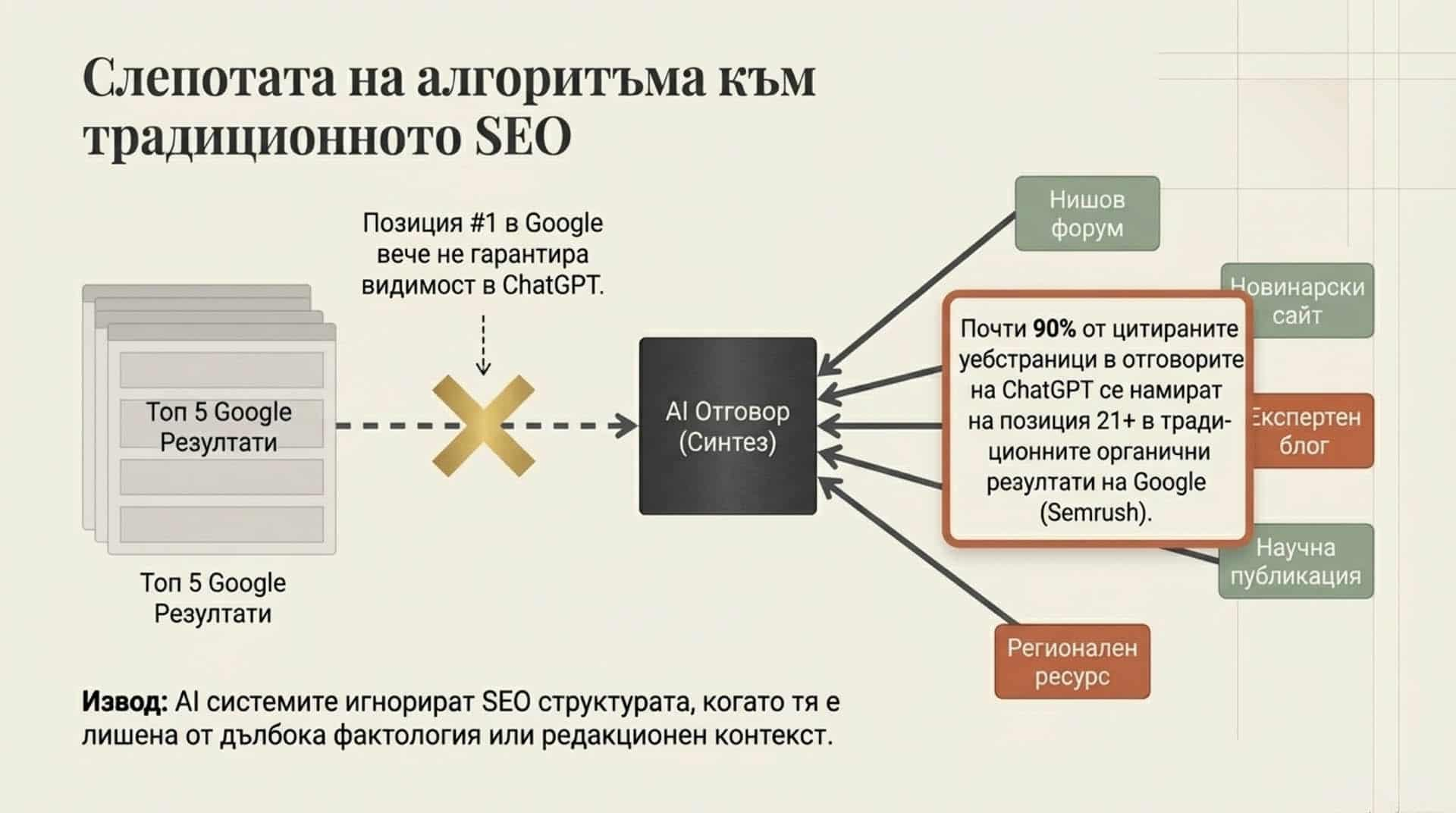
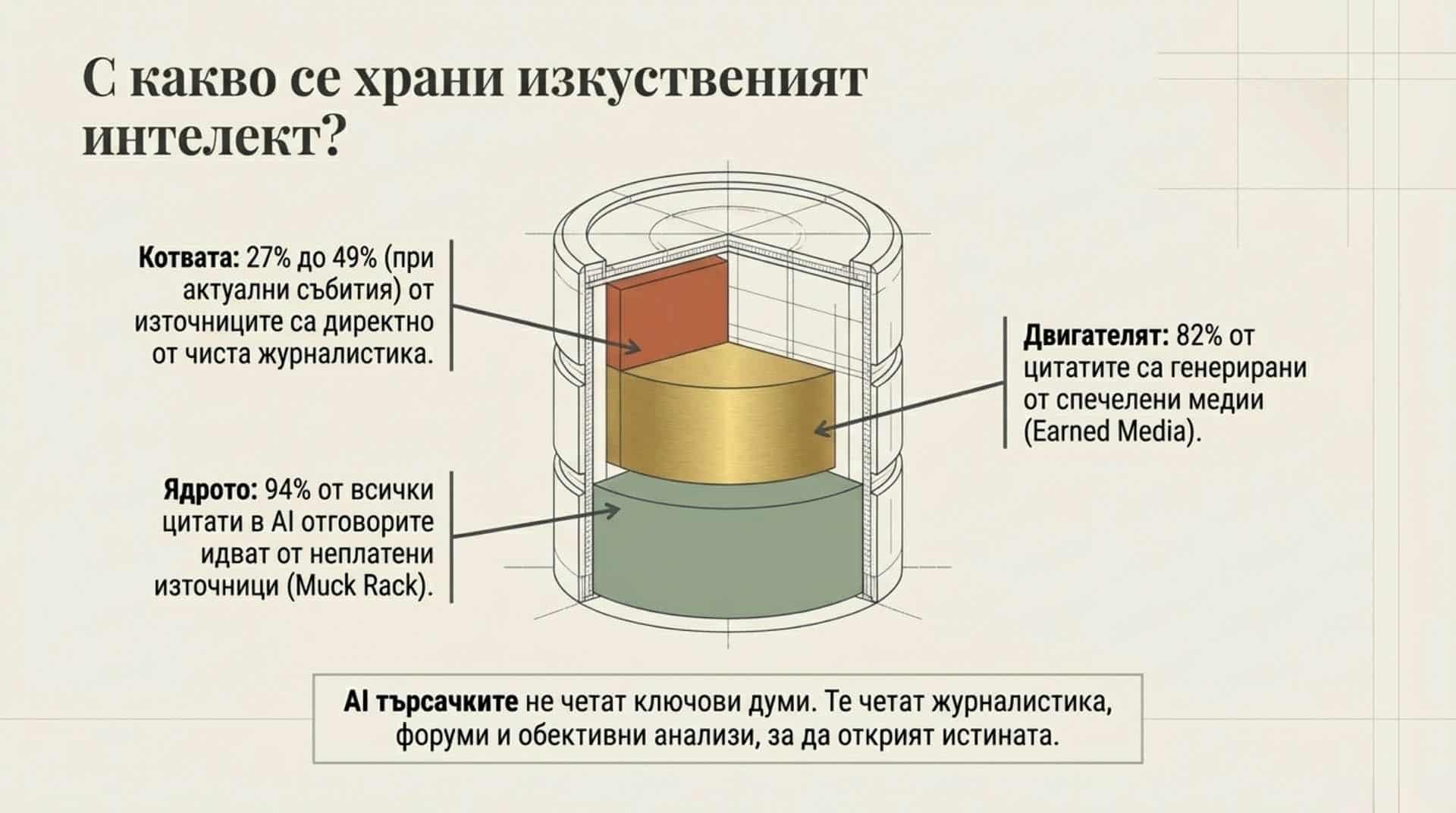
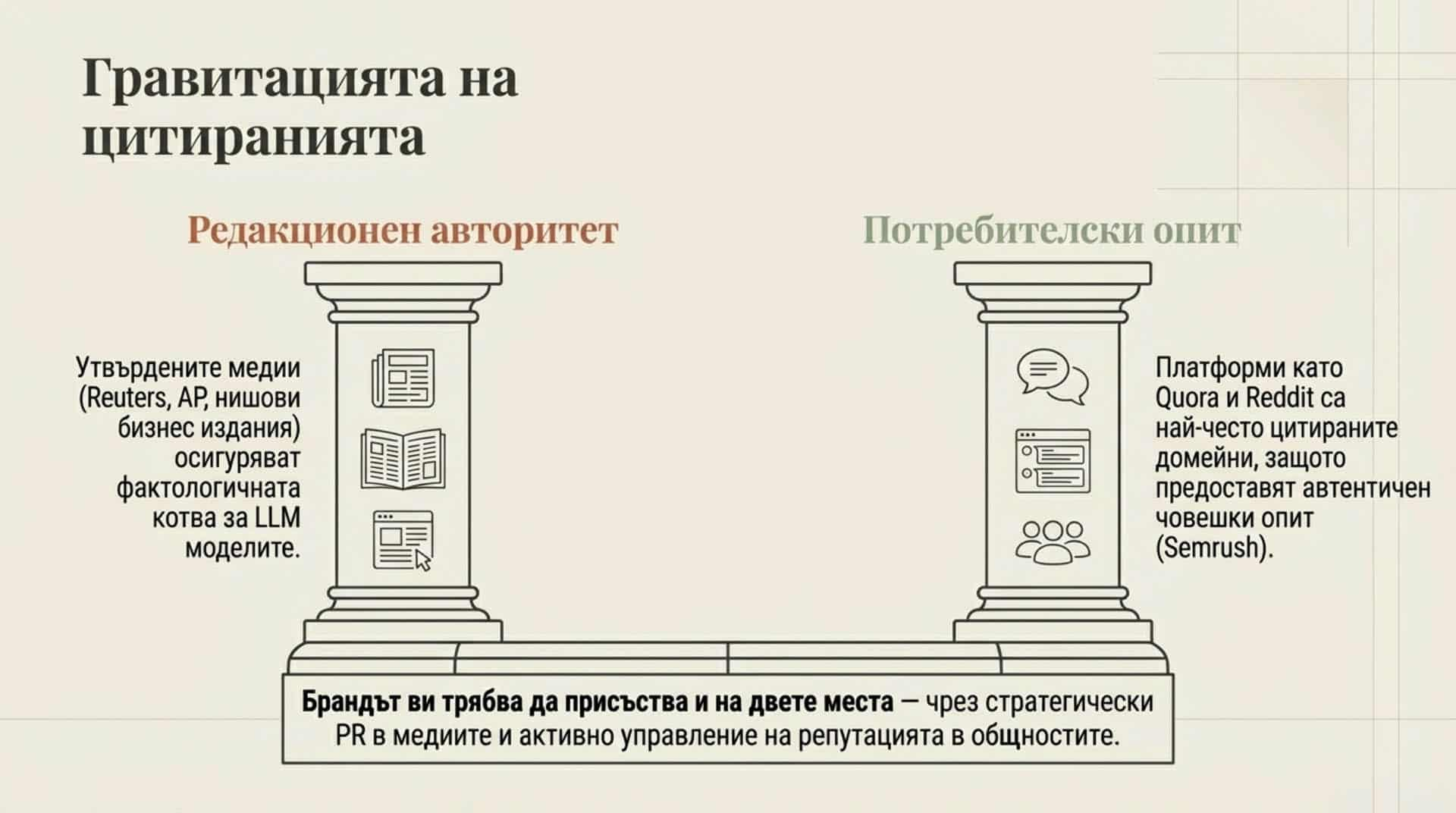
AI системите често предпочитат източници с ясно изразен редакционен авторитет, високо доверие към бранда и потвърждение от независими външни публикации. Анализи на Muck Rack показват, че приблизително 94–95% от връзките, цитирани от AI системи, идват от неплатени източници, а earned media има особено силна роля.
Това означава, че за добра GEO стратегия са нужни не само добър сайт и добро съдържание, но и:
медийно присъствие;
PR стратегия;
експертни публикации;
ясно изградена бранд репутация;
външни авторитетни потвърждения.
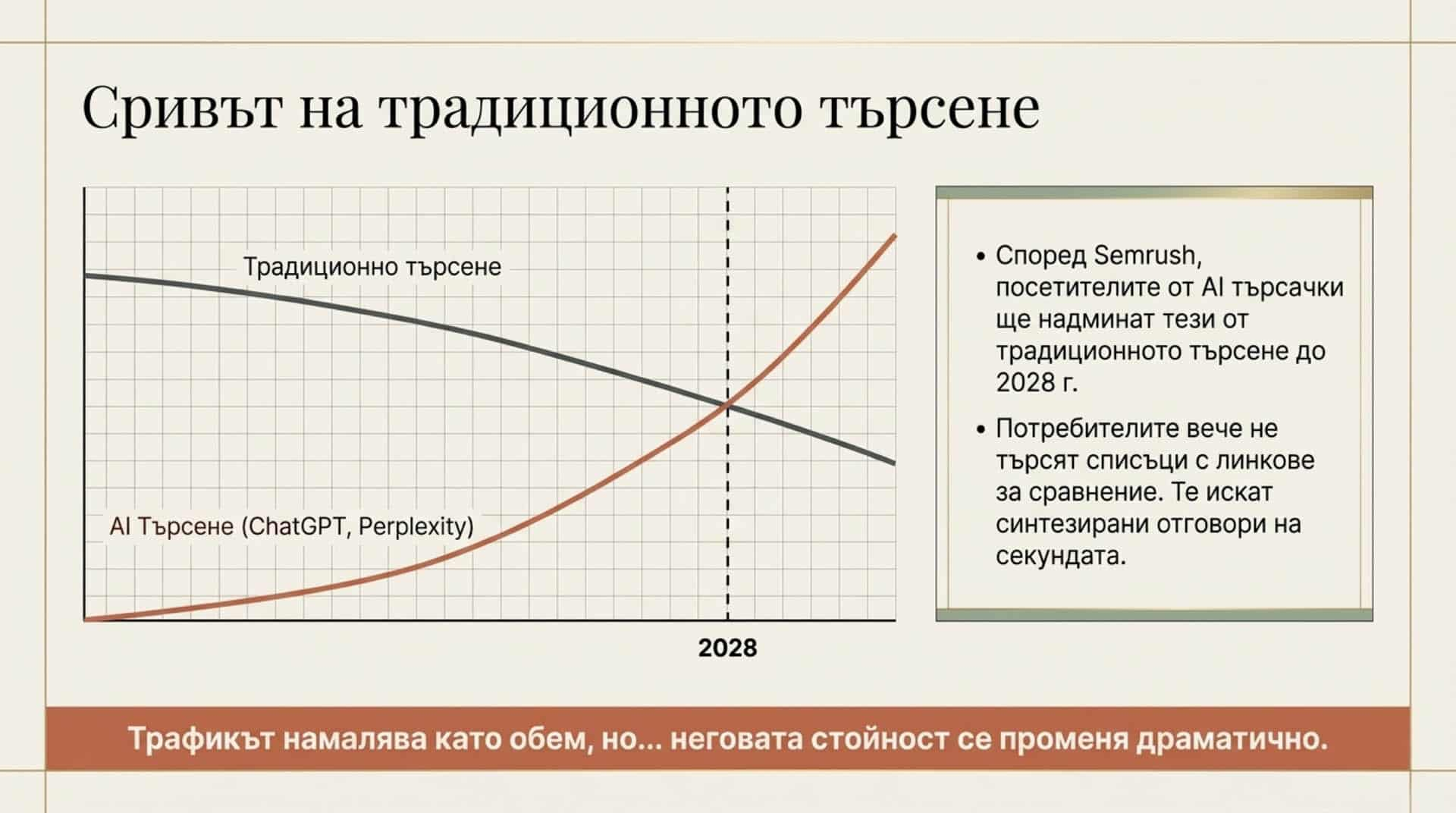
Сривът на традиционното трсенеКомпресираната фуния: По-малко кликове, хипер-ценен трафик
3. Съдържанието трябва да бъде създадено така, че AI да го разбира лесно
При класическото SEO съдържанието се оптимизира основно за откриваемост и тематична релевантност. При GEO то трябва да бъде написано така, че да може лесно да бъде извлечено, обобщено и използвано като част от отговор.
Затова добре работят:
ясни H2 и H3 подзаглавия;
кратки и директни абзаци;
въпроси и конкретни отговори;
списъци и структурирани елементи;
числа, факти, сравнения и примери;
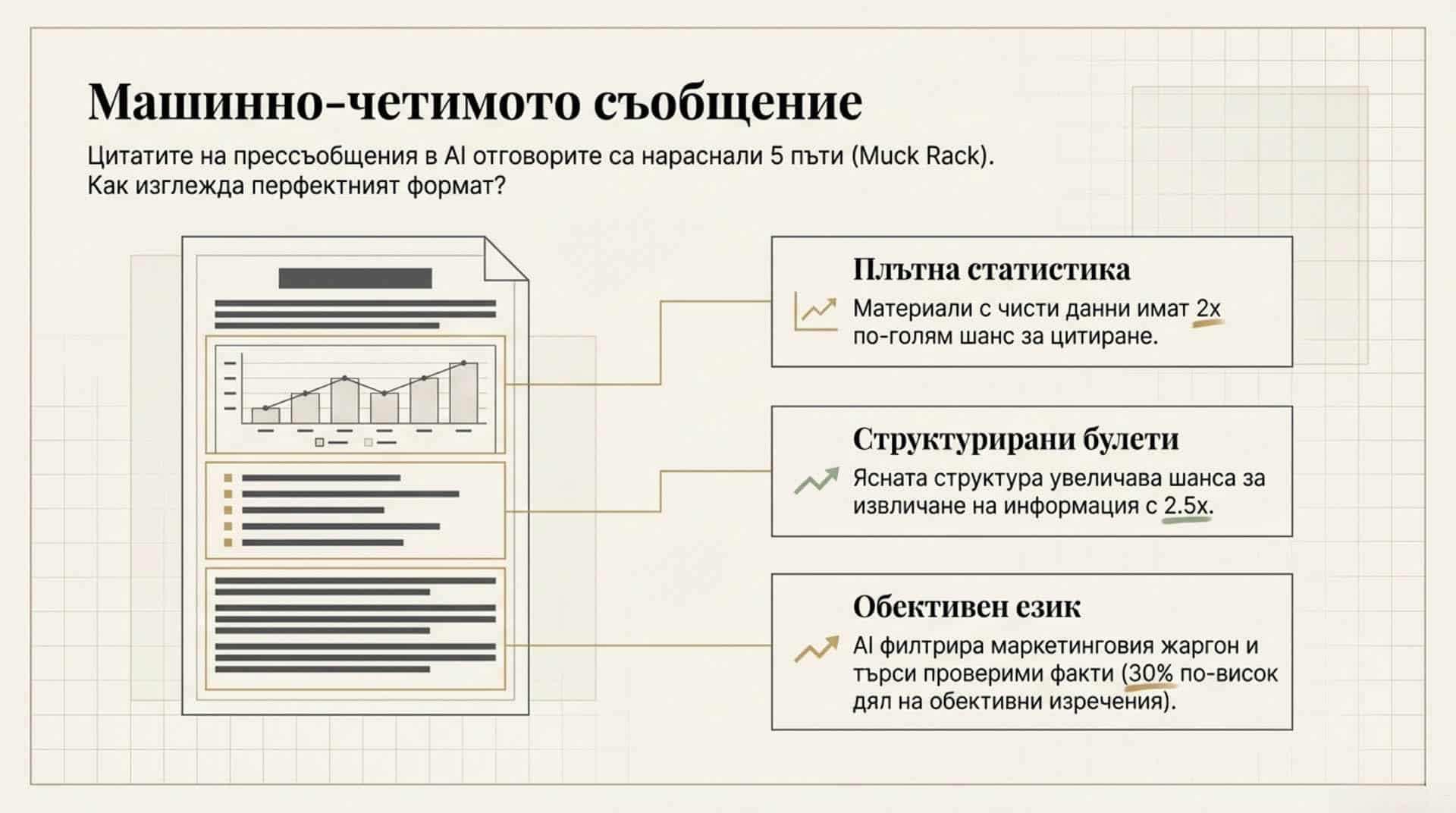
обективен тон без прекален маркетингов жаргон.
AI моделите предпочитат съдържание, което може лесно да се „компресира“ в ясен и надежден отговор. Именно затова GEO стои на пресечната точка между качествена журналистика, техническа яснота и експертно знание.
Слепотата на алгоритьма към традиционното SEOС какво се храни изкуственият интелект?
4. Актуалността играе по-голяма роля при GEO
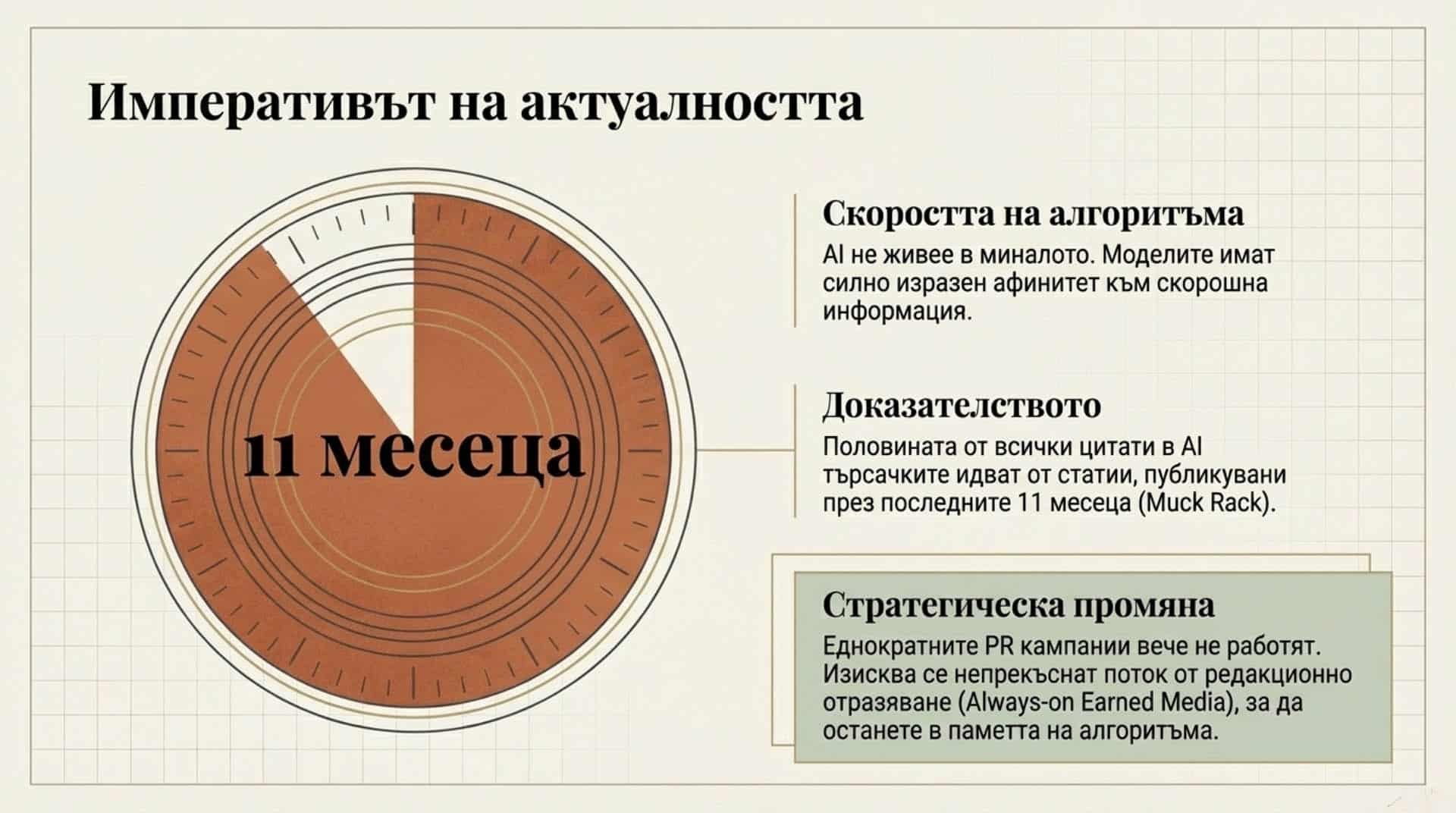
Една от големите разлики между SEO и GEO е значението на свежото съдържание.
При класическото SEO едно evergreen съдържание може да се класира добре с години. При AI системите обаче има ясно изразен recency bias. Според публикувани анализи над половината AI цитирания идват от съдържание, публикувано в рамките на последните около 11–12 месеца, а при актуални теми най-силен шанс за цитиране има съдържанието, публикувано скоро след събитието.
Това означава, че GEO не е еднократна оптимизация. То изисква:
постоянна редакционна активност;
редовни актуализации;
публикуване на нови анализи;
експертни коментари по актуални теми;
поддържане на живо, актуално съдържание.
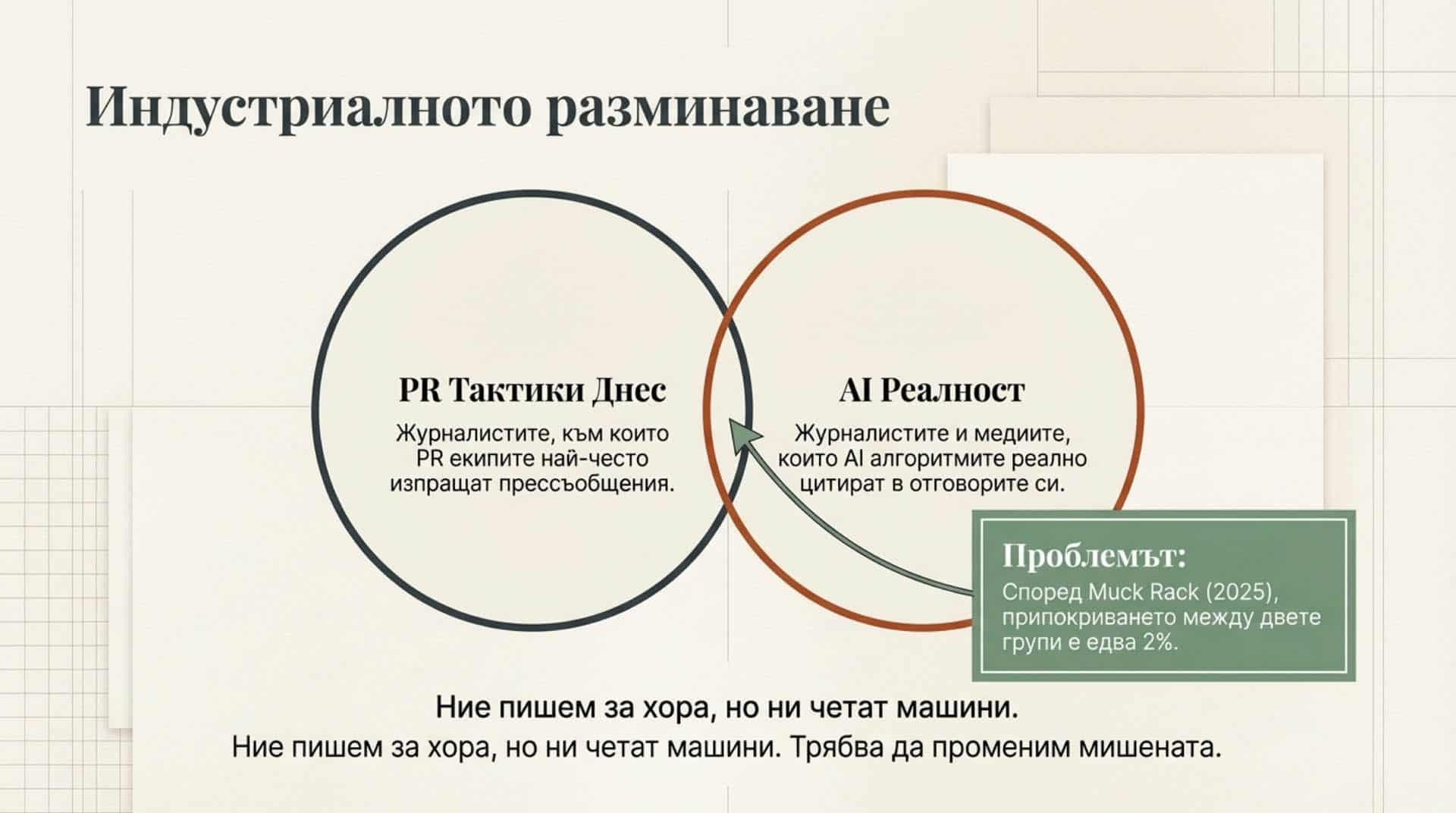
Гравитацията на цитираниятаИндустриалното разминаване
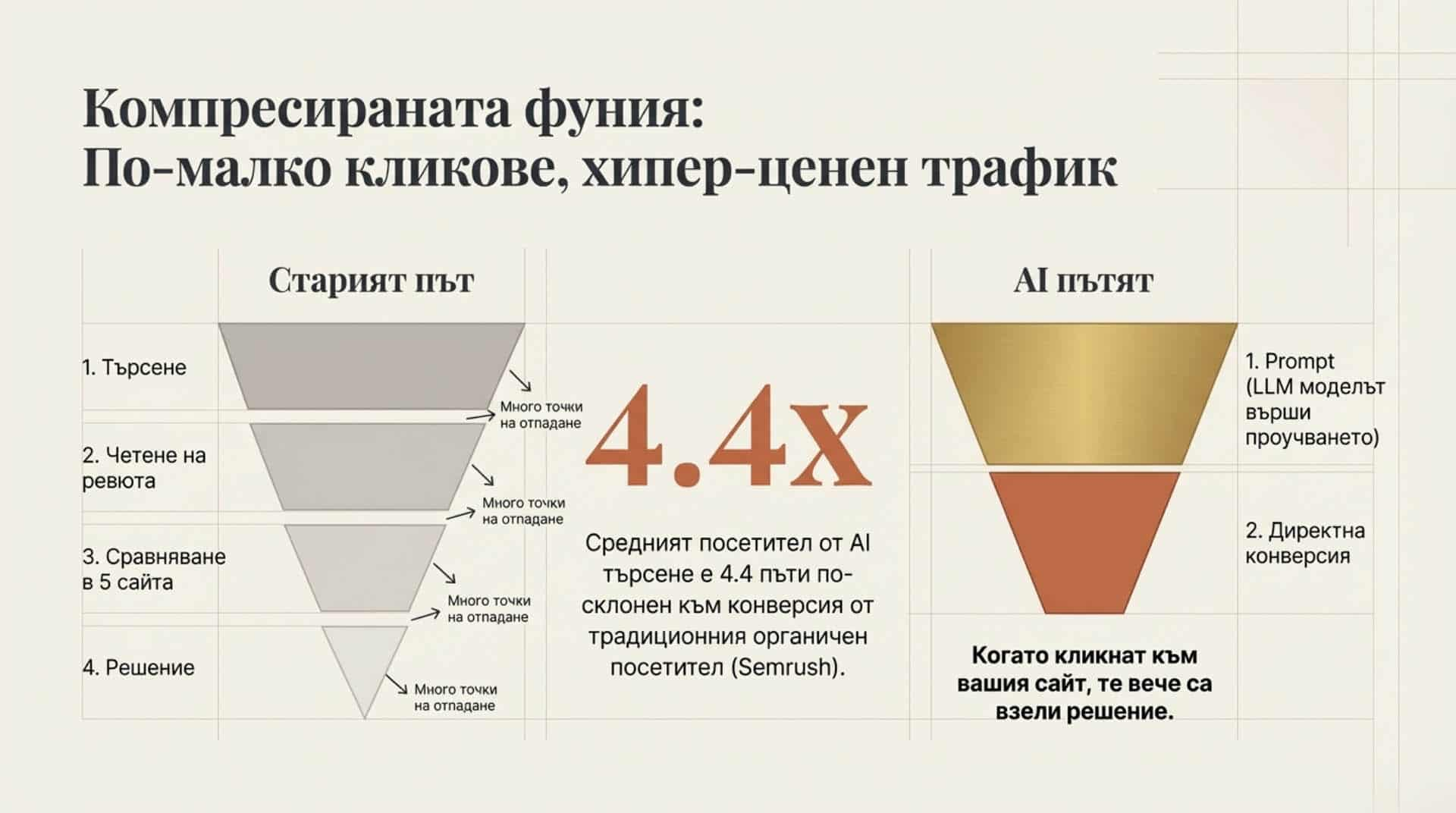
5. GEO променя потребителската фуния и качеството на трафика
При класическото търсене потребителят преминава през по-дълъг процес: търси, сравнява, отваря няколко сайта, чете ревюта и чак след това взема решение.
При AI търсенето голяма част от този процес вече се случва вътре в самия разговор. AI синтезира информацията, сравнява варианти и дава готов, по-контекстен отговор. Това прави потребителя много по-подготвен още преди да стигне до сайта.
Semrush публикува анализ, според който посетителите от AI търсене могат да конвертират значително по-добре, като в разглеждания набор от теми стойността достига 4.4 пъти по-висока конверсия спрямо традиционния органичен трафик. Това не означава, че числото е еднакво за всеки бизнес, но посоката е ясна: AI трафикът често е по-квалифициран.
Машинно-четимото съобщениеИмперативьт на актуалността
6. Защо силното SEO вече не е достатъчно
Много компании все още приемат, че ако сайтът им се класира добре в Google, автоматично ще присъства и в AI отговорите. Това вече не е сигурно.
AI системите не подбират източници по абсолютно същия модел, по който класическите търсачки класират резултатите. Те търсят съчетание от:
яснота;
авторитет;
цитируемост;
актуалност;
обективност;
доверие към източника.
Затова е напълно възможно сайт с отлично SEO да има слабо GEO присъствие, ако съдържанието му не е достатъчно ясно, авторитетно и удобно за извличане от AI.
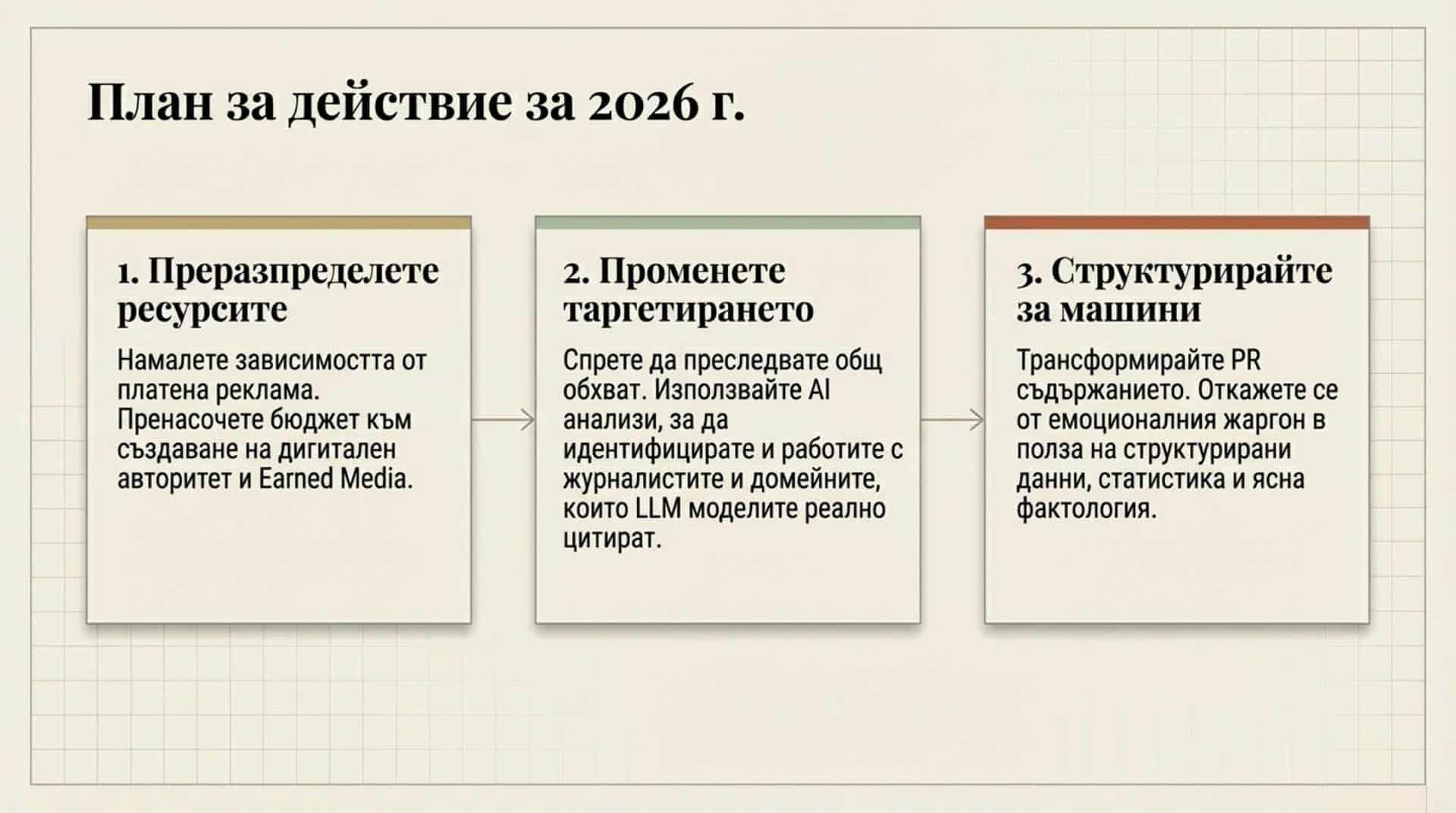
Финансовата прогноза: Бюджетите се пренареждат – SEO срещу GEO: каква е разликата и защо AI променя дигиталната видимостПлан за действие за 2026 г.
7. Как изглежда успешната стратегия днес
Най-силният подход вече не е SEO или GEO, а SEO + GEO + PR + експертно съдържание.
Това означава:
технически здрав сайт;
добре структурирани страници;
силна on-page оптимизация;
статии с ясно формулирани отговори;
експертни автори;
външни публикации и earned media;
актуално съдържание;
последователна бранд репутация.
Дигиталната видимост вече не се определя само от алгоритмите на търсачките, а и от това дали AI ще разпознае вашето съдържание като достатъчно надеждно, за да го използва като източник.
PR-ът вече не е просто инструмент за репутация. PR-ът е техническата инфраструктура на дигиталното откриване.
Заключение
SEO и GEO не са едно и също, макар че вече работят все по-тясно заедно. SEO остава основата за откриваемост, индексиране и органичен трафик. GEO добавя ново измерение: видимост в AI-генерирани отговори, където най-важни са не само позициите, а доверието, структурата, експертността и актуалността.
Бъдещето принадлежи на брандовете, които не оптимизират само за търсачки, а изграждат алгоритмично доверие. Именно това е голямата промяна, която GEO носи.