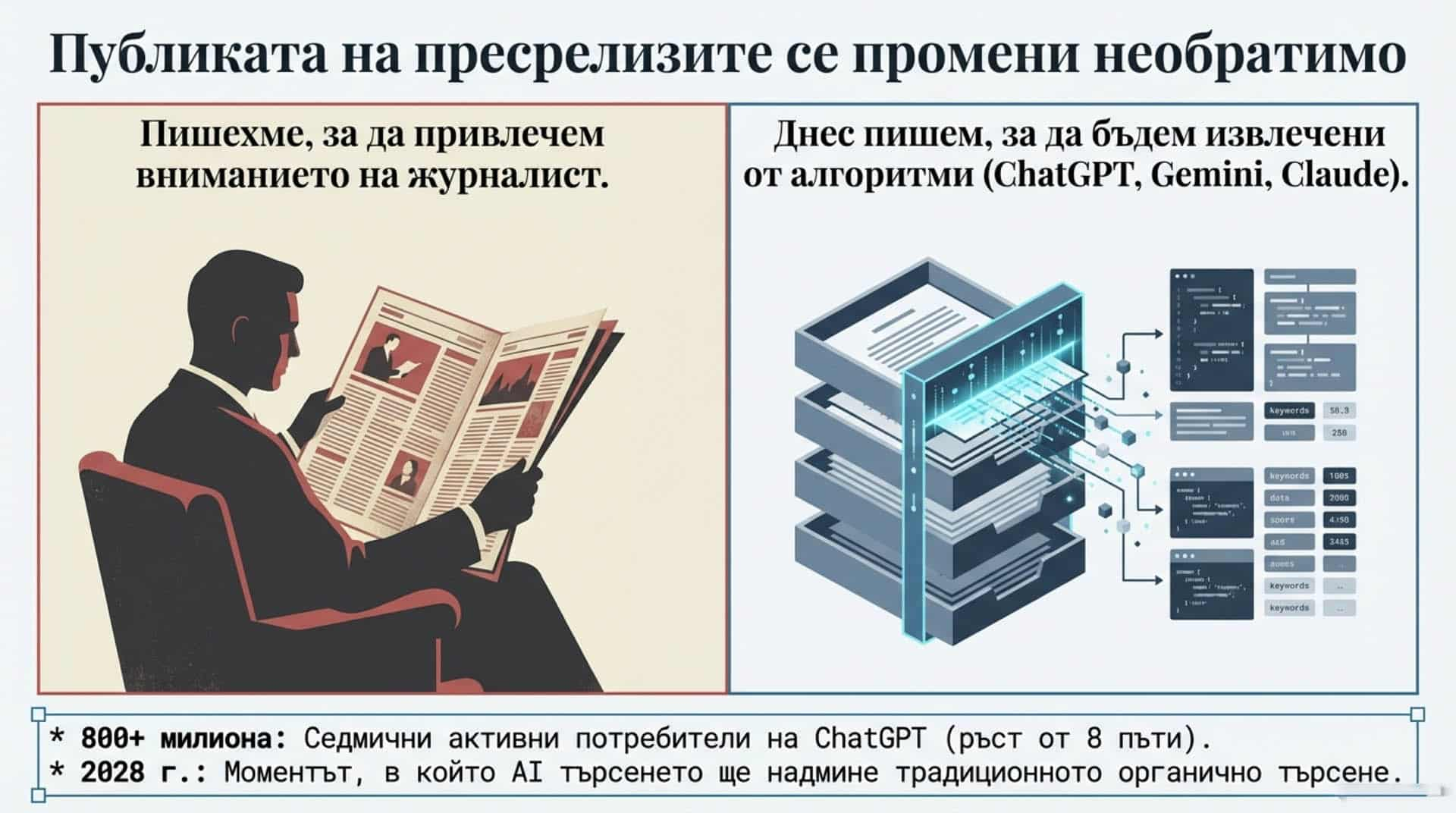
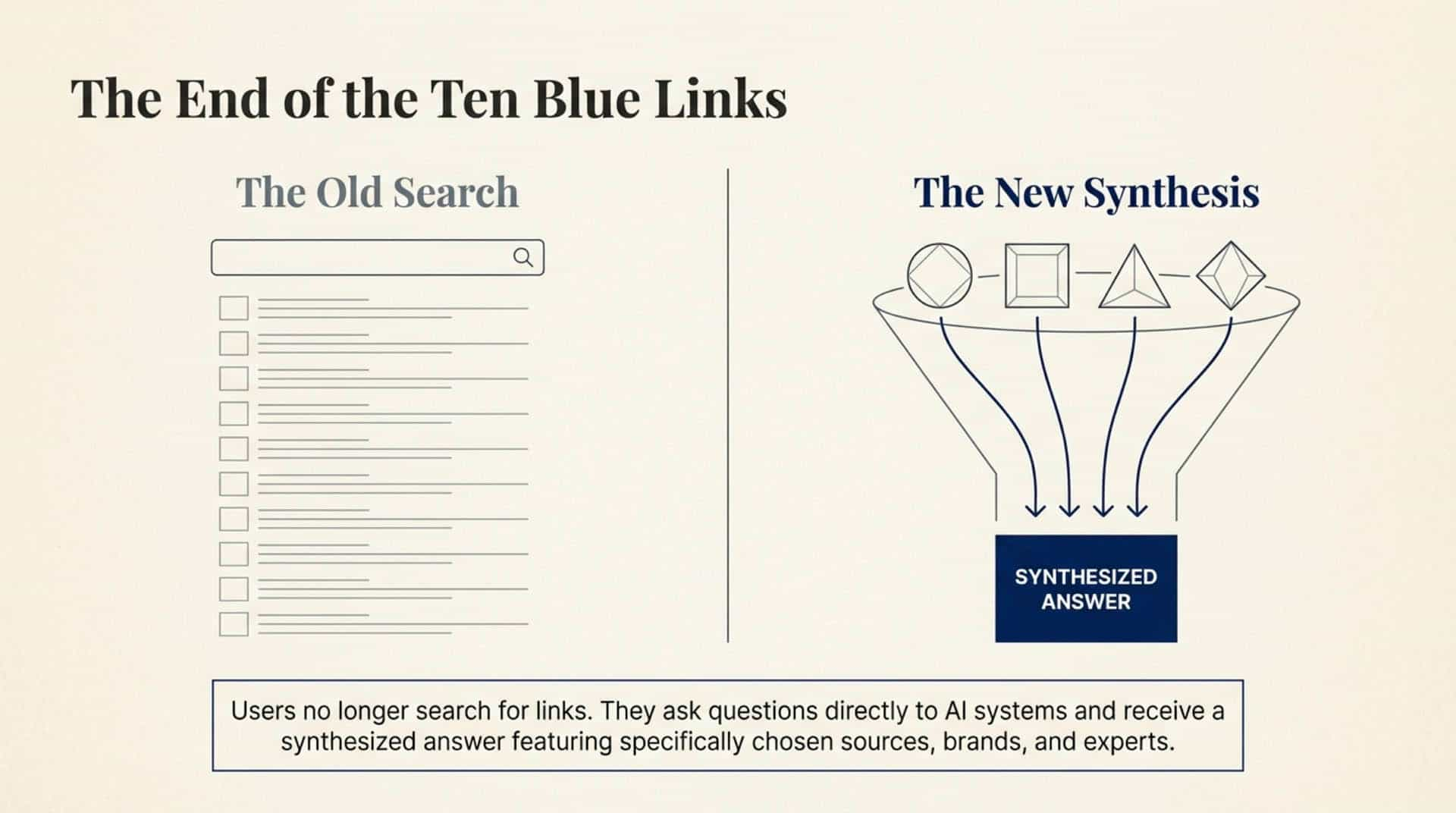
For a long time, digital visibility was measured mainly through rankings in Google. If a page ranked well, it had a strong chance of attracting traffic, trust, and business results. Today, however, user behavior is changing. More and more often, people are not simply searching for links — they are asking questions directly to AI systems such as ChatGPT, Gemini, Claude, and Perplexity. Instead of a list of results, they receive a synthesized answer in which specific sources, brands, publications, and experts are often included.
This changes the strategic question for businesses, PR teams, and marketers. It is no longer enough to simply be present online. It is becoming increasingly important to understand why AI systems choose some sources and ignore others.
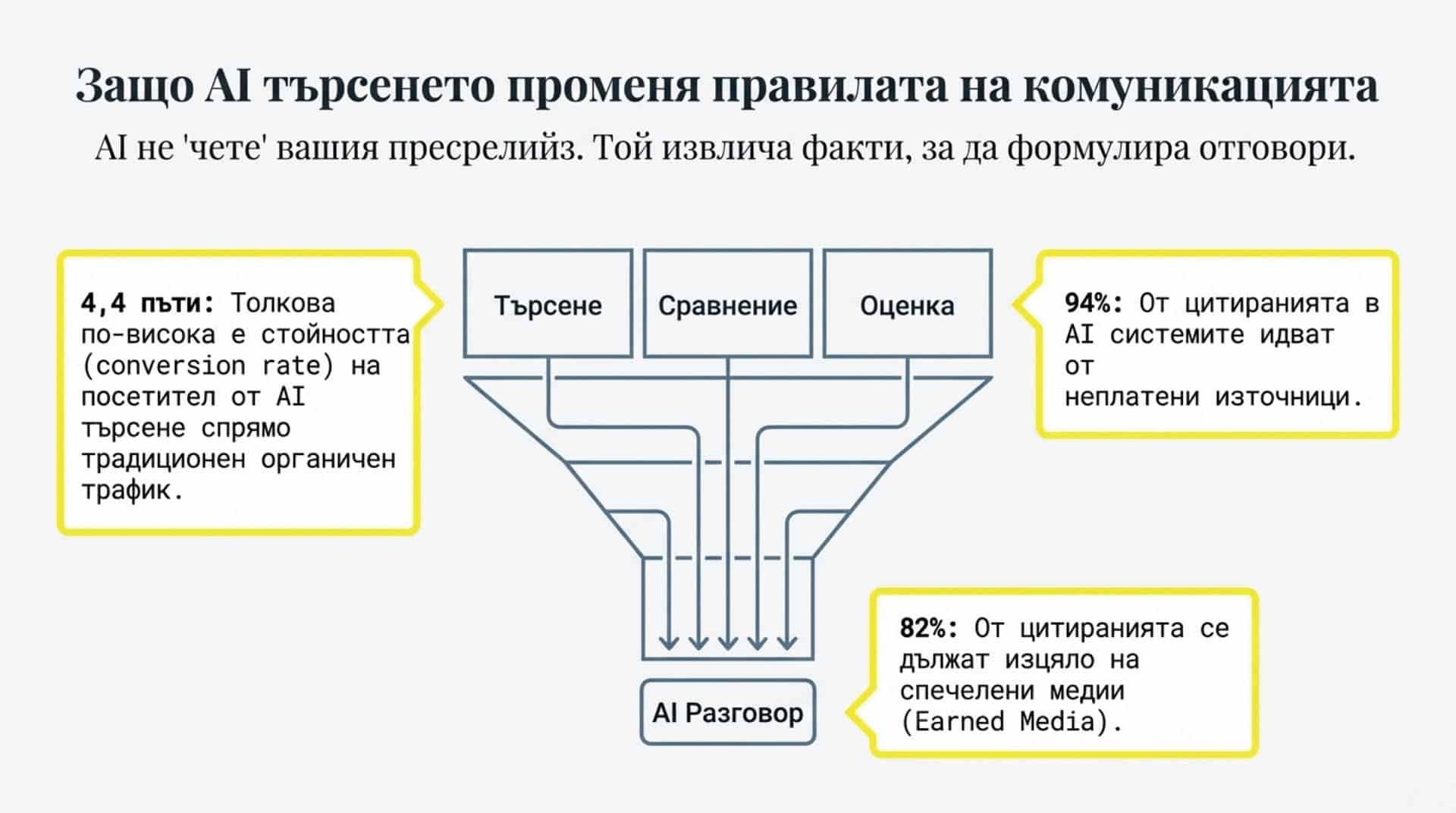
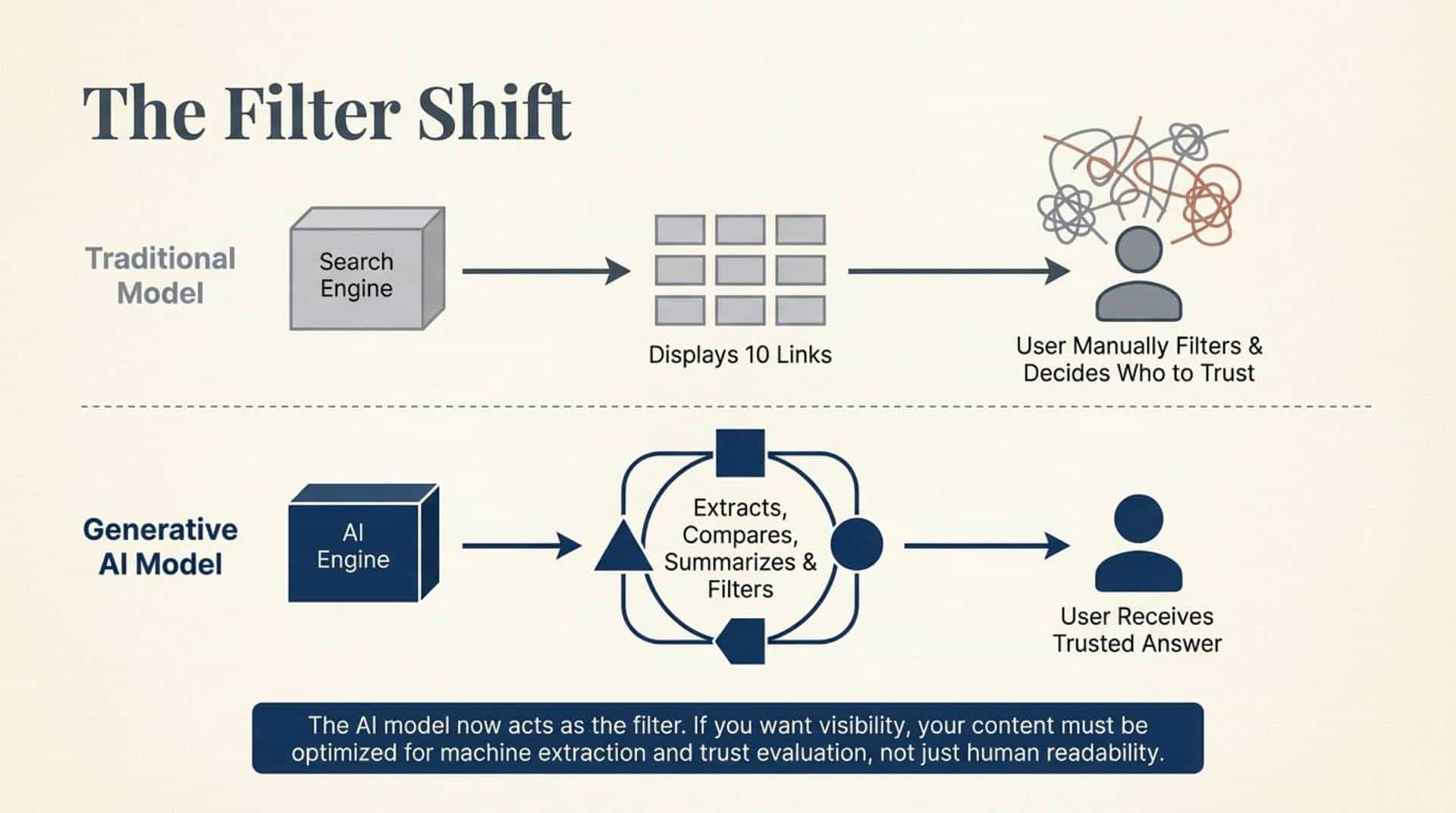
In the traditional search model, the search engine displayed a list of links and the user decided which source to trust. In generative systems, that filter shifts. The AI model extracts, compares, summarizes, and organizes information instead of the user doing it manually. This means that if you want your brand, publication, or expert opinion to be visible in this new environment, you need to think not only about SEO, but also about whether your content appears reliable, clear, and easy to cite.
From Links to Trusted Answers
Traditional search engines work by indexing, ranking, and displaying results. Generative AI systems have a different task. Their goal is not simply to show ten links, but to compose a useful and meaningful answer. To do that, they must determine which sources seem the most reliable, the clearest, and the most relevant to the question being asked.
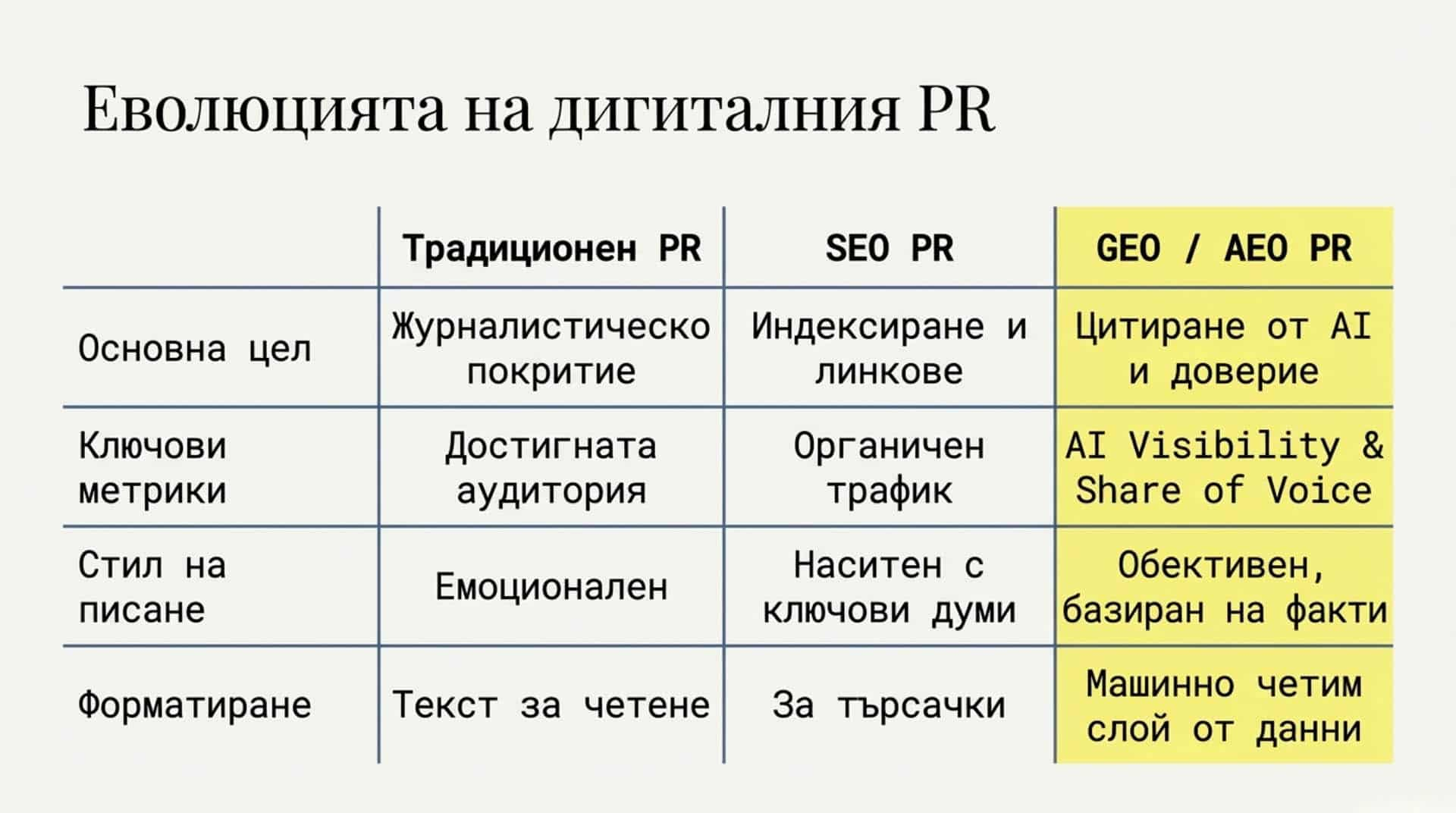
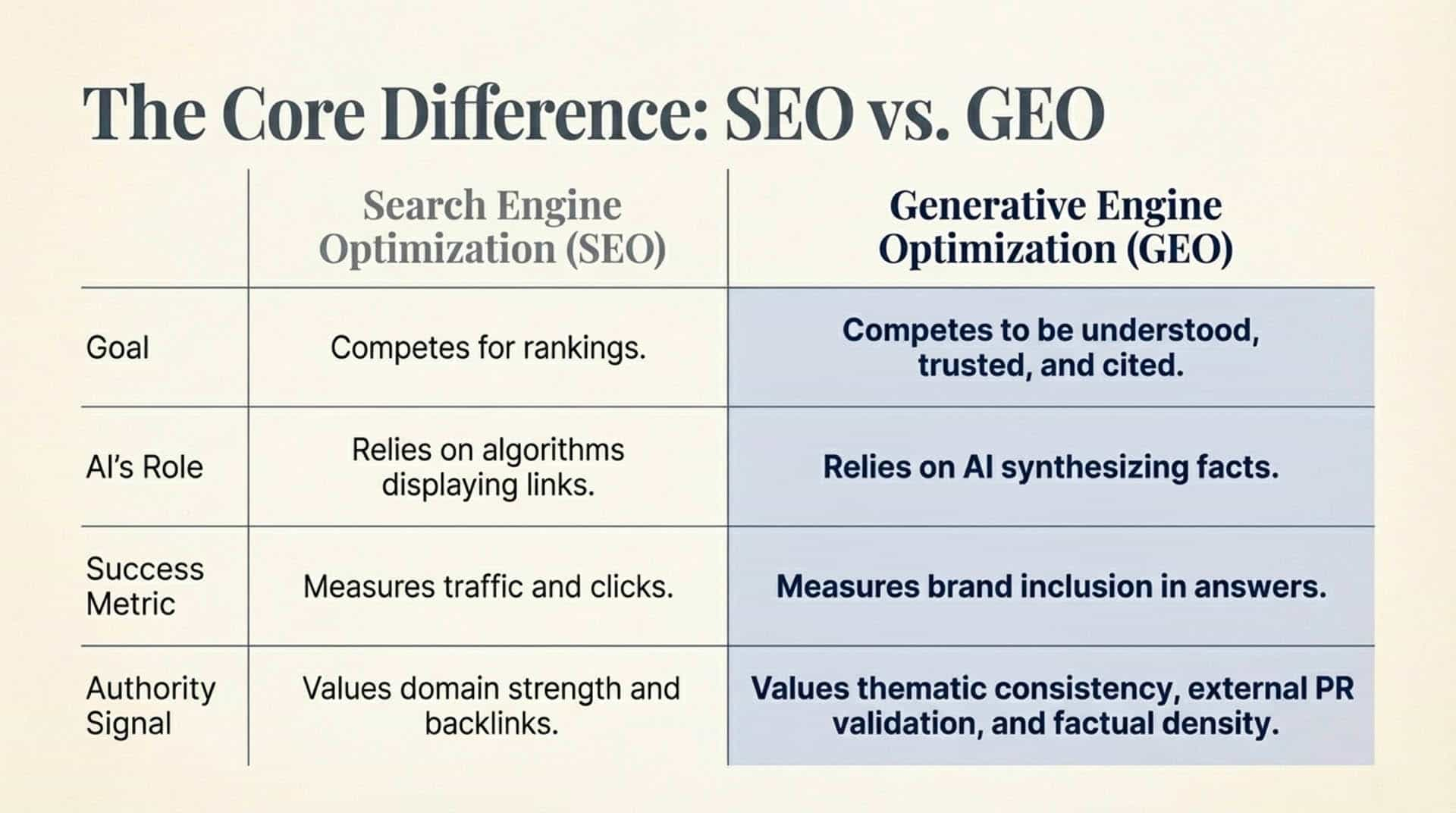
This is where the major difference between traditional SEO and GEO becomes visible. With SEO, you compete for better rankings. With GEO, you compete to have your content understood, trusted, and used directly in the answer itself.
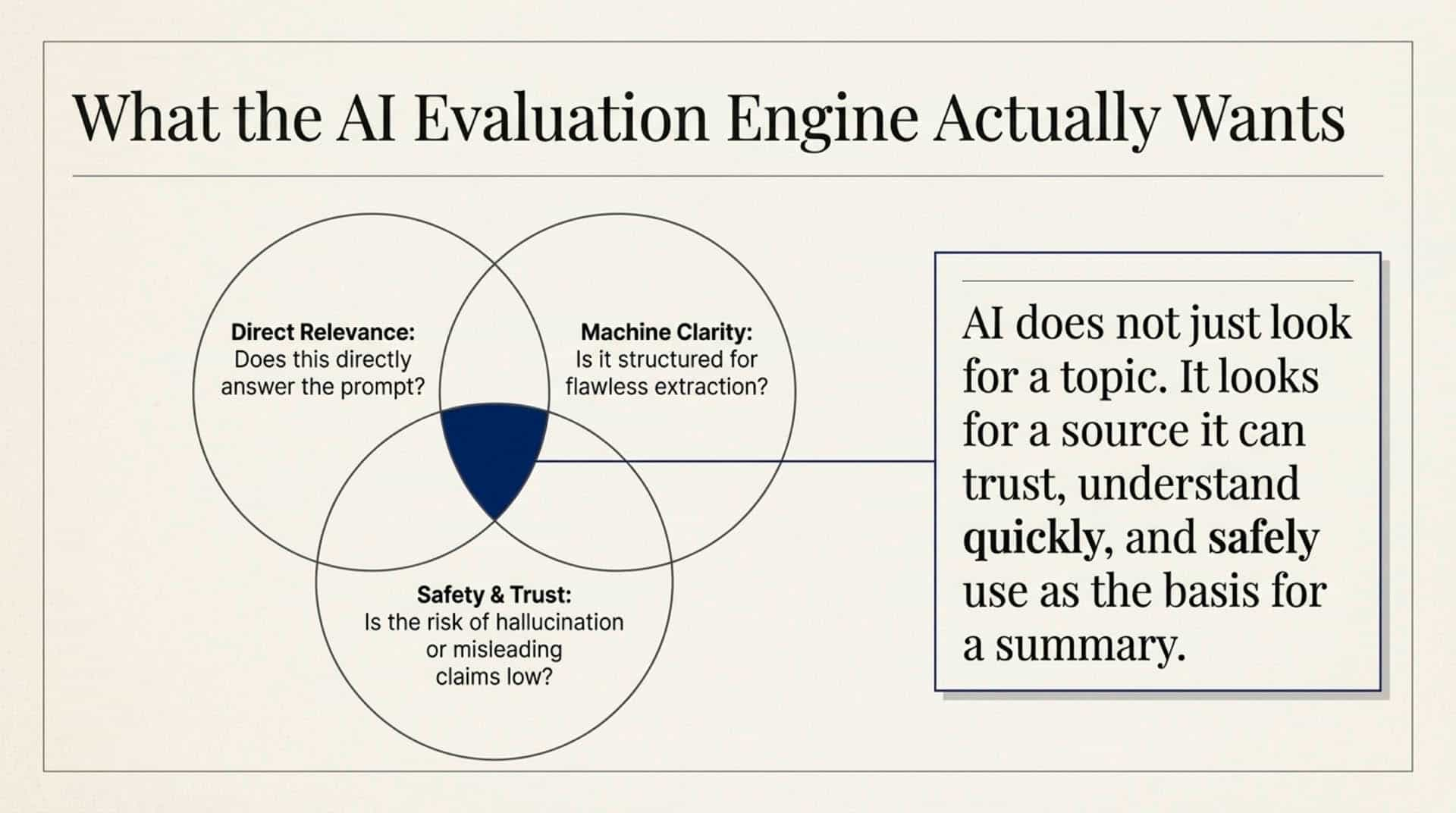
In other words, AI does not simply look for a page about a topic. It looks for a source it can trust, understand quickly, and safely use as the basis for a summary.
What AI Actually Looks for When “Choosing” a Source
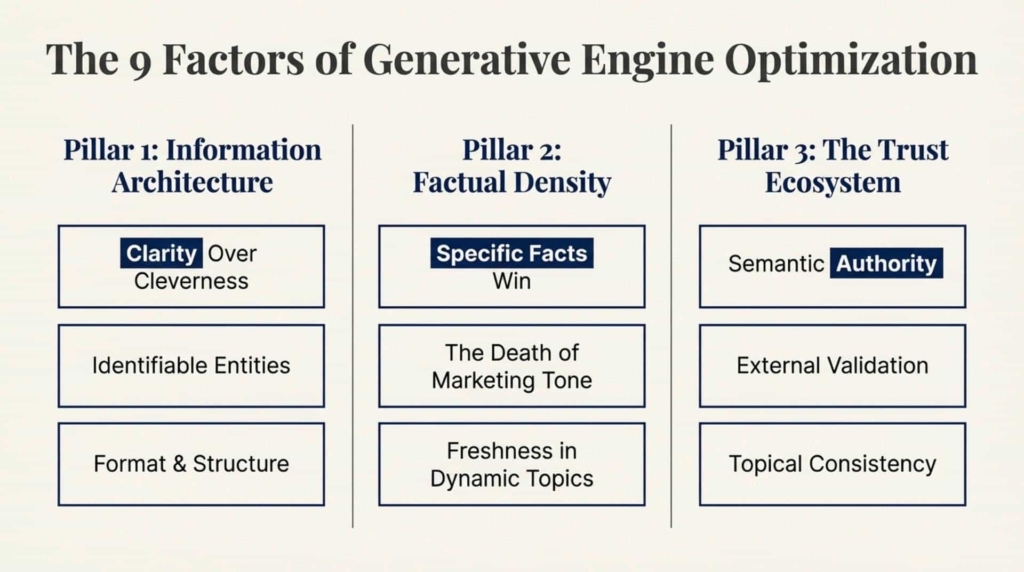
When an AI system formulates an answer, it is effectively trying to evaluate several things at once. First, whether a piece of content directly answers the question. Second, whether it is clear and well-structured enough to be extracted and summarized. Third, whether it appears trustworthy and consistent with other signals. And fourth, whether the risk of being misleading is low.
That is why, in an AI environment, it is not enough to simply have a page on the topic. What wins is content that is the easiest for machines to understand and the safest to cite.
1. Clarity Matters More Than Many Brands Realize
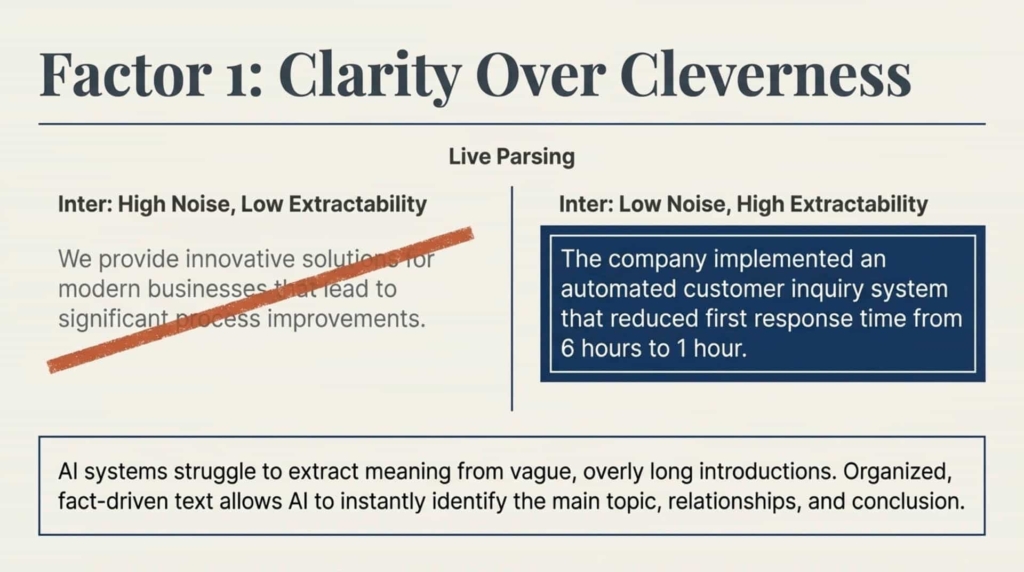
AI systems prefer content that is organized, clear, and free of unnecessary noise. Vague texts, overly long introductions, generic statements, and chaotic structure make understanding more difficult. And when AI cannot quickly determine what matters most, the chance of that source being used drops.
When a text is well organized, AI can more easily identify the main topic, the key claims, the facts, the relationships between them, and the conclusion.
Example:
Weak version:
“We provide innovative solutions for modern businesses that lead to significant process improvements.”
Stronger version:
“The company implemented an automated customer inquiry system that reduced first response time from 6 hours to 1 hour.”
The second version is clearer, more specific, and much easier to extract and cite.
This is one of the reasons many corporate websites may look good to a human reader but still function as relatively weak sources for AI. They often sound polished, yet fail to explain clearly what actually happened, who was involved, when it happened, and what the outcome was.
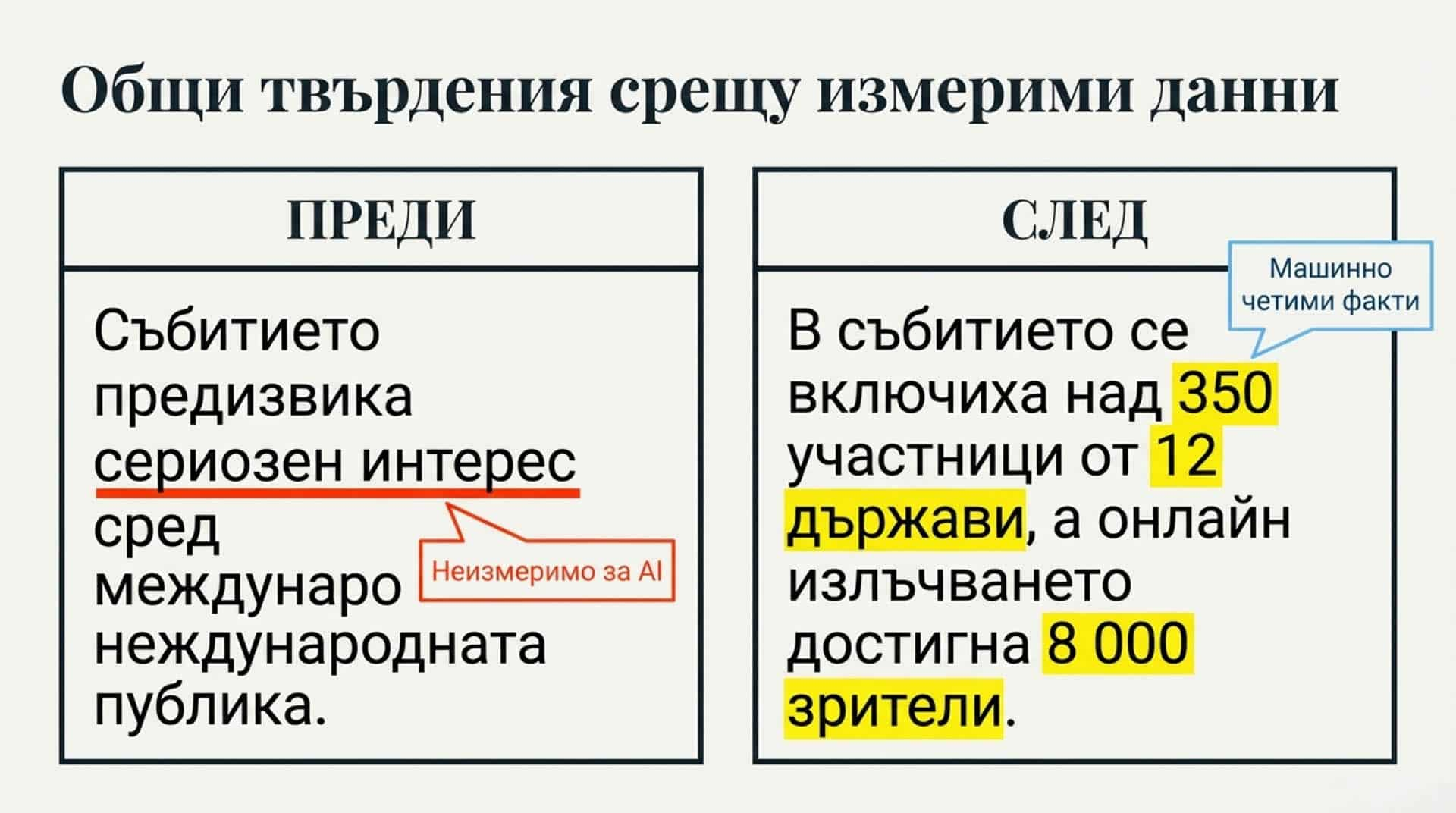
2. Specific Facts Win Over General Claims
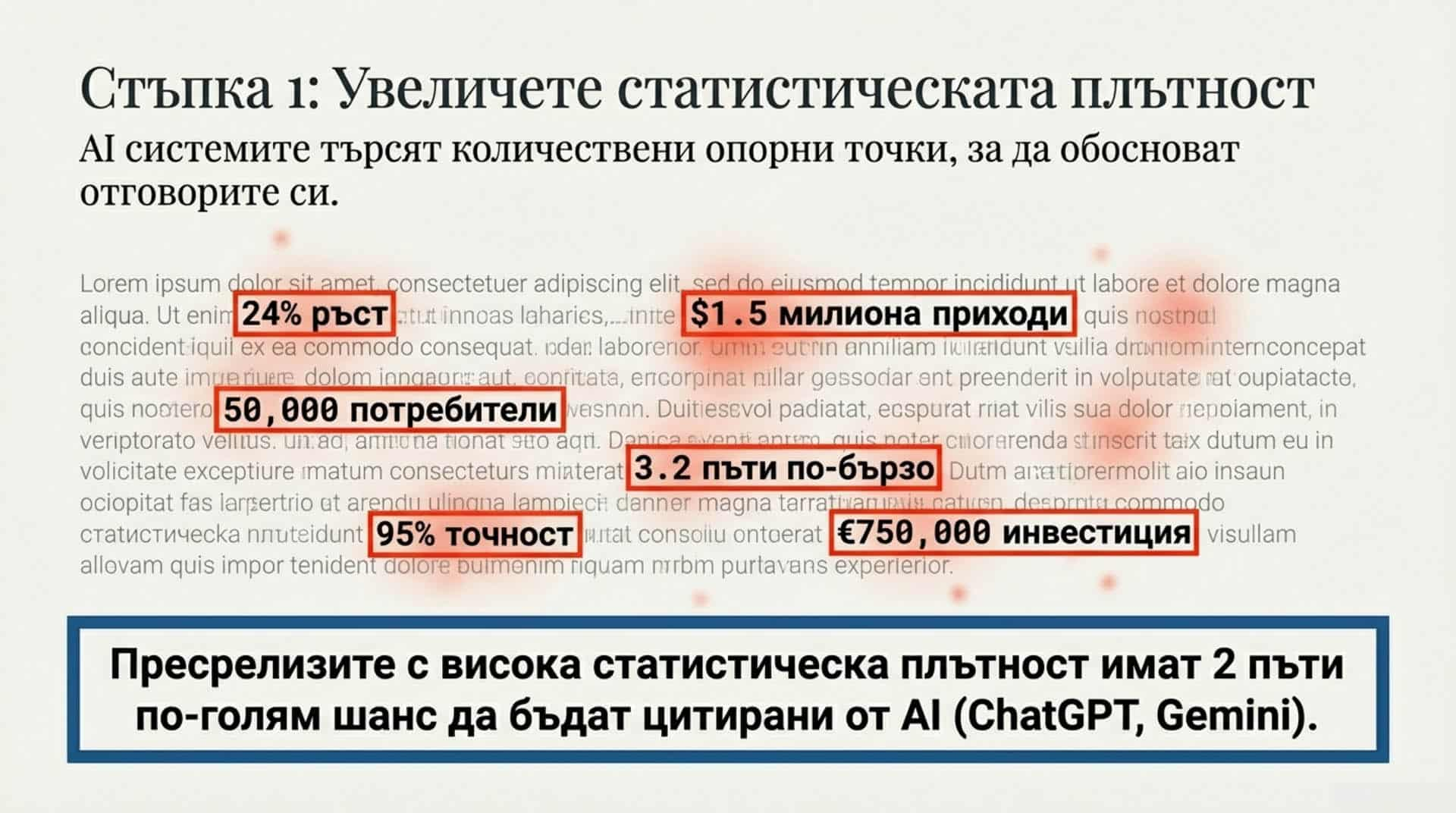
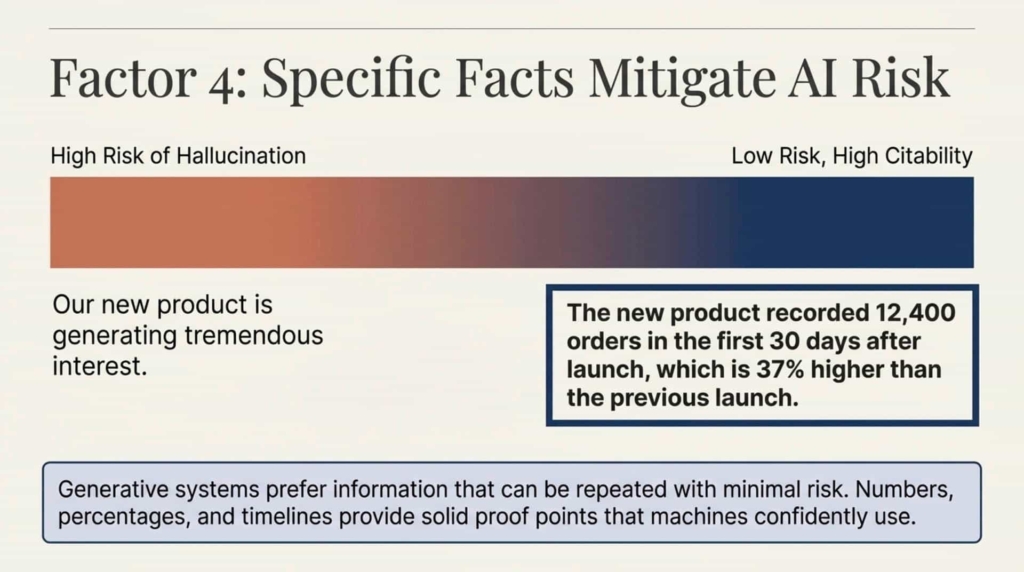
AI systems prefer information that can be repeated with minimal risk. That is why specificity is so valuable. Numbers, dates, names, percentages, results, and timelines provide solid anchors that machines can more easily use.
Example:
Marketing statement:
“Our new product is generating tremendous interest.”
Factual statement:
“The new product recorded 12,400 orders in the first 30 days after launch, which is 37% higher than the company’s previous product launch.”
In the second example, there is a concrete result, a time frame, and a comparison. That makes the text far stronger as a source.
The same applies to press releases, corporate news, interviews, and analytical articles. Phrases such as “strong interest,” “successful initiative,” “strong presence,” or “leading solution” may sound confident, but they do not provide enough value to AI systems unless they are supported by measurable information.
3. Authority Is No Longer Just an SEO Metric — It Is a Trust Signal
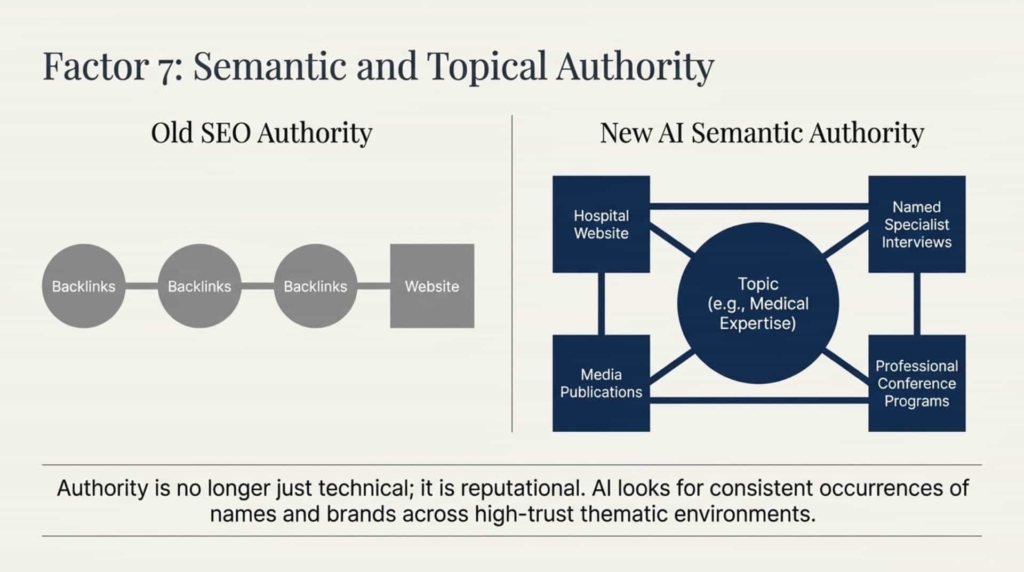
In traditional SEO, authority was often discussed in terms of domain strength, backlinks, and rankings. In AI environments, authority is interpreted more broadly. It is not only technical, but also reputational, topical, and semantic.
AI systems pay attention to whether a given brand, organization, or expert appears consistently within a topic. If multiple reliable sources point to the same names, institutions, or publications on a particular issue, the chance of those entities being used in an answer increases.
This means authority is built not only through onsite SEO, but also through:
- expert publications;
- media mentions;
- interviews;
- presence in topical environments;
- clear authorship;
- consistency around a subject.
Example:
If a medical topic is covered:
- on a hospital website;
- in an interview with a named specialist;
- in a media publication;
- in the program of a professional conference;
then AI is more likely to interpret that information as trustworthy.
The same topic, published only as an anonymous article in a corporate blog without an author, date, or external confirmation, sends a much weaker signal.
4. External Validation Is Critical
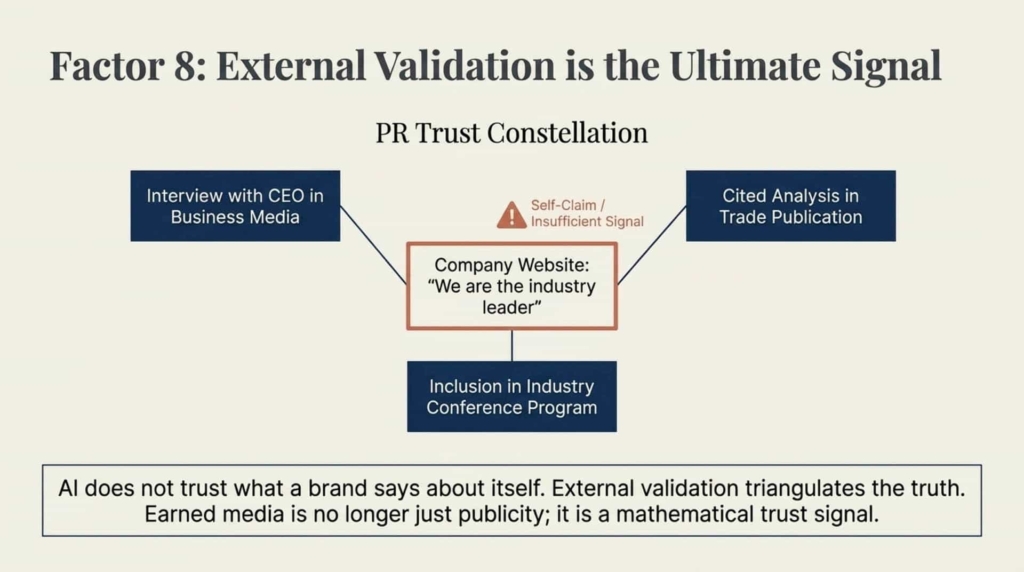
One of the most important ideas in GEO is that AI systems do not fully trust what a brand says about itself. If a company describes itself as a leader, innovator, or key market player, that alone is not enough. A much stronger signal appears when that role is confirmed externally.
AI prefers information that is consistent across multiple sources. This can include a media article, an interview, a professional analysis, conference participation, expert commentary, or another independent context.
Example:
Weak scenario:
A company publishes on its own website:
“We are the leader in industrial investment in the region.”
Stronger scenario:
The company:
- publishes its own analysis;
- has an interview with its CEO in a business publication;
- appears in a conference program;
- is cited in a local or specialized media outlet.
In that case, AI does not see only self-promotion. It sees a thematic footprint and external validation. That makes the brand more credible as a source.
This is where PR becomes especially important. Earned media, expert participation, and visibility beyond your own website are no longer just a matter of publicity. They become trust signals that help AI recognize your brand more reliably.
5. Clearly Identifiable Entities Have an Advantage
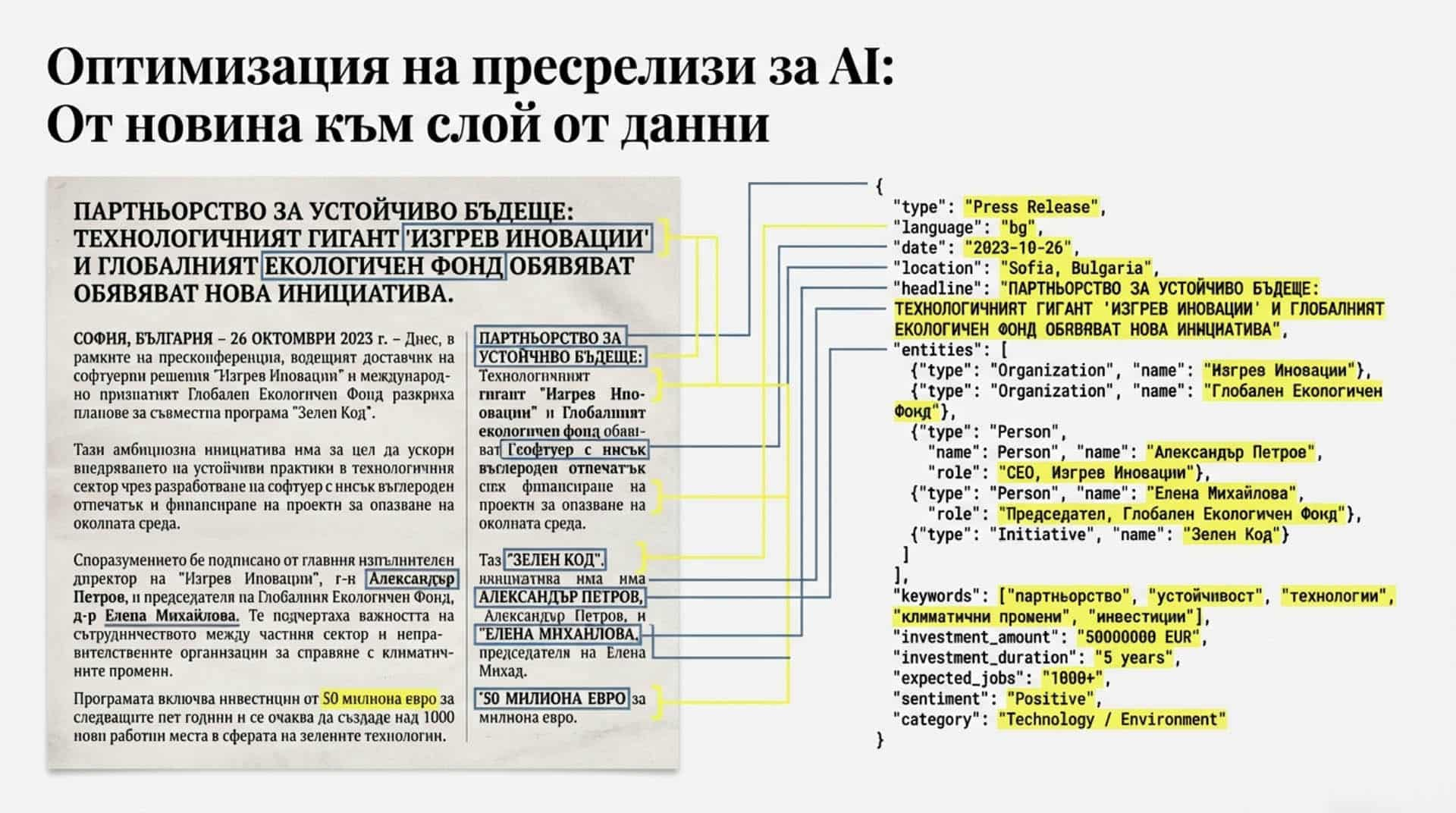
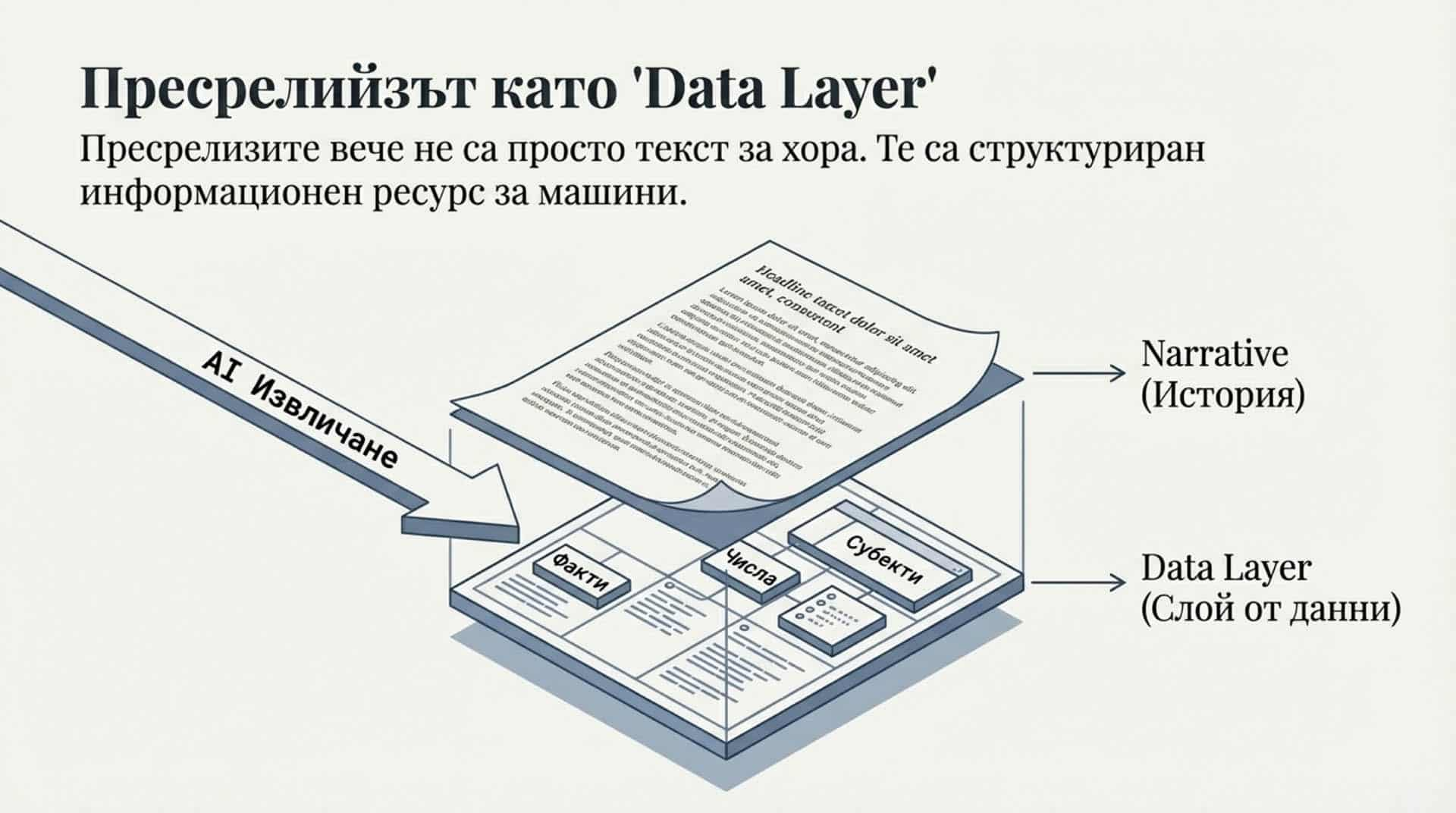
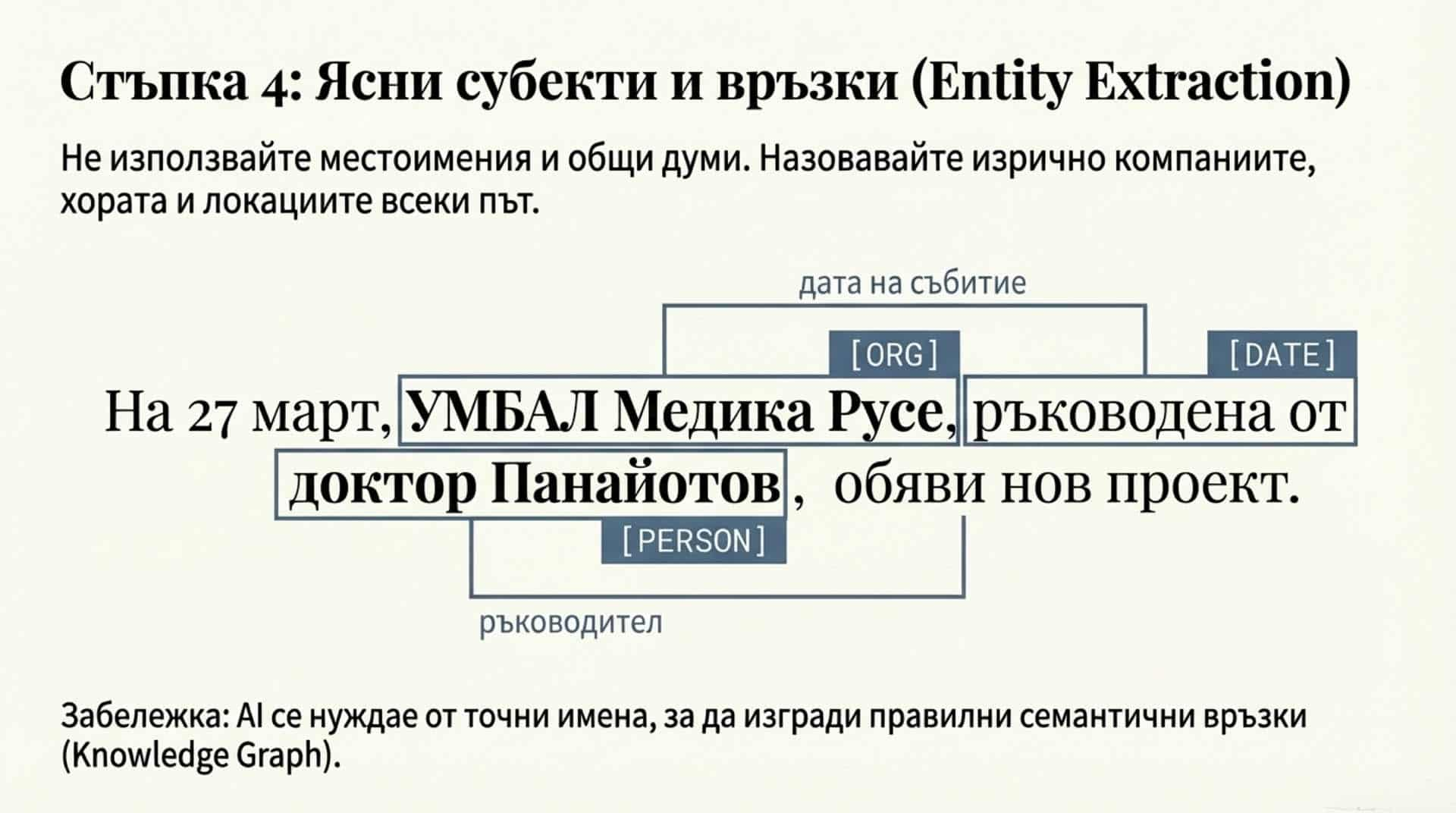
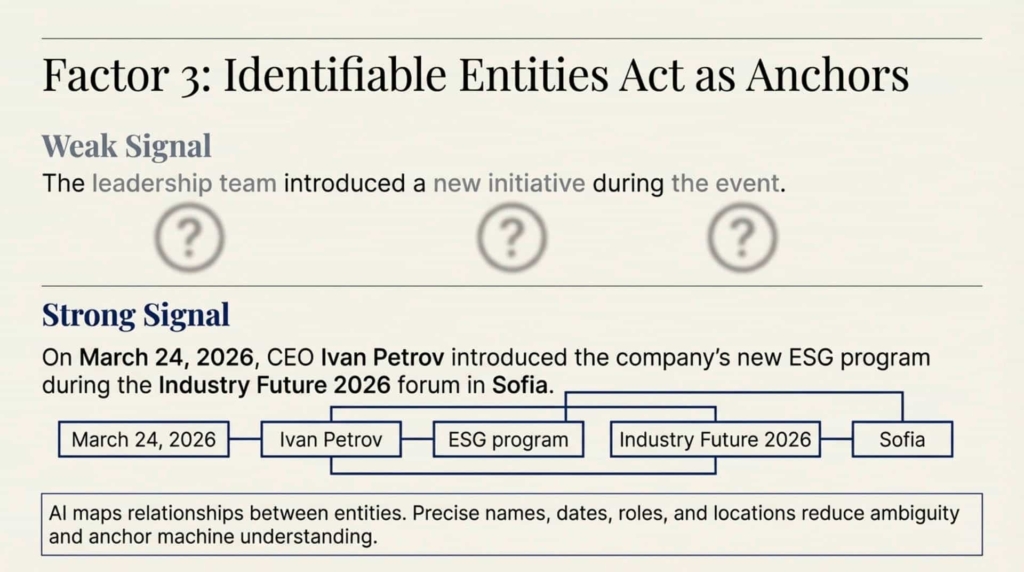
AI works with entities and the relationships between them: companies, individuals, institutions, products, events, dates, and locations. The more clearly and consistently these elements are named, the easier it is for the system to understand the content.
That is why strong sources almost always use precise names, specific roles, and clear context.
Example:
Unclear:
“The leadership team introduced a new initiative during the event.”
Clear:
“On March 24, 2026, CEO Ivan Petrov introduced the company’s new ESG program during the Industry Future 2026 forum in Sofia.”
The second version includes a name, role, date, topic, and location. That is far more valuable to AI systems because it helps them connect the right entities and reduce ambiguity.
The same applies to press releases. Terms such as “the company,” “the team,” “the event,” or “the new solution” are acceptable only if it is already absolutely clear who or what they refer to. Otherwise, they make machine understanding more difficult.
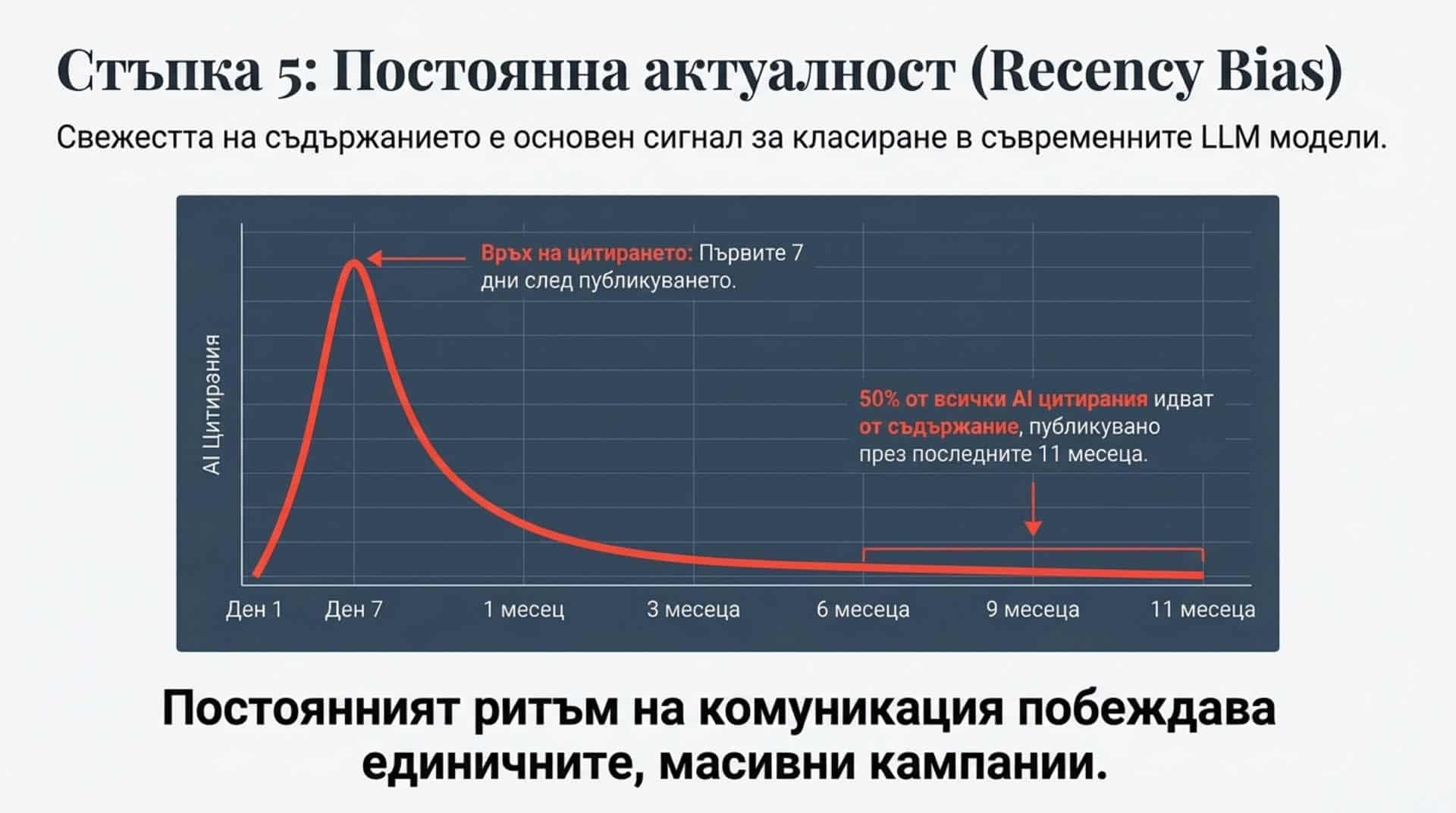
6. Freshness Matters, Especially in Dynamic Topics
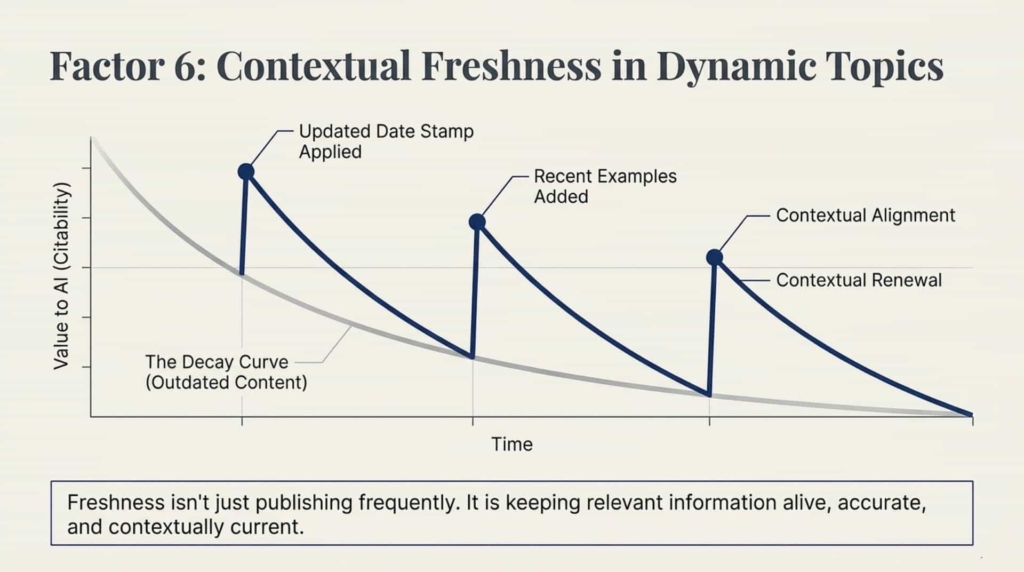
In areas such as technology, healthcare, regulation, markets, products, appointments, and events, freshness is often critical. AI systems are especially cautious when there is a risk that information may be outdated.
That is why sources that are current, updated, and timely often have an advantage over older, neglected pages.
Example:
If you have an article on “AI regulation in the EU” that was published once a year ago and never updated, its value will gradually decline.
But if that same page:
- includes a clear updated date;
- reflects the latest developments;
- adds new examples;
- clarifies the context;
then the chance of it being used in an AI response is significantly higher.
Freshness does not simply mean publishing often. It also means keeping relevant information alive, accurate, and contextually current.
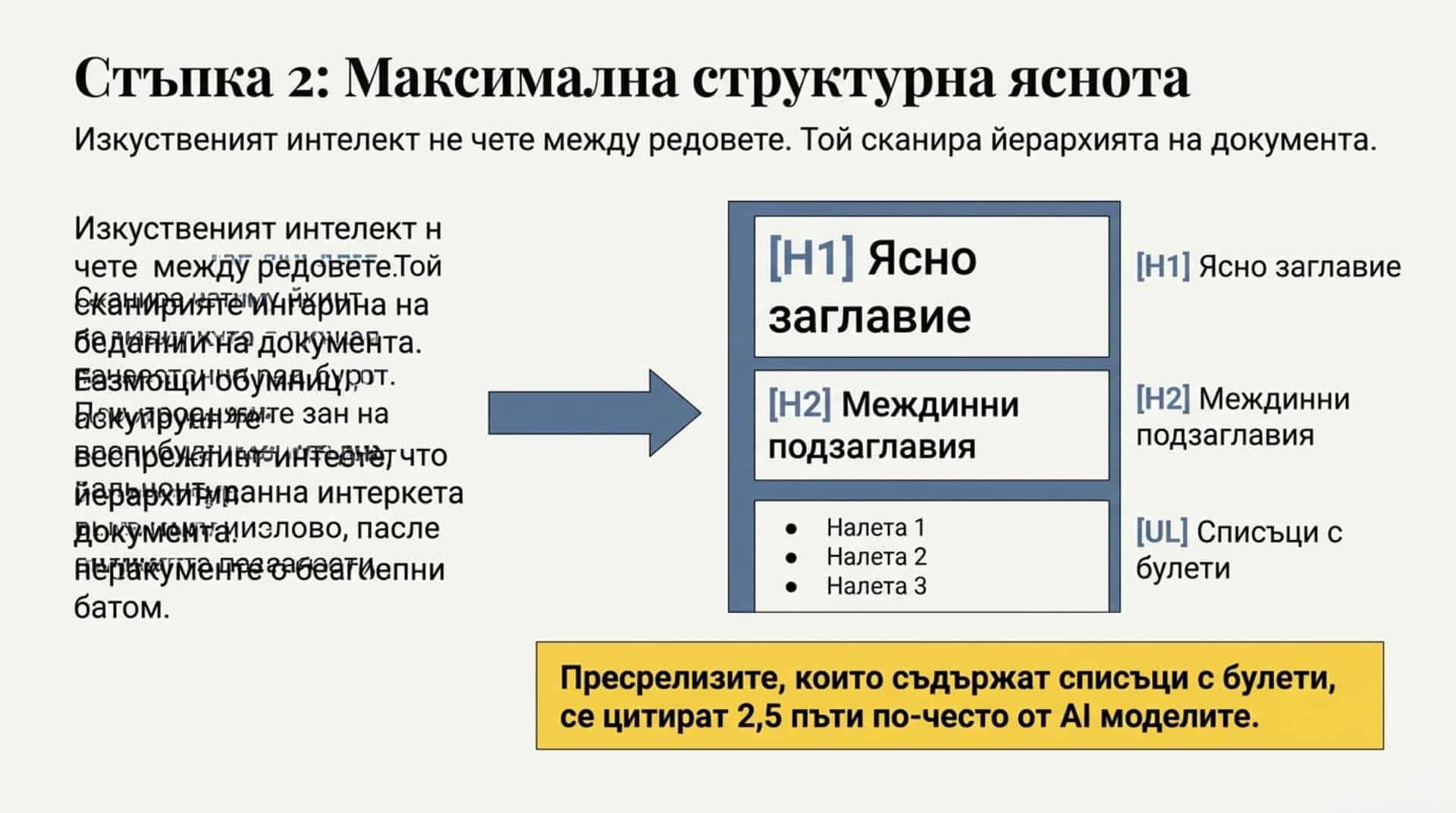
7. Format and Structure Often Determine Whether a Text Is “Citable”
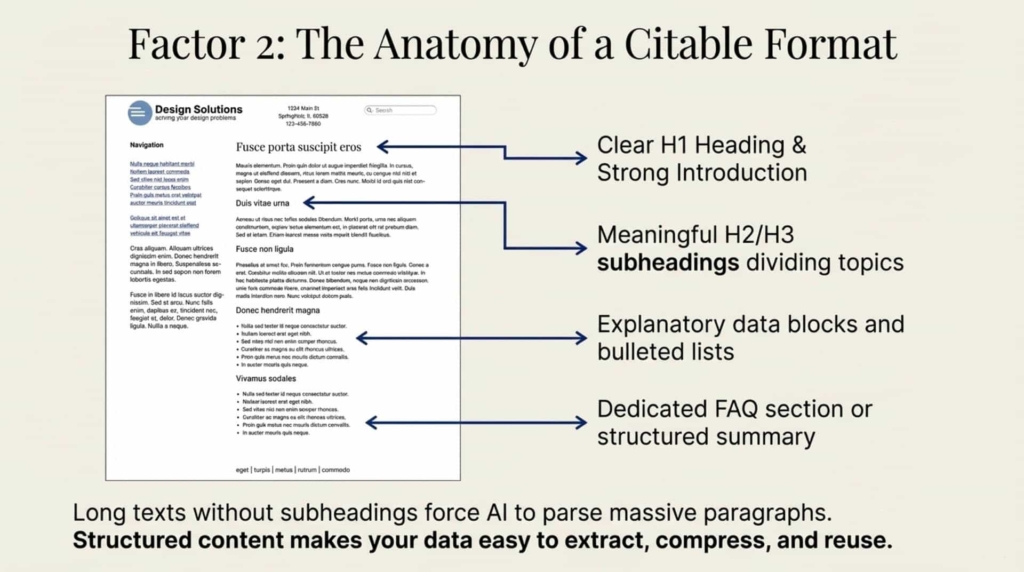
Some texts are rich in information but difficult to extract from. Others are shorter, but structured in a way that allows AI to quickly understand what matters most. Very often, this makes the second type more powerful.
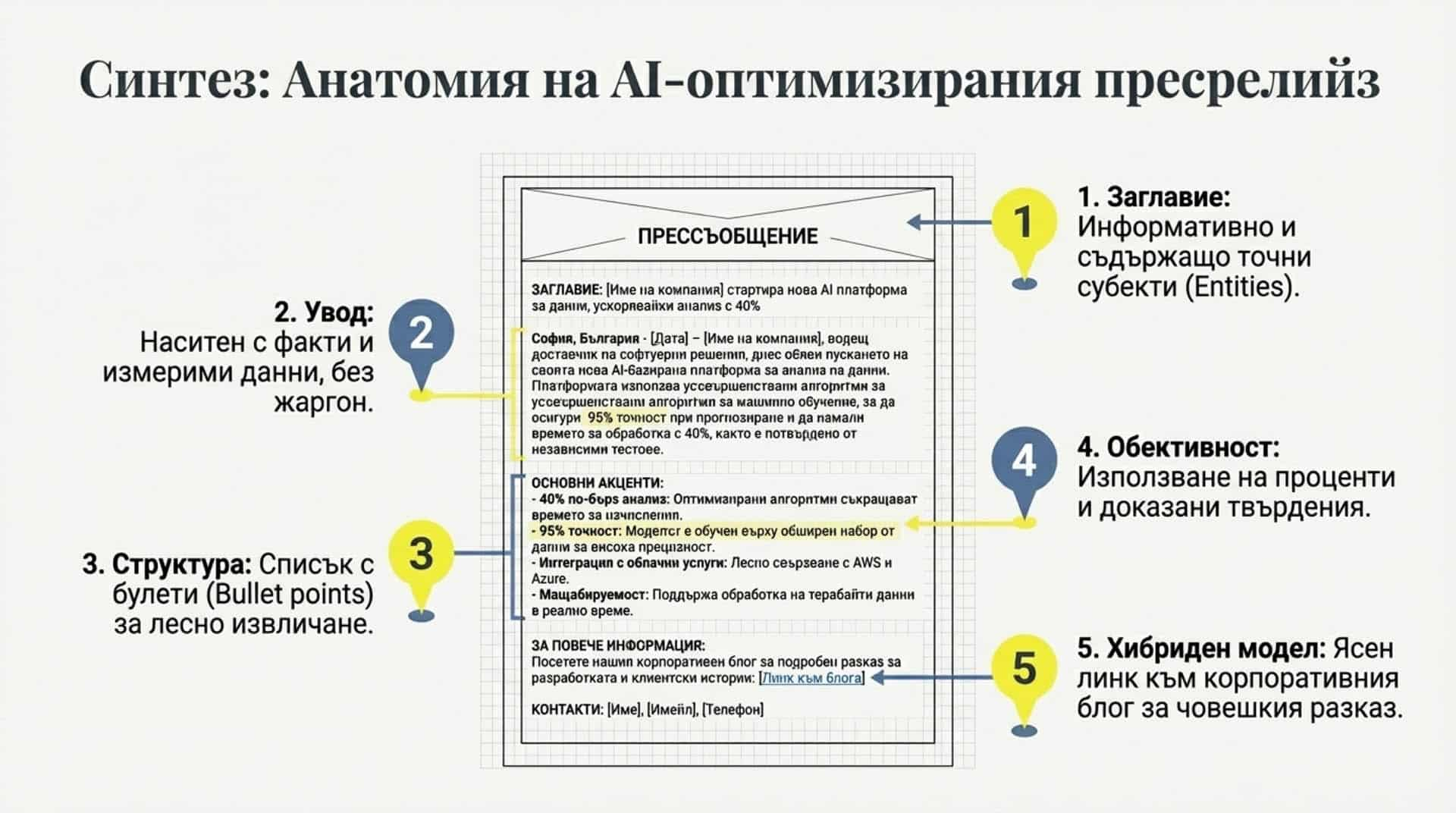
Citable content usually includes:
- a clear H1 heading;
- a strong introduction;
- meaningful H2 and H3 subheadings;
- logical topic separation;
- short explanatory blocks;
- lists where useful;
- examples;
- a FAQ section or summary.
Example:
An article structured like this:
- What GEO is
- How AI chooses sources
- What the main trust signals are
- Examples of good and bad practices
- FAQ
is far more suitable for AI than a long text without subheadings, where all ideas are merged into a few massive paragraphs.
This is not just an editorial preference. It is a way to make your content easier for machines to extract, compress, and reuse in an answer.
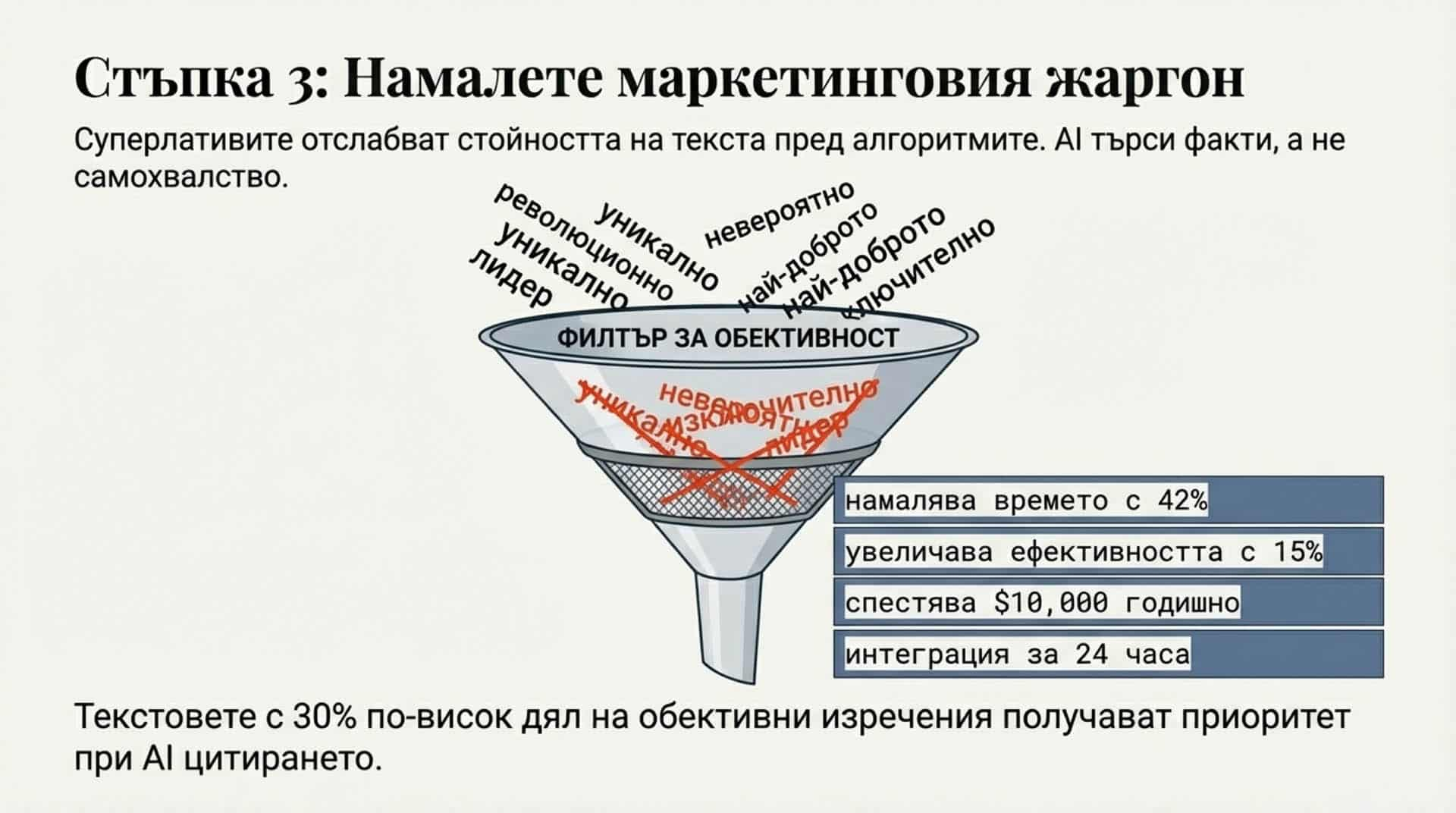
8. Excessive Marketing Tone Reduces Trust
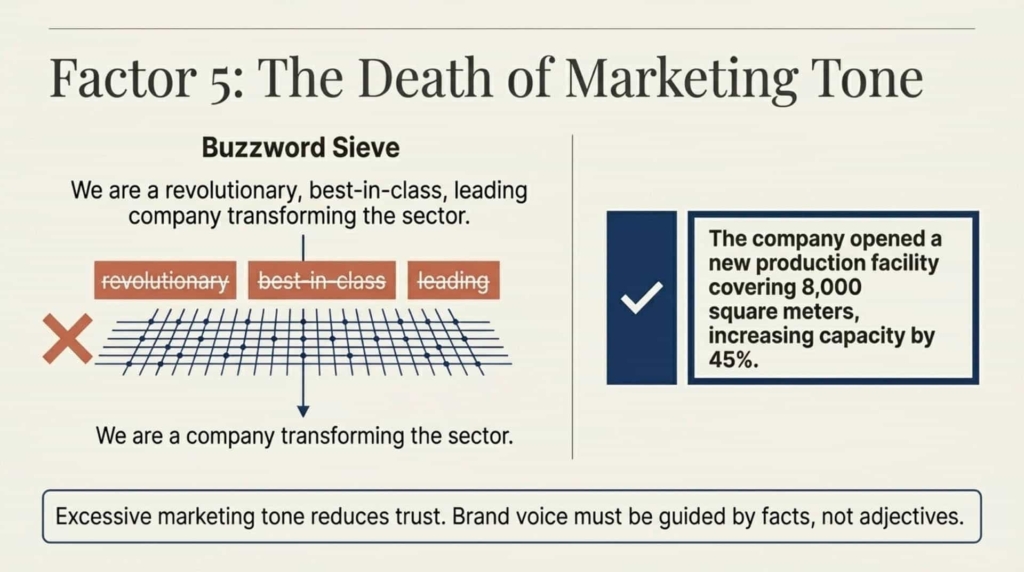
Many corporate texts lose value for AI because they sound more like advertising than information. Generative systems are not simply looking for “impressive” content. They are looking for content that appears reliable enough to be used with minimal risk.
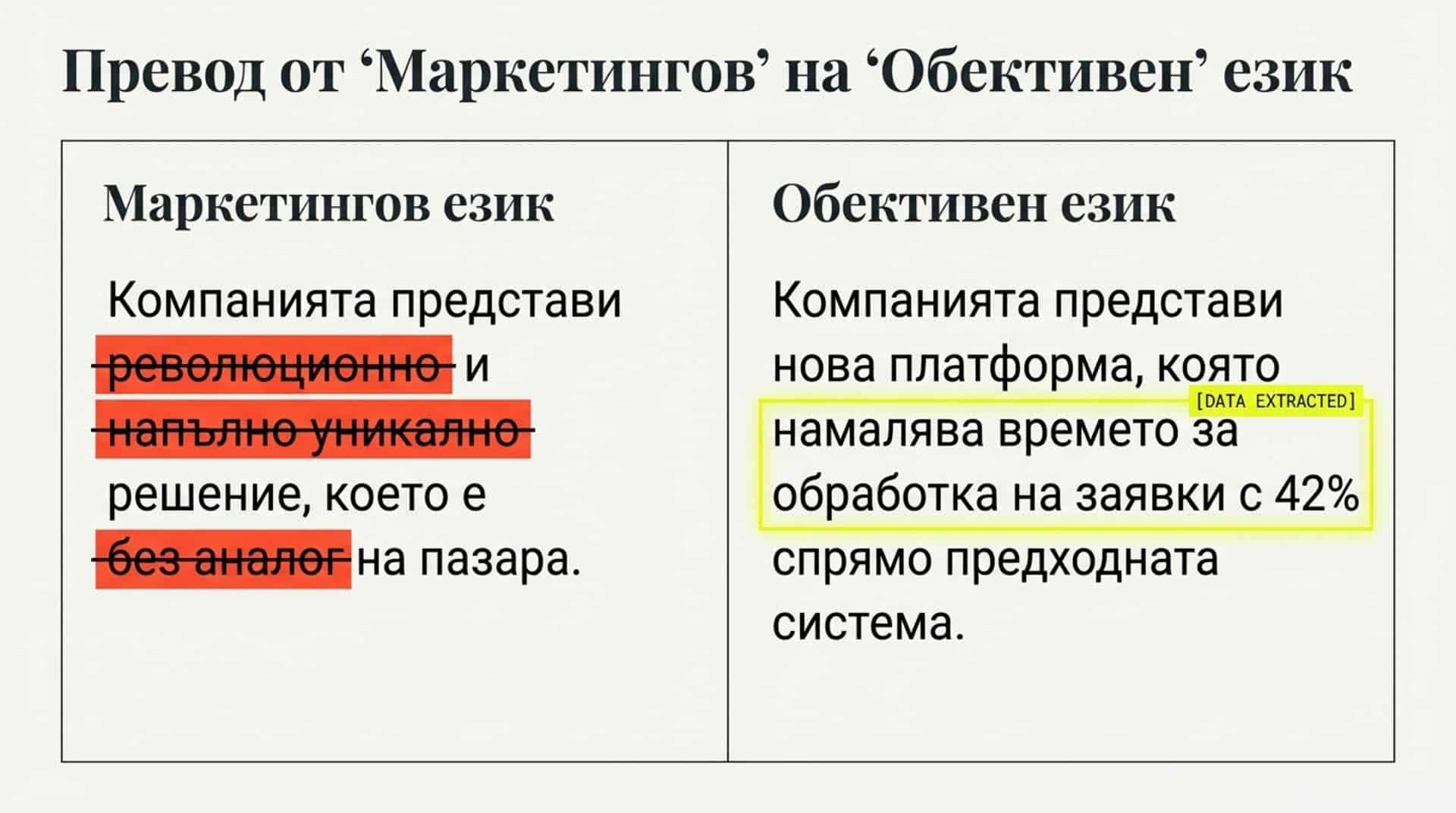
When a text is filled with phrases such as “leading,” “revolutionary,” “unmatched,” “without competition,” or “best-in-class,” without supporting evidence, it often becomes a weaker source.
Example:
Weak version:
“We are a leading, innovative, and revolutionary company transforming the future of the sector.”
Stronger version:
“The company opened a new production facility covering 8,000 square meters, where 120 people will work and which will increase capacity by 45%.”
The second sentence may sound less “promotional,” but it is much stronger because it provides real value and carries less ambiguity.
This does not mean brand voice should disappear. It means it should be guided by facts instead of replacing them.
9. Topical Consistency Is Stronger Than a Single “Hit”
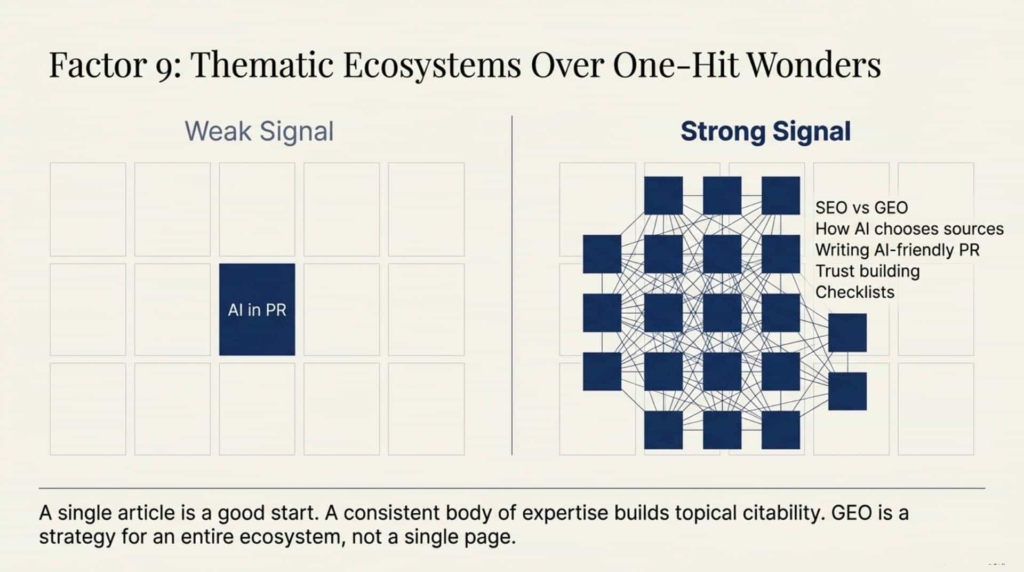
One strong article can be useful. But for AI systems, a stronger signal appears when a brand publishes consistently on a topic. That shows the topic is not being addressed randomly, but is part of a real thematic presence.
If a website regularly publishes analyses, commentary, FAQs, guides, press releases, and expert viewpoints along the same line, it gradually builds topical authority. That increases the chance that AI will treat it as a reliable source.
Example:
If a company has only one article about “AI in PR,” that is a good start.
But if it has an entire series such as:
- SEO vs GEO;
- how AI systems choose sources;
- how to write AI-friendly press releases;
- how trust is built through PR;
- a GEO checklist for content teams;
then AI sees not a single isolated article, but a consistent body of expertise.
This is exactly why GEO is not a tactic for one page. It is a strategy for building a thematic ecosystem.
A Quick Example from Practice
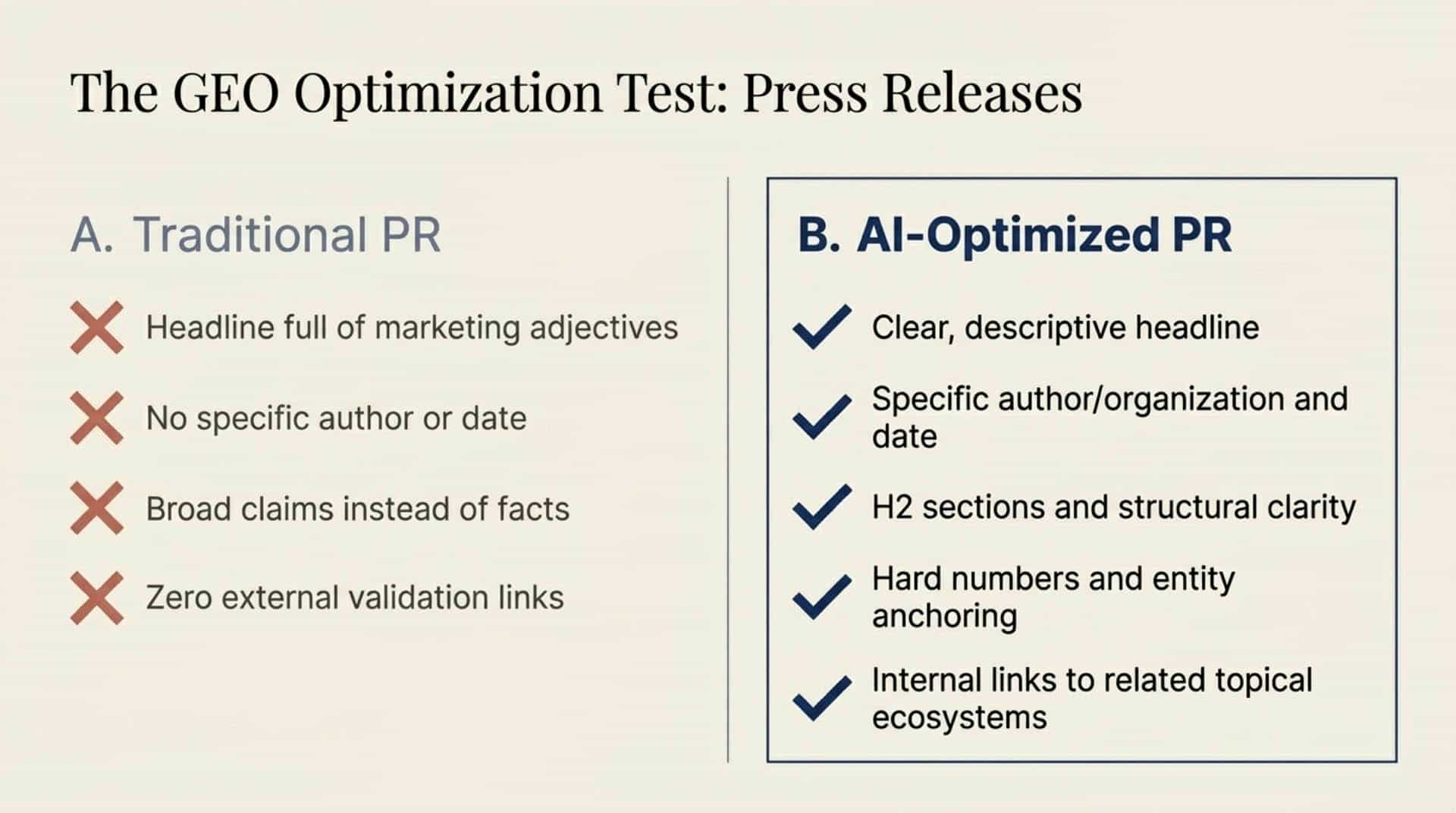
Let us take the topic “How to optimize a press release for AI systems.”
Version A: weak signal
- headline full of marketing language;
- no author;
- no date;
- no examples;
- no numbers;
- no external validation;
- broad claims instead of facts.
Version B: strong signal
- clear and descriptive headline;
- specific author or organization;
- publication date;
- clear H2 sections;
- “weak vs strong” examples;
- practical guidance;
- internal links to related topics;
- logical connection between PR, trust, and GEO.
AI is far more likely to use the second version because it is better structured, clearer, and safer as a source for an answer.
What This Means for PR Teams and Brands
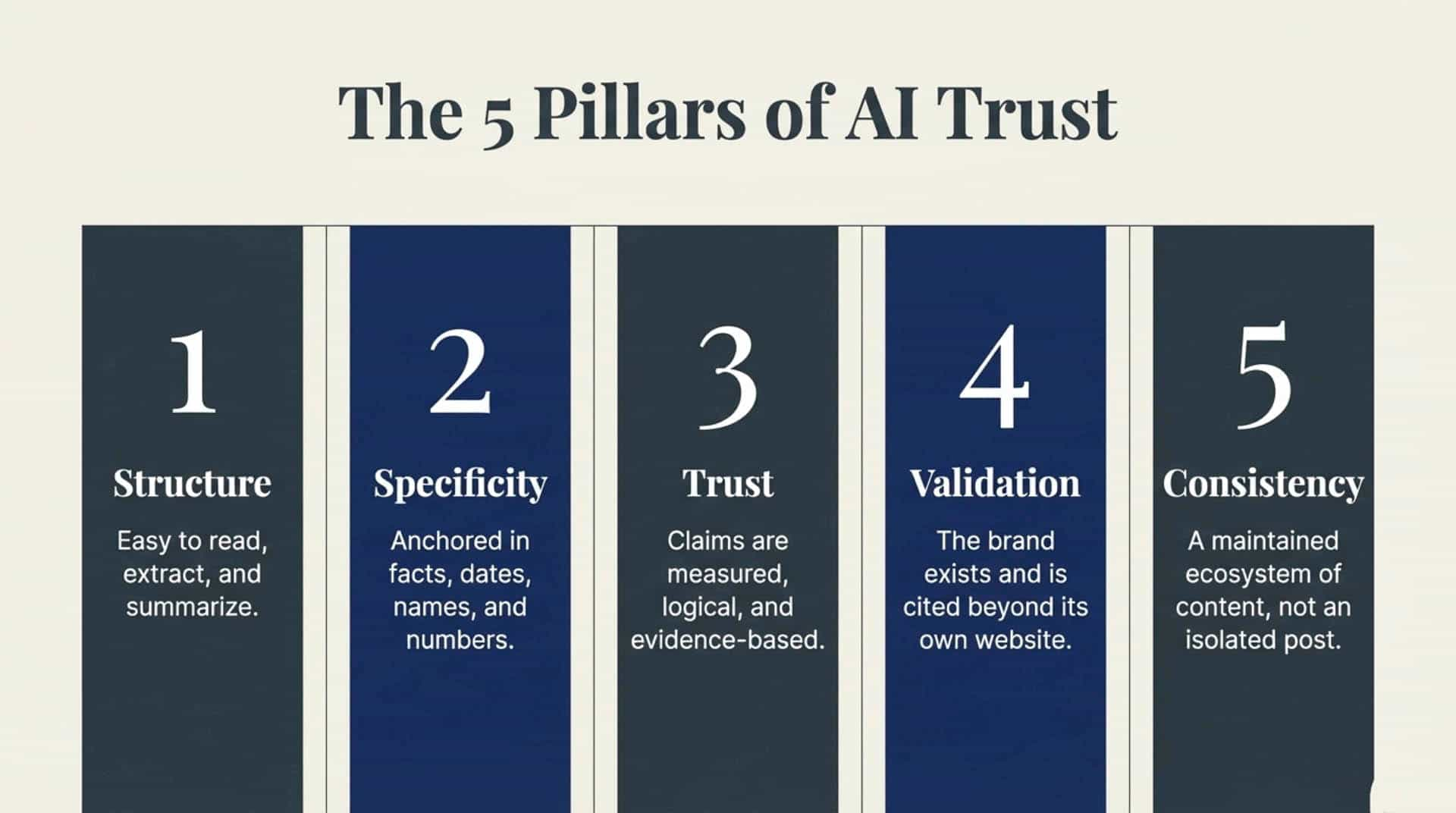
If we reduce all of this to a practical conclusion, AI systems most often choose sources that combine five key qualities.
First, clear structure. The text should be easy to read, understand, and summarize.
Second, specificity. Facts, dates, names, numbers, and real parameters are essential.
Third, trust. Claims should be measured, logical, and supported.
Fourth, external validation. The brand should exist beyond its own website.
Fifth, topical consistency. Not one isolated publication, but a whole ecosystem of content builds citability.
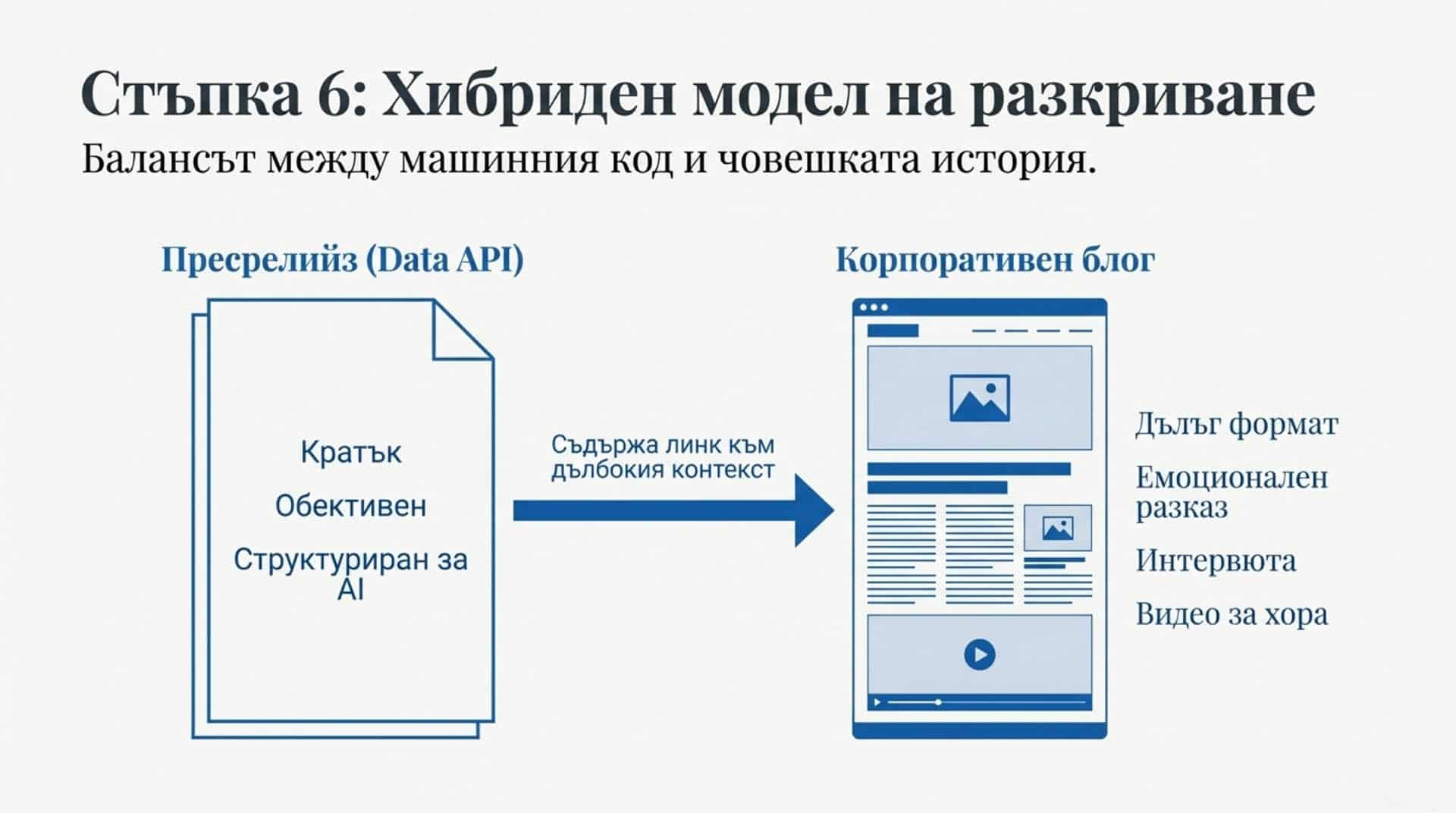
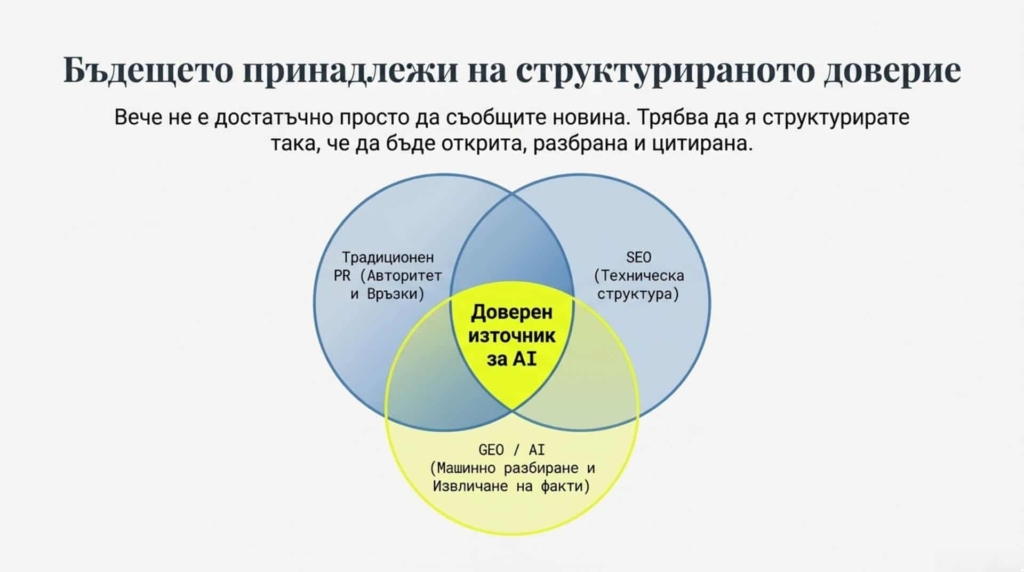
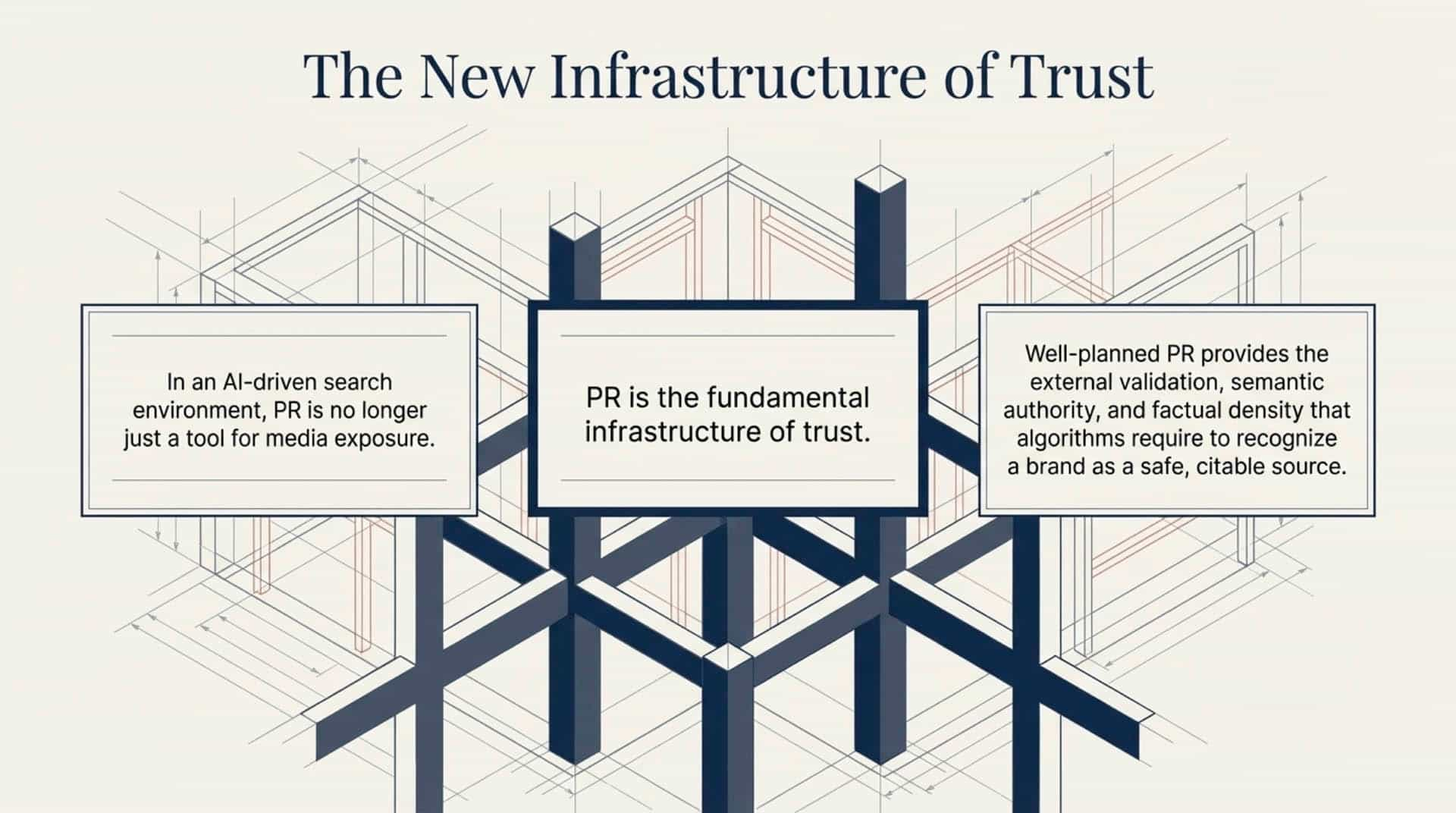
This also changes the role of PR. In AI environments, PR is no longer only a tool for media exposure. It becomes part of the infrastructure of trust. Well-planned PR helps not only people see the brand, but also helps AI systems recognize it as a more reliable source.
Conclusion
AI systems do not choose sources at random. They are not impressed by the loudest content, but by the most useful, the clearest, and the best-supported information. In an environment where machines increasingly summarize information instead of users reviewing dozens of links, trust, structure, and factual density become decisive.
For brands, this means something very important: visibility in AI answers is not earned through SEO alone, but through a combination of strong content, GEO thinking, expertise, PR, and external validation.
That is why the real question is no longer simply, “Do we rank well?” but:
Do we look like a source AI would choose to cite?
AI systems don’t choose sources based solely on traditional domain authority or backlink counts. Their goal is to find the most direct, extractable answer. If your content is too wordy, filled with “marketing fluff,” or lacks a clear structure, an AI might prefer a lower-ranking site that provides specific data, figures, and concise definitions.
Consistency across multiple channels. AI builds trust in a brand or expert when it sees the same information confirmed by independent sources—media publications, social signals, professional profiles, and official documents. The more uniform and clear your identity is across the web, the easier it is for AI to identify you as a reliable source.
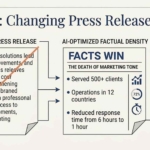
Yes. You are no longer writing just for journalists, but also for data extraction algorithms. Focus on “factual density”—instead of saying “we are industry leaders,” state “we serve 500+ clients across 12 countries.” Using bullet points, clear headings, and direct answers to the 5 Ws (Who, What, Where, When, Why) drastically increases your chances of being cited.
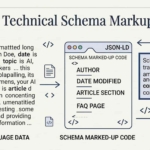
It is critical. Structured data (JSON-LD) acts as the “translator” between your human language and the machine’s language. Through Schema, you explicitly tell the AI who the author is, when the content was last updated, and what the core topic is. This removes ambiguity and boosts the AI’s “confidence score” in your content.
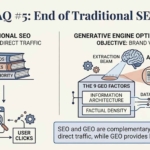
No, but it signals its evolution. Traditional SEO remains important for driving direct traffic, but GEO is now essential for brand reputation and visibility. It’s no longer enough to just be “in the search results”; the goal is to be part of the synthesized answer that the user consumes first.